Mahdist War: The Rise and Fall of the Mahdist State in Sudan
The Mahdist War (1881–1899) was a transformative conflict in Northeast Africa that saw the emergence of a powerful indigenous religious state and its eventual collapse under the weight of an international coalition. Driven by a millenarian movement led by Muhammad Ahmad, the war reshaped the borders of Sudan and established a complex political condominium between Britain and Egypt.
The conflict was rooted in the instability of 19th-century Egypt. Under Isma'il Pasha, Egypt pursued aggressive modernization and the construction of the Suez Canal, which led to crippling foreign debt. By 1876, Britain and France intervened via the Caisse de la Dette Publique, an international financial commission that seized control of Egyptian revenues. This foreign interference eroded the authority of the Egyptian government, creating a vacuum of power in the Sudan region.
Key Facts
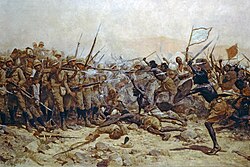
- Duration: 1881 to 1899.
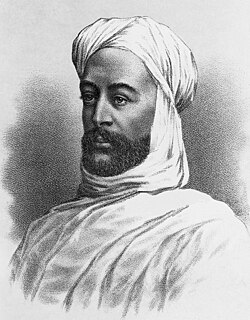
- Primary Leader: Muhammad Ahmad, who proclaimed himself the Mahdi (the guided one).
- Major Outcome: Allied victory and the creation of Anglo-Egyptian Sudan.
- Key Turning Point: The Battle of Omdurman in 1898.
- Human Cost: Significant population decline in Sudan, with estimates suggesting millions of deaths due to war and misgovernment.
The Mahdi Uprising and Early Victories
The conflict began in earnest in November 1881 when Muhammad Ahmad and his followers, known as the Ansar, arrived in the Nuba Mountains. The movement quickly gained momentum through a series of shocking military victories over Egyptian forces.
In December 1881, a force from Fashoda was ambushed and slaughtered, including its commander, Colonel Rashid Bay Ahman. This was followed in June 1882 by a dawn assault on an Egyptian army of 4,000 troops under Yusef Pasha. Due to extreme overconfidence, the Egyptian army failed to post sentries, allowing the Mahdi's forces—who were poorly clothed and armed mostly with sticks and stones—to annihilate them and seize vast stores of modern weaponry.
The Hicks Expedition
In an attempt to quell the rebellion, the Egyptian government, under British advisory, dispatched a force of approximately 8,300 men under Colonel William Hicks in 1883. Described by Winston Churchill as one of the worst armies ever to march to war, the force was unpaid and undisciplined. By the time they reached El-Obeid, the Mahdi had assembled a rigorously drilled army of 40,000 men. In November 1883, the Mahdist army crushed the expedition, leaving only about 500 Egyptian survivors.
The Siege of Khartoum and General Gordon
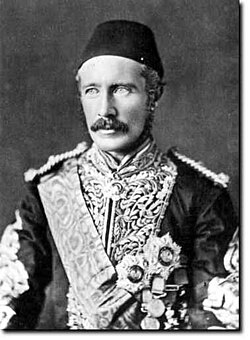
General Charles Gordon arrived in Khartoum in February 1884 to oversee the evacuation of Egyptian garrisons. However, Gordon became reluctant to leave, driven by a sense of honor to rescue every soldier and a belief that the Mahdi had to be crushed to ensure regional stability.
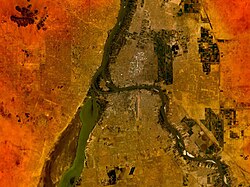
Khartoum was a formidable fortress, bordered by the Blue and White Nile rivers. While Gordon possessed ample ammunition and 7,000 soldiers, he was surrounded by 50,000 Dervish soldiers. Despite his strong defenses, Gordon's requests for specific strategic reinforcements were repeatedly vetoed by the British government. He remained besieged until the city eventually fell.
International Conflict and Regional Campaigns
The Mahdist State did not remain isolated; it clashed with several neighboring powers as it expanded its influence.
The Ethiopian Theatre
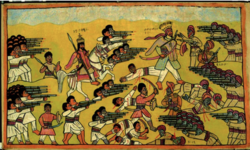
Ethiopia, under Emperor Yohannes IV, engaged in a bitter campaign to relieve besieged Egyptian garrisons. While the Ethiopians achieved victory at the Battle of Kufit in 1885, the conflict continued through several incursions. The Ethiopian theatre eventually culminated in the Battle of Gallabat.
Italian and Congo Interventions
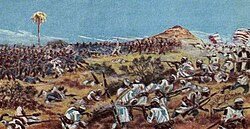
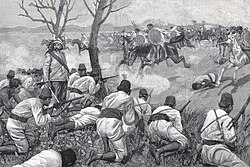
In the east, Italian colonial troops and Eritrean Askaris (local soldiers) fought the Mahdists, achieving a decisive victory at the Second Battle of Agordat in 1893 and later seizing Kassala. Simultaneously, forces from the Congo Free State engaged Mahdist troops at the Battle of Rejaf.
The Anglo-Egyptian Reconquest
By 1896, Britain decided to reassert control over Sudan to counter French influence in the Upper Nile and support the weakened Italian position. Herbert Kitchener, the Sirdar (commander) of the Anglo-Egyptian Army, led a methodical invasion.
Kitchener utilized modern technology to ensure victory, including Maxim machine-guns, modern artillery, and the construction of narrow-gauge railways to supply his troops across the desert. After wiping out the garrison at Ferkeh in 1896, the main force moved toward the Mahdist capital.
The Battle of Omdurman
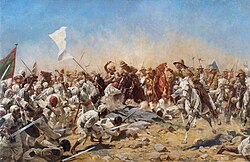
The climax of the war occurred on September 2, 1898, at the Battle of Omdurman. Kitchener's force of roughly 26,000 soldiers faced a Mahdist army of over 60,000 warriors. Despite their superior numbers, the Mahdists lacked modern weaponry and were devastated by the Anglo-Egyptian fire. The battle featured the famous charge of the 21st Lancers and resulted in the total collapse of the Mahdist state.
Aftermath and Legacy
The defeat at Omdurman led to the final end of organized Mahdist resistance in 1899. The result was the establishment of Anglo-Egyptian Sudan, a condominium jointly ruled by Britain and Egypt, though Britain maintained de facto control. The war left a devastating mark on the region; population estimates suggest that Sudan's population plummeted from roughly 7–8.5 million before the revolt to between 2–3.5 million by 1899 due to war, famine, and misgovernment.
| Category | Details |
|---|---|
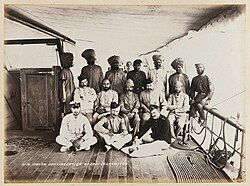
| Belligerents | Mahdist State vs. Britain, Egypt, India, Canada, New South Wales, Italy, Ethiopia, and Congo Free State |
| Key Leaders | Muhammad Ahmad (Mahdi), Herbert Kitchener, Charles Gordon, Yohannes IV |
| Major Battles | El Obeid, Siege of Khartoum, Gallabat, Omdurman |
| Territorial Result | Creation of Anglo-Egyptian Sudan; Italy temporarily occupied Kassala |
| Technological Edge | Maxim guns, modern artillery, and military railways (Anglo-Egyptian forces) |
Frequently Asked Questions
Who was the Mahdi?
Muhammad Ahmad was a religious leader who proclaimed himself the Mahdi (the "guided one"), leading a millenarian uprising against Egyptian rule in Sudan starting in 1881.
Why did the Hicks Expedition fail?
The expedition failed because the troops were unpaid, untrained, and undisciplined, while the Mahdi had spent months rigorously drilling his army and equipping them with captured modern arms.
What happened to General Charles Gordon?
General Gordon was besieged in Khartoum by Mahdist forces. Despite his strong defenses, he was unable to break out or be rescued in time, and he died when the city fell.
What was the significance of the Battle of Omdurman?
The Battle of Omdurman in 1898 was the decisive engagement of the war. The Anglo-Egyptian victory, powered by modern weaponry, effectively destroyed the Mahdist army and led to the collapse of the Mahdist state.
What was Anglo-Egyptian Sudan?
It was a polity established in 1899 as a de jure condominium (joint rule) between the British Empire and the Kingdom of Egypt, although Britain held the actual control.