String Theory: The Quest for a Unified Theory of Everything
In the realm of theoretical physics, string theory proposes a radical shift in how we perceive the building blocks of the universe. Rather than viewing the fundamental constituents of matter as zero-dimensional point-like particles, string theory suggests they are actually one-dimensional objects called strings. These strings move through space and interact via vibrations, much like the strings of a musical instrument.
On scales larger than the string itself, these vibrations manifest as particles. The specific vibrational state of a string determines its mass, charge, and other physical properties. Crucially, one of these states corresponds to the graviton—a quantum mechanical particle that carries the force of gravity. By incorporating the graviton, string theory emerges as a robust candidate for a theory of quantum gravity.

Because it potentially provides a unified description of gravity and particle physics, string theory is often pursued as a theory of everything: a single mathematical model capable of describing all fundamental forces and forms of matter in the universe.
Key Facts
- Fundamental Unit: Replaces point-particles with one-dimensional strings.
- Quantum Gravity: Naturally includes the graviton, bridging the gap between general relativity and quantum mechanics.
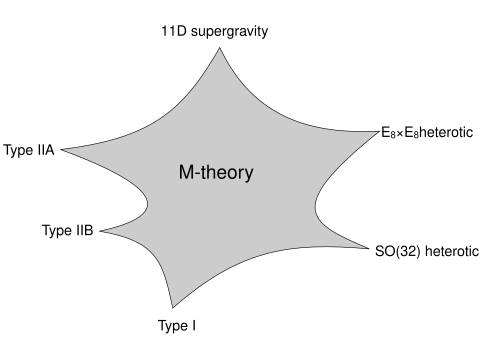
- M-Theory: An eleven-dimensional framework that unifies five different superstring theories.
- AdS/CFT Correspondence: A profound relationship linking string theory to quantum field theory.
- Multidimensionality: Requires more than the standard four dimensions of spacetime to be mathematically consistent.
The Evolution of String Theory
String theory was not originally intended to explain gravity. In the late 1960s, it was first studied as a way to describe the strong nuclear force. However, it was eventually superseded by quantum chromodynamics. Physicists later realized that the very characteristics that made the theory unsuitable for nuclear physics made it an ideal candidate for quantum gravity.
The theory evolved through several stages:
- Bosonic String Theory: The earliest version, which only included bosons (force-carrying particles).
- Superstring Theory: An advanced version introducing supersymmetry, a proposed symmetry between bosons and fermions (matter particles).
- M-Theory: In the mid-1990s, it was conjectured that five distinct versions of superstring theory were actually different limiting cases of a single, eleven-dimensional theory called M-theory.

Core Concepts and Mathematical Frameworks
Dualities and Branes
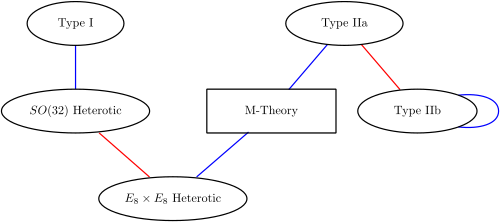
String theory utilizes dualities—mathematical relationships that show two seemingly different physical theories are actually equivalent. These include S-duality and T-duality, which help physicists navigate the complex landscape of the theory.
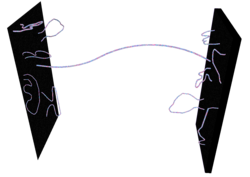
Another critical discovery was the existence of branes (short for membranes). While strings are one-dimensional, branes can have higher dimensions. For example, open strings—strings with two endpoints—can be attached to a pair of D-branes.
Compactification and Hidden Dimensions
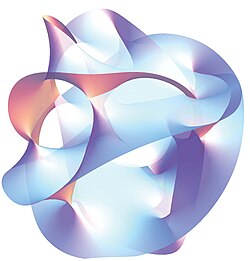
To reconcile the theory's requirement for extra dimensions with our observation of only four (three of space and one of time), physicists use compactification. This process involves curling up extra dimensions into tiny, complex shapes, such as the Calabi-Yau manifold, making them invisible at macroscopic scales.

The AdS/CFT Correspondence
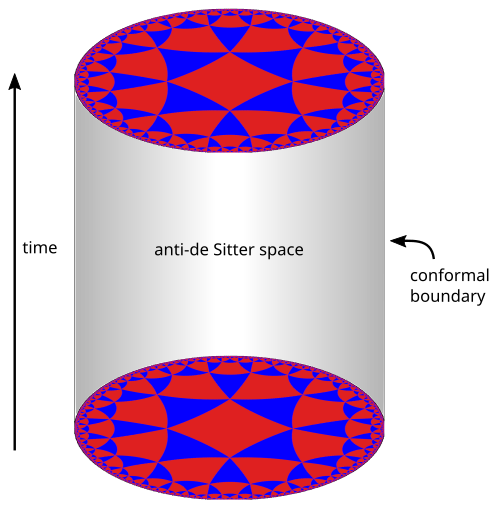
Discovered in late 1997, the anti-de Sitter/conformal field theory (AdS/CFT) correspondence relates string theory to quantum field theory. This holographic relationship has provided breakthroughs in understanding black hole physics, nuclear physics, and condensed matter physics, including the study of high-temperature superconductivity.

Impact on Mathematics and Science
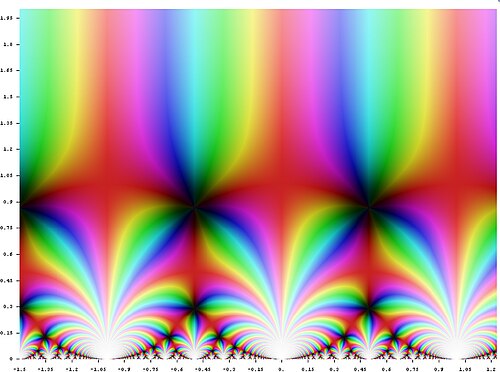
Beyond physics, string theory has stimulated major developments in pure mathematics. It has contributed to the study of mirror symmetry and the phenomenon of monstrous moonshine, which links sporadic groups in mathematics to string theory. Recent research has expanded this into "umbral moonshine," further bridging the gap between group theory and physics.

| Theory/Concept | Key Characteristic | Primary Contribution |
|---|---|---|
| Bosonic String Theory | Bosons only | Foundational string model |
| Superstring Theory | Supersymmetry | Includes fermions; consistent gravity |
| M-Theory | 11 Dimensions | Unifies five superstring theories |
| AdS/CFT | Holographic duality | Links gravity to quantum field theory |
Criticisms and Challenges

Despite its mathematical elegance, string theory faces significant criticism. Some physicists argue that the theory allows for too many solutions, making it difficult to make unique, testable predictions about the real world. Others point to its potential incompatibility with dark energy or the lack of background independence (the idea that the theory should not rely on a pre-existing spacetime geometry).
Frequently Asked Questions




What is the difference between a particle and a string?
A particle is modeled as a zero-dimensional point, whereas a string is a one-dimensional object. In string theory, what we perceive as different particles are actually the same type of string vibrating at different frequencies.
Why does string theory require extra dimensions?
The mathematical equations of string theory are only consistent if the strings vibrate in more than the four dimensions we experience. Without these extra dimensions, the theory would produce mathematical anomalies.
What is M-theory?
M-theory is a theoretical framework proposed in the 1990s that unifies five different versions of superstring theory into a single theory existing in eleven dimensions.
Can string theory be proven?
Currently, string theory is primarily a mathematical framework. Because the strings are so small, they are beyond the reach of current experimental technology, leading to ongoing debate about its status as an empirical science.
What is the graviton?
The graviton is a hypothetical quantum particle that carries the force of gravity. String theory is significant because it naturally predicts the existence of the graviton as a specific vibrational state of a closed string.