Strike Command: The Powerhouse of the Royal Air Force (1968–2007)
For nearly four decades, Strike Command served as the operational heart of the United Kingdom's aerial defense and offensive capabilities. Established to streamline the Royal Air Force (RAF), it controlled the vast majority of the nation's bomber and fighter aircraft, ensuring the UK remained a formidable force during the Cold War and beyond.
Operating under the motto "Defend and Strike," the command was headquartered at RAF High Wycombe in Buckinghamshire. It functioned as the primary military formation for air operations until April 1, 2007, when it merged with Personnel and Training Command to create the unified Air Command.
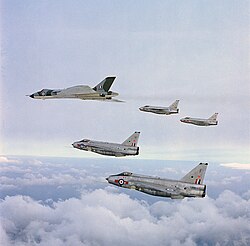
Key Facts
- Active Period: 30 April 1968 to 1 April 2007.
- Headquarters: RAF High Wycombe, Buckinghamshire.
- Primary Role: Control of UK bomber and fighter aircraft.
- Final Commander-in-Chief: Air Chief Marshal Sir Joe French.
- Successor: Air Command.
The Evolution of Strike Command
Formation and Early Integration
Strike Command was born on April 30, 1968, through the merger of Bomber Command and Fighter Command, which were reorganized as No. 1 Group and No. 11 Group, respectively. This consolidation was the beginning of a series of absorptions designed to centralize RAF authority.
Over the following years, other specialized commands were integrated into the structure:
- Signals Command: Absorbed on January 1, 1969.
- Coastal Command: Absorbed on November 28, 1969, becoming No. 18 Group RAF.
- Air Support Command: (Formerly Transport Command) Absorbed on September 1, 1972, becoming No. 46 Group RAF.
NATO Responsibilities and UKAIR
In 1975, the command's scope expanded to include a critical international role. The Commander-in-Chief of Strike Command also served as the Commander-in-Chief United Kingdom Air Forces (UKAIR) for NATO. This role placed the command under NATO's Allied Command Europe, based in Mons, Belgium.
In the event of a conflict with the Warsaw Pact, UKAIR would have held authority over all RAF units within the UK, as well as the US Air Force's Third Air Force based at RAF Mildenhall. Additionally, any reinforcements arriving from the continental United States or units moving toward other European fronts would have fallen under UKAIR's jurisdiction.
Post-Cold War Restructuring
The end of the Cold War necessitated a shift in strategy and organization. On April 1, 1993, RAF Germany was absorbed as No. 2 (Bomber) Group. By April 1, 2000, the structure was further refined to specialize the roles of its groups:
- No. 1 Group: Focused on tactical fast jet forces.
- No. 2 Group: Managed air transport, air refueling, reconnaissance, the RAF Regiment, and No. 32 (The Royal) Squadron RAF.
- No. 3 Group: Included Nimrod long-range Maritime Patrol aircraft, search and rescue helicopters, and Joint Force 2000 (later Joint Force Harrier).
Notably, the command of No. 3 Group was transferred to the Flag Officer Naval Aviation, with Rear Admiral Iain Henderson serving as the first incumbent. During this era, the Air Warfare Centre at Waddington and the Military Air Traffic Organisation at Uxbridge also joined Strike Command.
Command Structure and Leadership
Organizational Summary
The command was divided into various groups that initially mirrored the functions of the legacy Fighter, Bomber, and Coastal Commands. By its final stages, it was primarily split into the "Air Combat Group" (No. 1 Group) and the "Air Combat Support Group" (No. 2 Group).
| Group | Active Period within Strike Command |
|---|---|
| No. 1 Group RAF | 1 April 1968 – 1 April 2007 |
| No. 2 Group RAF | 1993–1996; 2000–2007 |
| No. 3 Group RAF | 1 April 2000 – 1 April 2006 |
| No. 11 Group RAF | 1 April 1968 – 1 April 1996 |
| No. 18 Group RAF | 28 November 1969 – 1 April 1996 |
| No. 11/18 Group RAF | 1 April 1996 – 7 January 2000 |
| No. 38 Group RAF | 1 July 1972 – 17 November 1983 |
| No. 46 Group RAF | 1 September 1972 – 1 January 1976 |
| No. 90 Group RAF | 1 January 1969 – 1 September 1972 |
| Royal Observer Corps | 1 April 1968 – 31 December 1995 |
Leadership
The command was led by an Air Officer Commanding-in-Chief. The lineage began with Air Chief Marshal Sir Wallace Kyle in 1968 and concluded with Air Chief Marshal Sir Joe French in 2007. Supporting the chief was a Deputy Air Officer Commanding-in-Chief, a role held by various Air Marshals, including Sir Jock Stirrup and Sir Clive Loader.
Frequently Asked Questions
When was Strike Command established and dissolved?
Strike Command was formed on April 30, 1968, and remained active until April 1, 2007.
What happened to Strike Command in 2007?
Following a Process and Organisation Review, Strike Command merged with Personnel and Training Command to form a single entity known as Air Command, co-located at RAF High Wycombe.
What was the role of UKAIR?
UKAIR (Commander-in-Chief United Kingdom Air Forces) was the NATO designation for the command. In the event of war with the Warsaw Pact, it would have commanded all RAF units in the UK and the US Air Force's Third Air Force.
Which groups made up the final structure of Strike Command?
In its final reorganization, the command consisted of No. 1 Group RAF (the Air Combat Group) and No. 2 Group RAF (the Air Combat Support Group).
Where was the headquarters of Strike Command located?
The headquarters, often abbreviated as HQSTC, was located at RAF High Wycombe in Buckinghamshire.