Stephen Jay Gould: The Visionary Paleontologist Who Reshaped Evolutionary Theory
Stephen Jay Gould (1941–2002) was a towering figure in 20th-century science. An American paleontologist, evolutionary biologist, and historian of science, Gould possessed a rare ability to bridge the gap between rigorous academic research and public understanding. Throughout his career, he challenged established norms of biological evolution and became one of the most widely read popular science authors of his generation.
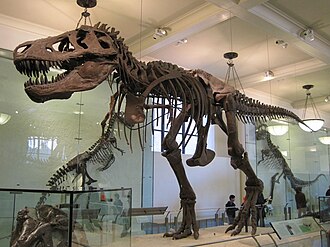
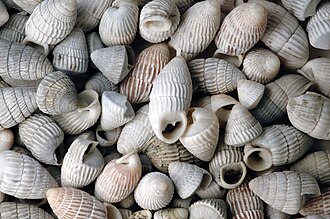
Gould's professional life was centered at prestigious institutions, including Harvard University and the American Museum of Natural History in New York. Later in his career, he also served as the Vincent Astor Visiting Research Professor of Biology at New York University. His intellectual curiosity spanned from the minute details of land snail shells to the grand architecture of evolutionary history.
Key Facts
- Primary Fields: Paleontology, evolutionary biology, and the history of science.
- Major Theory: Co-developed punctuated equilibrium, suggesting evolution occurs in rapid bursts separated by long periods of stability.
- Key Concepts: Introduced spandrels (biological traits that are by-products of other adaptations) and exaptation (traits that evolve for one purpose but are later used for another).
- Public Impact: Wrote 300 essays for Natural History magazine in a series titled "This View of Life."
- Academic Legacy: Taught at Harvard University and New York University; elected to the National Academy of Sciences in 1989.
Revolutionizing Evolution: Punctuated Equilibrium
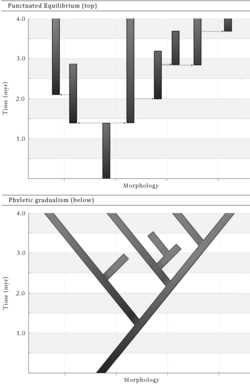
One of Gould's most significant contributions to science was the theory of punctuated equilibrium, developed alongside Niles Eldredge. This model challenged phyletic gradualism, the traditional view that evolution occurs at a slow, constant pace through the steady accumulation of small changes.
Instead, Gould proposed that species experience long periods of morphological stability (stasis), which are interrupted by episodic bursts of rapid evolutionary change. This process, often involving cladogenesis (the splitting of a parent species into two or more distinct species), better explained the gaps often found in the fossil record.
Biological Architecture: Spandrels and Exaptation
Gould was critical of "adaptationism"—the belief that every single trait of an organism must be a direct product of natural selection for a specific purpose. To illustrate this, he used the architectural concept of a spandrel. In architecture, a spandrel is the triangular space between two arches; it is not designed for a purpose but is a necessary byproduct of the arches' construction.
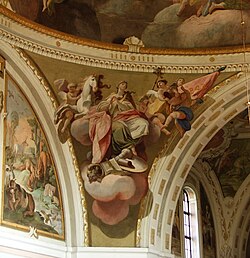
In biology, Gould argued that some traits are similarly "spandrels"—by-products of other structural changes that do not initially serve an adaptive purpose. This led to the concept of exaptation, where a trait that evolved for one function (or no function at all) is later co-opted for a new use.
The Intersection of Science, Society, and Religion
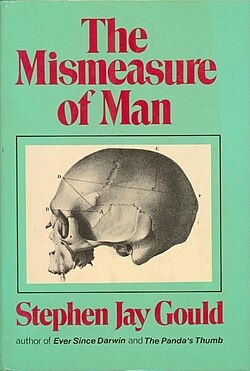
Beyond the fossil record, Gould was a fierce critic of biological determinism. In his influential book, The Mismeasure of Man, he attacked the misuse of intelligence testing and the history of scientific racism, arguing against the idea that human behavior and intelligence are solely predetermined by genetics.
Gould also sought to resolve the tension between science and faith through his concept of non-overlapping magisteria (NOMA). He proposed that science and religion occupy two distinct domains: science deals with the empirical realm (what the universe is made of and how it works), while religion deals with questions of ultimate meaning and moral value. By keeping these domains separate, Gould argued that conflict between the two could be avoided.
Academic and Literary Legacy
Gould's productivity was immense. Between 1965 and 2000, he published 479 peer-reviewed papers, 22 books, and 300 essays. His work ranged from technical studies on land snails to his magnum opus, The Structure of Evolutionary Theory, published in 2002.
| Category | Details |
|---|---|
| Education | BA from Antioch College; PhD from Columbia University |
| Key Institutions | Harvard University, American Museum of Natural History, NYU |
| Major Awards | MacArthur Fellowship, National Book Award, Darwin–Wallace Medal (posthumous) |
| Notable Books | The Panda's Thumb, The Mismeasure of Man, Wonderful Life |
| Core Theories | Punctuated Equilibrium, NOMA, Exaptation |
Frequently Asked Questions
What is punctuated equilibrium?
It is a theory proposing that evolution consists of long periods of stability (stasis) interrupted by brief, rapid bursts of significant change and speciation, rather than a slow, constant gradual process.
What does Gould mean by a "spandrel" in biology?
A spandrel is a biological trait that is a byproduct of the evolution of other features, rather than a trait that was specifically selected for its own adaptive purpose.
What are non-overlapping magisteria (NOMA)?
NOMA is the idea that science and religion represent two different domains of teaching—one empirical and one moral/meaning-based—and therefore do not need to conflict with one another.
What was the main argument of The Mismeasure of Man?
The book argues against biological determinism and critiques the history of using cranial measurements and IQ tests to justify racial or social hierarchies.
What is exaptation?
Exaptation occurs when a trait that originally evolved for one purpose, or had no purpose at all, is later repurposed by evolution to serve a different, beneficial function.