State Museum of Natural History Stuttgart
The State Museum of Natural History Stuttgart (SMNS) stands as one of the premier repositories for state-owned natural history collections in Baden-Württemberg, Germany. Alongside its counterpart in Karlsruhe, the SMNS preserves a vast record of the natural world, offering visitors a comprehensive look at the evolution of life and the geological history of the region.
The museum is uniquely distributed across two distinct locations within the scenic Rosenstein Park in Stuttgart. This dual-site arrangement allows the institution to separate its focus between the ancient world of fossils and the living diversity of biology.
Key Facts
- Annual Visitors: Approximately 110,069 people.
- Primary Locations: Museum am Löwentor (Paleontology/Geology) and Rosenstein Palace (Biology/Ecology).
- Major Exhibit: A 3D-mounted Meyerasaurus (plesiosaur) recovered from the original museum rubble.
- Specialized Collections: Extensive amber fossils and the skull of the prehistoric man of Steinheim.
- Regional Focus: Heavy emphasis on the Triassic, Jurassic, and Cenozoic sediments of southwestern Germany.
The Museum's History and Architecture
Before World War II, the collections were housed on Neckarstraße in downtown Stuttgart. While the original building was destroyed by fire following Allied bombing, the majority of the exhibits had been moved to safety. Some significant specimens were later recovered from the ruins, including a spectacular plesiosaur (a long-necked marine reptile) known as Meyerasaurus.
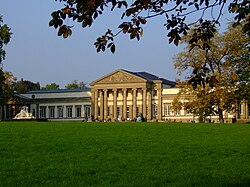
The museum's current structure evolved in stages. The biological specimens have been displayed at Rosenstein Palace since 1954. The dedicated paleontological building, the Museum am Löwentor, was constructed between 1981 and 1985.

The Löwentor Museum is architecturally striking, featuring a principal exhibition area that consists of a single room spanning three floors. This space covers over 3,500 square meters (37,600 square feet) and reaches heights of up to 11 meters, providing ample room for large-scale fossil displays.
Permanent Exhibitions
Paleontology and Geology at Museum am Löwentor
The exhibitions at the Löwentor Museum highlight the rich fossil record of Baden-Württemberg. The region is renowned for its well-exposed sediments from various eras:
- Triassic Period: Displays include the early prosauropod dinosaur Plateosaurus and other terrestrial animals from the Buntsandstein and Keuper formations, as well as marine invertebrates from the Muschelkalk.
- Jurassic Period: The museum showcases a wide array of marine life from the Posidonia Shale and other Lower Jurassic formations, including ichthyosaurs, pliosaurs, plesiosaurs, sharks, and exquisite ammonites.
- Cenozoic Era: This section features vertebrates and invertebrates from across Germany, including a Pleistocene elephant, a copy of a mammoth mummy, and the skull of Homo steinheimensis (the prehistoric man of Steinheim).
Additionally, the museum maintains a spectacular collection of plant and animal fossils preserved in amber (fossilized tree resin).
Biology and Ecology at Rosenstein Palace
While the Löwentor focuses on the ancient past, the Museum Rosenstein focuses on extant animals—species that are still alive today—and the complexities of ecology.
Institutional Ethics and Repatriation
The SMNS is committed to the ethical management of its collections. In 2023, the museum participated in a significant repatriation effort, returning Māori and Moriori ancestral remains to the Museum of New Zealand Te Papa Tongarewa.
Museum Overview
| Building | Primary Focus | Key Highlights |
|---|---|---|
| Museum am Löwentor | Paleontology & Geology | Plateosaurus, Posidonia Shale fossils, Meyerasaurus |
| Rosenstein Palace | Biology & Ecology | Extant animals and ecological systems |
Frequently Asked Questions
What is the difference between the two museum buildings?
The Museum am Löwentor is dedicated to paleontology and geology (fossils and rocks), while the Museum Rosenstein focuses on biology and the study of living animals and ecology.
Which famous dinosaurs can be seen at the museum?
The museum exhibits the early prosauropod dinosaur Plateosaurus, as well as various marine reptiles like ichthyosaurs and the 3D-mounted Meyerasaurus plesiosaur.
What is the significance of the Posidonia Shale in the exhibition?
The Posidonia Shale is a Lower Jurassic formation that has yielded a plethora of well-preserved marine fossils, including sharks and various plesiosaurs, which are featured prominently in the museum.
Does the museum have any human evolutionary exhibits?
Yes, the museum houses the skull of the prehistoric man of Steinheim (Homo steinheimensis).
How did the museum recover after World War II?
Although the original building on Neckarstraße was destroyed by fire, most exhibits had been moved to safety. Some specimens, including the Meyerasaurus, were successfully recovered from the rubble.