Sponges: The Biology and Ecology of Phylum Porifera
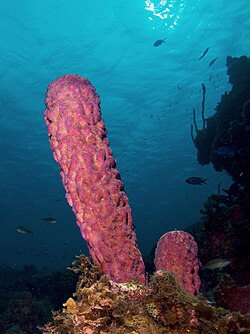
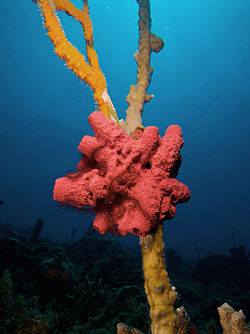
Sponges, belonging to the phylum Porifera, are among the simplest and most ancient multicellular animals on Earth. These aquatic organisms are defined by their porous bodies, which they use to filter water for food and oxygen. Unlike most animals, sponges lack true tissues and organs, yet they play a critical role in maintaining the health of marine and freshwater ecosystems.
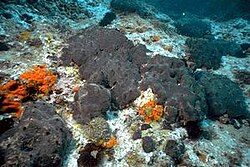
From the shallow intertidal zones to the deepest abyssal plains, sponges have adapted to nearly every aquatic environment. While they may appear as stationary lumps of organic matter, they are complex biological filters with a sophisticated system of water transport and a rich symbiotic relationship with microorganisms.
Key Facts
- Phylum: Porifera.
- Diversity: Approximately 9,000 identified species, dominated by demosponges.
- Structure: Lack a nervous system and true tissues; rely on a system of pores and channels.
- Feeding: Primarily filter feeders, though some specialized species are carnivorous.
- Longevity: Tropical and deep-ocean species can live for 200 years or more; some calcified species may be thousands of years old.
- Habitat: Found in marine, brackish, and freshwater environments.
Basic Anatomy and Cellular Structure
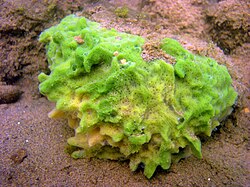
The body of a sponge is designed for one primary purpose: moving water. They lack a nervous system and a basement membrane, but their cells are bound together by inter-cell connections. The middle layer of a sponge, known as the mesohyl, contains various cell types that can move and change functions.
Specialized Cell Types
The most critical cells in a sponge are the choanocytes (collar cells). These cells possess flagella that beat rhythmically to draw water into the sponge's body, trapping nutrients and removing waste.
![Cells of the protist choanoflagellate clade closely resemble sponge choanocyte cells. Beating of choanocyte flagella draws water through the sponge so that nutrients can be extracted and waste removed.[22]](/images/f8/17/f8178f348037a8b666230a23e2059c66dc698eea493102029d391109fff0cbea.png)
Skeletal Support
To maintain their shape and protect themselves, sponges utilize a skeleton made of spicules (small, needle-like structures) or spongin (a collagen-like protein). Depending on the class, these spicules may be composed of silica or calcium carbonate.
![Sponge with calcium carbonate skeleton.[25] Mesohyl Spicules Seabed / rock Water flow](/images/c6/81/c681c91f9ebe43598800a388842deda1cb0a69d339b4819dfbe04f55ae52a428.png)
Water Flow and Body Plans
![Bathymetrical range of some sponge species.[65] Demosponge Samus anonymus (up to 50 m), hexactinellid Scleroplegma lanterna (~100–600 m), hexactinellid Aulocalyx irregularis (~550–915 m), lithistid demosponge Neoaulaxinia persicum (~500–1700 m)](/images/b1/1d/b11d1788f2ca017013b4f6453ab9fe19ae564f1fc7138102234567eedd5ecab7.jpg)
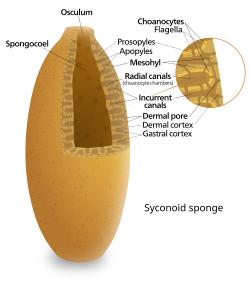
Sponges are categorized by the complexity of their water-transport systems. Water enters through tiny pores called ostia and exits through a larger opening called the osculum.
- Asconoid: The simplest form, featuring a simple tube-like structure.
- Syconoid: A more complex system with folded walls to increase surface area.
- Leuconoid: The most complex and common form, featuring an intricate network of chambers.
Classification of Sponges
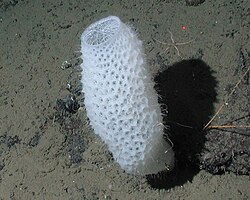
The phylum Porifera is divided into classes based primarily on the composition of their skeletons.
| Class | Spicule Material | Spongin Fibers | Common Habitats | Body Form |
|---|---|---|---|---|
| Demospongiae | Silica | Present in many | Marine, brackish, freshwater | Leuconoid |
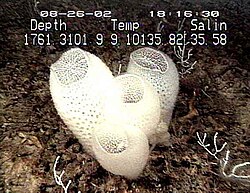
| Hexactinellida (Glass Sponges) | Silica (fused) | Never | Deep marine (soft sediment) | Leuconoid |
| Calcarea (Calcareous Sponges) | Calcite | Never | Shallow marine (<100m) | Asconoid, Syconoid, Leuconoid |
| Homoscleromorpha | Silica | Present in many | Marine | Sylleibid or Leuconoid |
Ecology and Environmental Impact
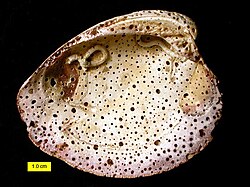
Sponges are more than just passive filters; they are active participants in the ocean's nutrient cycle. One of the most significant ecological contributions is the sponge loop. In this process, sponges take up dissolved organic matter (DOM) released by corals and algae and convert it into detrital particulate organic matter (POM), which then becomes food for other detritivores in the reef.
![Sponge loop hypothesis. Steps of the sponge loop pathway: (1) corals and algae release exudates as dissolved organic matter (DOM), (2) sponges take up DOM, (3) sponges release detrital particulate organic matter (POM), (4) sponge detritus (POM) is taken up by sponge-associated and free-living detritivores.[81][82][83]](/images/c7/59/c75907727455699db82610ffba49bad0a168f7204f6e85a33437ed992b54b7bb.png)
The Sponge Holobiont
A sponge is not a single organism but a holobiont—a nested ecosystem consisting of the sponge animal and its diverse microbiome. These symbiotic microorganisms influence the sponge's health and, by extension, the structure of the surrounding community.
![The sponge holobiont as a nested ecosystem. Key functions carried out by the sponge microbiome (colored arrows) influence holobiont functioning and, through cascading effects, subsequently influence community structure and ecosystem functioning.[96]](/images/74/9e/749efc11fd804fd00f89d942cf8e31ce1ff330cca47c093cf085089c409c800e.png)
Specialized Adaptations
While most sponges filter-feed, some have evolved to be carnivorous. For example, the ping-pong tree sponge (Chondrocladia lampadiglobus) captures prey using specialized structures.
![The carnivorous ping-pong tree sponge, Chondrocladia lampadiglobus[41]](/images/03/be/03be946a65c3edcdc8e7cb0005d820d4de159ab65aa0c8a8f55ac991ee8acb08.jpg)
Evolutionary History
![Generalised food web for sponge reefs[73]](/images/96/58/9658a366b3eb7dce0160bbc42170036e6452f145a977e069fb0dbd4e6d047c57.jpg)
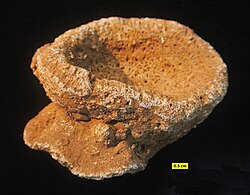
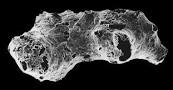
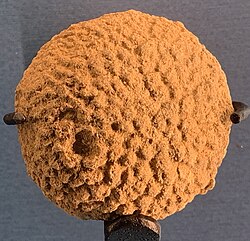
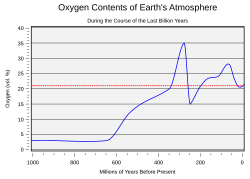
The fossil record suggests that sponges are among the oldest animal lineages. Some fossilized sponges date back to 890 million years ago, potentially predating the Neoproterozoic Oxygenation Event. Early Cambrian fossils, such as the Archaeocyathids, were once debated but are now widely regarded as a distinctive group of sponges.
Frequently Asked Questions
Can sponges move?
Adult sponges are primarily sessile (stationary). However, some species can move across the seabed at speeds of 1–4 mm per day via amoeba-like movements of their cells. Juveniles are often free-swimming or drifting.
How long do sponges live?
Lifespans vary wildly. Temperate species may live only a few years, while tropical and deep-sea species can exceed 200 years. Some slow-growing calcified demosponges are estimated to be up to 5,000 years old.
What is the difference between a natural sponge and a synthetic one?
Natural sponges are animals from the phylum Porifera, whereas synthetic sponges are man-made tools. Some "natural" sponges sold commercially are also derived from the sponge gourd, which is a plant, not an animal.
Do sponges have a brain?
No, sponges do not have a nervous system, brain, or true organs. They coordinate their activities through cellular communication and the movement of water through their porous bodies.
What are glass sponges?
Glass sponges (Class Hexactinellida) are deep-ocean sponges with skeletons made of silica (glass). A famous example is Euplectella aspergillum, known as "Venus's flower basket," which can be found at depths exceeding 2,500 meters.