Choanoflagellates: The Closest Living Relatives of Animals
In the vast diversity of microscopic life, few organisms hold as much evolutionary significance as the choanoflagellates. These single-celled eukaryotes are the closest living relatives of animals (Metazoa), making them an indispensable model for scientists attempting to reconstruct the last unicellular ancestor of the entire animal kingdom.
Their importance stems from a striking morphological similarity to choanocytes—specialized "collar cells" found in sponges. This physical link, first noted in the 19th century, has since been validated by cutting-edge genomic research, revealing that the blueprints for animal life were being written long before the first multicellular animal ever appeared.
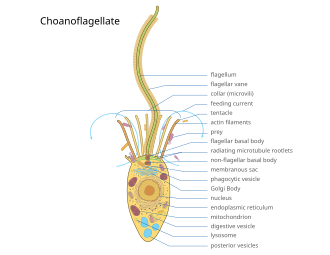
Key Facts
- Closest Relative: They are the sister group to all animals (Metazoa).
- Habitat: Found globally in marine, brackish, and freshwater environments.
- Temporal Range: Fossil evidence dates them from the Neoproterozoic to the present (950–0 Ma).
- Diversity: Over 125 extant species are currently known.
- Genetic Link: They possess homologues of animal cell signaling and adhesion genes.
Ecology and Distribution
Choanoflagellates are distributed globally, inhabiting environments ranging from the frozen Arctic to the tropics. They occupy both pelagic (open water) and benthic (bottom-dwelling) zones. While most sampling occurs in the upper 25 meters of the water column, these resilient organisms have been discovered as deep as 300 meters in open water and even 100 meters beneath Antarctic ice sheets.
Classification and Taxonomy
The classification of choanoflagellates is divided into two primary orders based on their structure and morphology:
Order Craspedida
This group includes families such as the Salpingoecidae and Codonosigaceae. Notable genera include Monosiga, Codosiga, and Proterospongia.
Order Acanthoecida
Known as the loricate choanoflagellates, these organisms typically secrete a basket-like shell. This order is further divided into the Acanthoecidae (nudiform) and Stephanoecidae (tectiform).
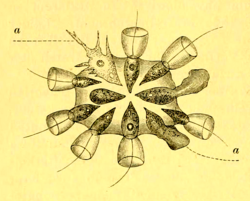
The Evolutionary Link to Animals
The hypothesis that choanoflagellates and animals are closely related was proposed as early as 1841 by French biologist Félix Dujardin. In recent decades, this has been confirmed through independent analyses of 18S rDNA, nuclear protein-coding genes, and mitochondrial genomes.
Crucially, mitochondrial genome sequencing has confirmed that choanoflagellates are an outgroup to Metazoa, meaning they branched off before animals evolved, rather than evolving from them. Furthermore, research from 2001 showed that they synthesize genes for cell signaling and adhesion—tools essential for multicellularity—proving that the molecular machinery for animal life existed in a unicellular state.
![The calcium homeostasis of a modern sperm cell (B) looks very similar to that of an ancient choanoflagellate (A). The hormone precursor farnesol is very ancient in evolution, and its use goes back at least as far as the choanoflagellates which preceded the animals.[31]](/images/14/2a/142a54fc2bed57249bbfb2bcad25927d4472b3aa3e5fa82a004647f2efbe0a71.jpg)
Genomics and Biological Insights
Studying the genomes of specific species has provided deep insights into early eukaryotic evolution:
- Monosiga brevicollis: Its genome consists of 41.6 million base pairs. Interestingly, it contains several algal genes, likely acquired through phagocytosis (the process of engulfing food particles) during its early evolutionary history.
- Sexual Reproduction: The presence of 18 out of 19 tested eukaryotic meiotic genes in M. brevicollis indicates that meiosis, and therefore sexual reproduction, occurs within choanoflagellates.
- Salpingoeca rosetta: This species has been pivotal in studying the regulation of cell differentiation and the transition to colonial living.
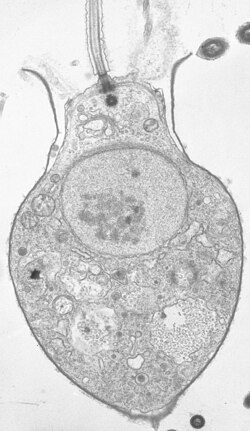
Summary of Choanoflagellate Characteristics
| Feature | Details |
|---|---|
| Domain | Eukaryota |
| Closest Relative | Metazoa (Animals) |
| Key Orders | Craspedida, Acanthoecida |
| Distribution | Global (Marine, Brackish, Freshwater) |
| Fossil Record | 950 million years ago to present |
| Key Genetic Traits | Cell signaling homologues, meiotic genes |
Frequently Asked Questions
Are choanoflagellates animals?
No, they are not animals, but they are the closest living relatives to the animal kingdom. They serve as a sister group to Metazoa.
How do choanoflagellates relate to sponges?
They bear a strong morphological resemblance to choanocytes, which are the specialized collar cells found in sponges, suggesting a shared evolutionary origin.
Where can choanoflagellates be found?
They are found worldwide in marine, freshwater, and brackish environments, from tropical waters to beneath Antarctic ice sheets.
Do choanoflagellates reproduce sexually?
Yes. Genomic evidence, specifically the presence of conserved meiotic genes in species like Monosiga brevicollis, indicates that meiosis and sex are present in these organisms.
What is the significance of the Monosiga brevicollis genome?
Its genome reveals that the molecular precursors for animal cell signaling existed before multicellularity and suggests that early choanoflagellates consumed algae via phagocytosis.