Spanish languageCastilianIbero-RomanceSpanish historySpanish speakers

Spanish Language: A Global Journey from Vulgar Latin to Modern Dominance

The Global Reach and Evolution of the Spanish Language Spanish, also known as Castilian (castellano), is one of the world's most influential and widely spoken languages. From its roots in...

The Global Reach and Evolution of the Spanish Language

Spanish, also known as Castilian (castellano), is one of the world's most influential and widely spoken languages. From its roots in the Iberian Peninsula to its massive presence across the Americas and Africa, Spanish has evolved from a regional dialect into a global powerhouse of communication, culture, and literature.

With a total of approximately 636 million speakers projected for 2025, the language serves as a primary means of expression for over 500 million native speakers. This vast community spans 21 countries, making it a vital component of international diplomacy, commerce, and social interaction.

The Cartularies of Valpuesta, written in a late form of Latin, were declared in 2010 by the Royal Spanish Academy as the record of the earliest words written in Castilian, predating those of the Glosas Emilianenses.[21]
: The Cartularies of Valpuesta, written in a late form of Latin, were declared in 2010 by the Royal Spanish Academy as the record of the earliest words written in Castilian, predating those of the Glosas Emilianenses.[21]

Key Facts

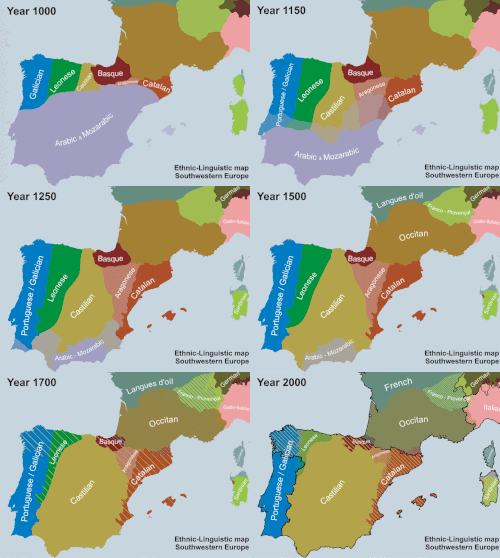
Chronological map showing linguistic evolution in southwest Europe
  • Total Speakers: Approximately 636 million (including 519 million native speakers).
  • Official Status: Official language in 21 countries and one dependent territory.
  • Language Family: Indo-European $\rightarrow$ Italic $\rightarrow$ Latin $\rightarrow$ Romance $\rightarrow$ Ibero-Romance.
  • Writing System: Latin script (the Spanish alphabet) and Spanish Braille.
  • Regulatory Bodies: Regulated by the Association of Spanish Language Academies (ASALE).

The Historical Roots of Spanish
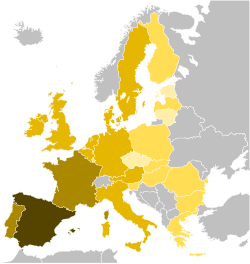
Percentage of people who self reportedly know enough Spanish to hold a conversation, in the EU, 2005 Native country More than 8.99% Between 4% and 8.99% Between 1% and 3.99% Less than 1%

The journey of Spanish began with Vulgar Latin, the spoken form of Latin used by soldiers and settlers. Over centuries, this evolved through Proto-Romance and Old Spanish into the Early Modern Spanish we recognize today. The language is part of the Ibero-Romance branch, closely related to other languages like Portuguese, Galician, and Catalan.

One of the most significant milestones in the language's history was the publication of the Gramática de la lengua castellana by Antonio de Nebrija, which stands as the first grammar of a modern European language. This formalization helped stabilize the language as it expanded.

Antonio de Nebrija, author of Gramática de la lengua castellana, the first grammar of a modern European language[24]
: Antonio de Nebrija, author of Gramática de la lengua castellana, the first grammar of a modern European language[24]

Linguistic Connections

To understand Spanish, it is helpful to see how it relates to its "cousins" in the Romance language family. While they share a common ancestor in Latin, they have diverged significantly. For example, the Latin word for "son" (*filium*) became hijo in Spanish, filho in Portuguese, and figlio in Italian.

Comparison of Common Romance Language Terms
English Latin Spanish Portuguese French Italian
Son filium hijo filho fils figlio
Fire focum fuego fogo feu fuoco
Cheese caseus queso queijo fromage formaggio
More magis más mais plus più

Geographical Distribution and Demographics
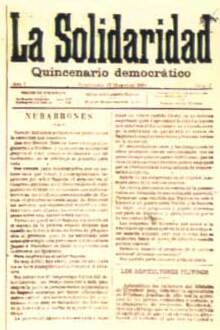
An 1892 issue of La Solidaridad, a Spanish-language newspaper on the colonial Philippines published in Barcelona by Filipino exiles and international students

Spanish is a truly global language, with its presence felt across three continents. While its heart remains in Spain, the largest concentrations of speakers are found in Hispanic America and the United States.

The Americas

Mexico holds the largest population of Spanish speakers in the world. In the United States, the language has a massive and growing footprint, with tens of millions of speakers contributing to the country's cultural fabric. Other major hubs include Colombia, Argentina, and Peru.
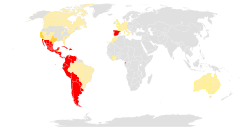
Geographical distribution of the Spanish language Official or co-official language Important minority (more than 25%) or majority language, but not official Notable minority language (less than 25% but more than 500,000 Spanish speakers)
: Geographical distribution of the Spanish language Official or co-official language Important minority (more than 25%) or majority language, but not official Notable minority language (less than 25% but more than 500,000 Spanish speakers)
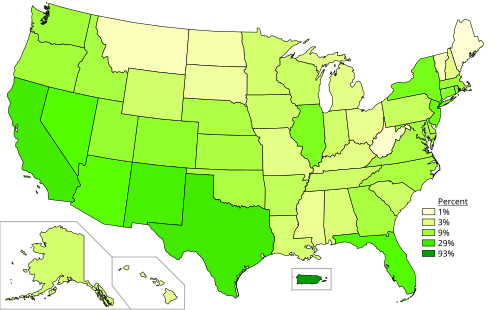
Percentage of the U.S. population aged 5 and over who speaks Spanish at home in 2019, by states
: Percentage of the U.S. population aged 5 and over who speaks Spanish at home in 2019, by states

Africa and Beyond

Beyond the Americas, Equatorial Guinea stands as a key Spanish-speaking nation in Africa. The language also maintains historical and cultural traces in various parts of Asia and Oceania, often through creoles or historical colonial influences.
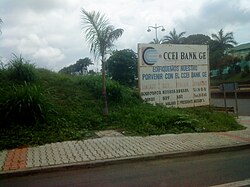
Spanish language signage in Malabo, capital city of Equatorial Guinea
: Spanish language signage in Malabo, capital city of Equatorial Guinea

Linguistic Features: Phonology and Grammar
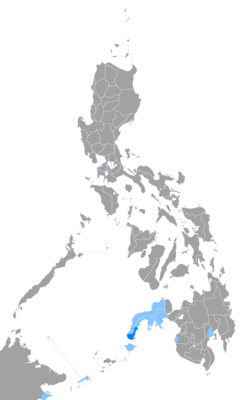
Map of the Chavacano language in various provinces of the Philippines, as well as Sabah in Malaysia (where it is spoken by immigrants)

Spanish is characterized by a distinct phonology (the system of sounds) and a structured morphology (the study of word formation). The Spanish alphabet consists of 27 letters, and the language utilizes a specific set of vowels and consonants, including unique sounds like the trilled "r" and the palatal "ñ".

Spanish vowel chart, from Ladefoged & Johnson (2010:227)
: Spanish vowel chart, from Ladefoged & Johnson (2010:227)

Dialectal Variations and Voseo

Spanish is not a monolith; it is a collection of diverse dialects. One of the most notable grammatical variations is voseo—the use of the pronoun vos instead of . This is common in several regions of Latin America, such as Argentina and parts of Central America, and it affects how verbs are conjugated in the present tense and imperative moods.
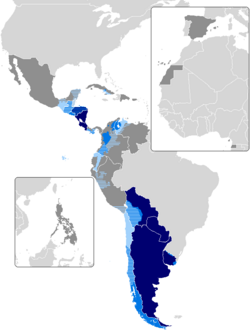
An examination of the dominance and stress of the voseo feature in Hispanic America. Data generated as illustrated by the Association of Spanish Language Academies. The darker the area, the stronger its dominance.
: An examination of the dominance and stress of the voseo feature in Hispanic America. Data generated as illustrated by the Association of Spanish Language Academies. The darker the area, the stronger its dominance.
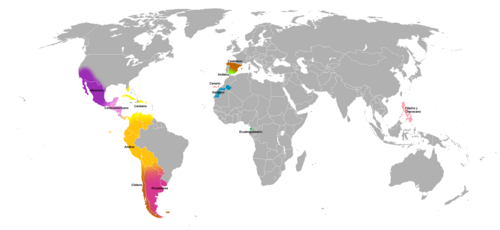
A world map attempting to identify the main dialects of Spanish
: A world map attempting to identify the main dialects of Spanish

Literary and Cultural Legacy

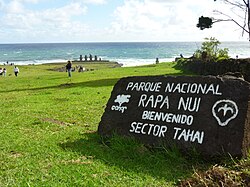
Announcement in Spanish on Easter Island, welcoming visitors to Rapa Nui National Park

The Spanish language has produced some of the world's greatest literature. Most notably, Miguel de Cervantes authored Don Quixote, a work widely regarded as the first modern European novel. The language's expressive power has made it a vehicle for profound poetry, music, and storytelling across generations.
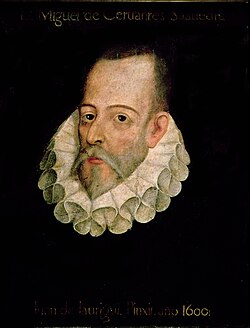
Miguel de Cervantes, considered by many the greatest author of Spanish literature, and author of Don Quixote, widely considered the first modern European novel
: Miguel de Cervantes, considered by many the greatest author of Spanish literature, and author of Don Quixote, widely considered the first modern European novel

Frequently Asked Questions

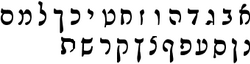
The Rashi script, originally used to print Judaeo-Spanish
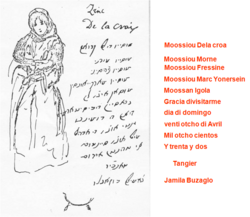
An original letter in Haketia, written in 1832
Member states of the ASALE[270]

What is the difference between Spanish and Castilian?

In many contexts, the terms are used interchangeably. "Castilian" (castellano) refers to the specific dialect that originated in the Castile region of Spain, while "Spanish" is the broader name for the language as it is known globally.

Is Spanish an official language in the United States?

No, Spanish is not an official language of the United States at the federal level, though it is spoken by a massive portion of the population and holds significant cultural and social importance.

How many people speak Spanish worldwide?

As of 2025 estimates, there are approximately 636 million total speakers, including 519 million native speakers and 117 million who speak it as a second language.

What organizations regulate the Spanish language?

The language is regulated and standardized by the Association of Spanish Language Academies (ASALE), which works to ensure consistency across the various Spanish-speaking nations.

Are there different versions of Spanish?

Yes, there are many regional variations. These include differences in accent, vocabulary, and grammar (such as voseo) between Peninsular Spanish (Spain), Mexican Spanish, Caribbean Spanish, and various South American dialects.

References

  1. 75% of U.S. Hispanics speak Spanish very well or pretty well (according to a 2022 survey).[102] There were 68,013,553 Hispanics in the U.S.[103] of which 62,879,127 are over 5 years old,[104] as of 2024. 75% of this figure is 47,159,345. There were also another 2,512,591 non-Hispanic Spanish speakers at home older than 5 years old (5.6% of 44,867,699) as of 2024.[105] In 2011, a similar survey tells that 82% of U.S. Hispanics speak Spanish very well or pretty well, and there were another 2.8 million non Hispanics who speak Spanish at home.[106]
  2. 44,867,699 as a first language + 20,000,000 (Hispanics with limited proficiency, and part of the 8.9 million Spanish students that they are non-Hispanic). Some of the 11 million undocumented Hispanic immigrants not reflected in the census are not included.[92]
  3. 90% of U.S. Hispanics know how to speak at least a little Spanish (according to a 2022 survey).[102] There were 68,013,553 Hispanics in the U.S.[103] of which 62,879,127 are over 5 years old,[104] as of 2024. There were also another 2,512,591 non-Hispanic Spanish speakers at home older than 5 years old (5.6% of 44,867,699) as of 2024.[105] Total number of people who speak at least a little Spanish: 59,103,805.[107] To avoid double counting, 7.9 million Spanish students are not included, nor are some of the 7.4 million undocumented Hispanics who may not be reflected in the census).
  4. Indigenous population that does not speak Spanish: 148,392
  5. Indigenous population that does not speak Spanish: 335,576