Spanish Baroque Architecture: From Churrigueresque Splendor to Colonial Fusion
Spanish Baroque is a dramatic and emotive architectural movement that flourished across Spain, its European provinces, and its vast overseas colonies. Unlike the intellectual rigor of Northern European Baroque, the Spanish iteration focused on appealing to the emotions, utilizing exuberant ornamentation and theatrical light to create a sense of awe and spiritual intensity.
The movement represented a bold rebellion against the sobriety of Herreresque classicism—the restrained, austere style championed by Juan de Herrera in the late 16th century. As Italian influences crossed the Pyrenees, Spanish architects began to embrace a more fluid, decorative, and often capricious approach to design.
Key Facts
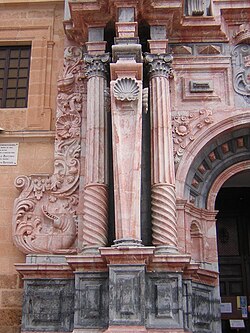
- Emotional Appeal: Prioritized emotional impact over intellectual pleasure.
- Churrigueresque Style: An ultra-ornate style named after the Churriguera family, characterized by intricate surface decoration.
- The Estipite: A signature column shaped like an inverted cone or obelisk, central to the style between 1720 and 1760.
- Global Reach: Evolved into distinct regional variations in Mexico (New Spain) and Peru, incorporating indigenous and Moorish influences.
- Transition: Shifted from extreme ornamentation toward neoclassical sobriety between 1760 and 1780.
The Evolution of the Spanish Style
The development of Spanish Baroque occurred in three distinct chronological phases:
- 1680–1720: The Churriguera family popularized the "supreme order," a blend of Solomonic columns (twisted, spiral columns) and the Composite order.
- 1720–1760: The era of the estipite, where the inverted-cone column became the primary element of ornamental decoration.
- 1760–1780: A gradual transition away from twisted movements and excessive detail toward the balance and sobriety of Neoclassicism.
Regional Variations in Spain
In Madrid, a vernacular Baroque emerged, blending traditional brick construction with Herrerian roots. This is still visible today in the city's squares and palaces.
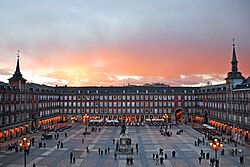
Some of the most striking examples of the period include the energetic façades of the University of Valladolid and the Hospicio de San Fernando. In many of these works, the ornamentation is purely decorative; the elaborate surrounds of doorways—featuring broken pediments and stucco shells—often have little relation to the building's actual structure.
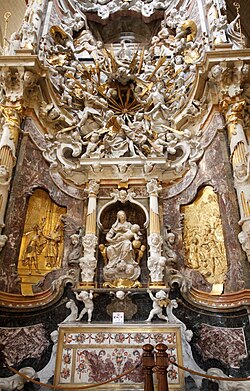
For those seeking the height of interior drama, the Granada Charterhouse and the El Transparente of the Cathedral of Toledo demonstrate a masterful integration of sculpture and light.
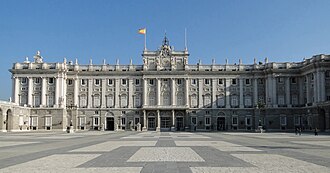
While some projects were florid, others followed a sober international Baroque style. The Royal Palace of Madrid, commissioned by Philip V and Charles III, is often mistaken for neoclassical due to its restraint.
Additionally, the Royal Palaces of La Granja de San Ildefonso and Aranjuez showcase a blend of French influence—La Granja is often called the "Spanish Versailles"—and local spatial concepts reflecting the region's Moorish heritage.
The Baroque in Flanders
In the Spanish province of Flanders, the decorative detailing was more tightly integrated into the building's structure. The Abbey of Averbode and the Church of St. Michel at Louvain represent a convergence of Spanish, French, and Dutch aesthetics, featuring exuberant façades and complex sculptural details.
Spanish Baroque in the Americas
In the colonies, the Baroque style evolved into something even more expressive than its European counterpart, often blending with Native American and Moorish influences.
Mexican Churrigueresque
In New Spain (Mexico), the style reached a "visually frenetic" peak known as Mexican Churrigueresque. Lorenzo Rodriguez's Sagrario Metropolitano is a primary example of this ultra-Baroque approach.
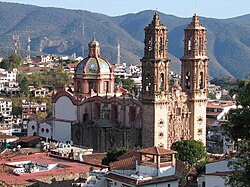
The city of Puebla became a center for a highly localized art form. Using talavera (hand-painted ceramic tiles) and a unique white stucco decoration called alfeñique (named after a local sugar candy), artisans created churches with colorful, glazed domes and interiors saturated in gold leaf.
Peruvian and Andean Baroque
In South America, the Baroque arrived later, with the Jesuit shrine in Cusco (1664) marking a turning point. Peruvian Baroque was particularly lush, as seen in the Monastery of San Francisco in Lima.
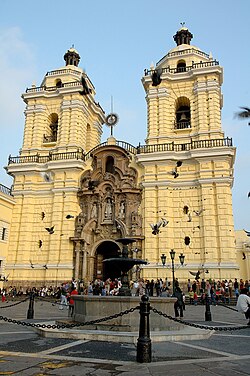
In regions like Arequipa, Potosí, and La Paz, "mestizo" (crossbred) styles emerged. These designs often drew inspiration from the Mudéjar art of medieval Spain, resulting in façades that resembled carved altarpieces, such as the Iglesia de La Compañía in Quito.
Summary of Spanish Baroque Characteristics
| Region | Key Characteristics | Notable Examples |
|---|---|---|
| Castile/Madrid | Brick vernacular, transition from Herrerian to Churrigueresque | Plaza Mayor, Royal Palace of Madrid |
| Flanders | Integration of Spanish, French, and Dutch aesthetics | Abbey of Averbode, Church of St. Michel |
| Mexico | Ultra-Baroque, talavera tiles, alfeñique stucco | Sagrario Metropolitano, Church of Santa Prisca |
| Peru/Andes | Mestizo style, Mudéjar influence, carved altarpiece façades | Monastery of San Francisco, Iglesia de La Compañía |
Frequently Asked Questions
What is the difference between Baroque and Churrigueresque?
While Baroque is the broader movement, Churrigueresque is a specific, highly ornate Spanish subset of Baroque. It is characterized by extreme surface decoration, the use of the estipite column, and a rejection of classical sobriety.
What is an estipite?
An estipite is a decorative column shaped like an inverted cone or obelisk. It became a central element of Spanish Baroque ornamentation between 1720 and 1760.
How did indigenous cultures influence American Baroque?
In the colonies, Native American artisans blended their own traditions with Spanish styles. This resulted in "mestizo" architecture, featuring unique materials like talavera tiles in Mexico and distinct sculptural interpretations in the Andes.
What was the influence of the Moorish occupation on this style?
The Moorish influence is evident in the Mudéjar elements found in both the Royal Palaces of Spain and the colonial churches of Peru, manifesting in specific spatial conceptions and geometric decorative patterns.
Why is the Royal Palace of Madrid often mistaken for Neoclassical?
The Royal Palace was built in a sober, international Baroque style under Philip V and Charles III, which lacked the exuberant ornamentation of the Churrigueresque, making it appear more aligned with the later Neoclassical movement.