Southern Federal District: A Comprehensive Overview
The Southern Federal District is one of the eight primary federal districts of Russia. Situated largely on the Pontic–Caspian steppe, this expansive region serves as a vital gateway between the Russian interior and the surrounding seas. The district's geography is defined by its proximity to the Azov Sea and the Black Sea to the west, and the Caspian Sea and Kazakhstan to the east.
Key Facts
- Administrative Centre: Rostov-on-Don
- Largest City: Krasnodar
- Total Area: 447,821 km²
- Established: 13 May 2000
- GDP (Nominal, 2024): ₽ 12.57 trillion (US$ 170.7 billion)
- Human Development Index (2022): 0.764 (High)
Historical Evolution
The district has undergone several administrative transformations since its inception. Originally established on 13 May 2000 under the name "North Caucasian Federal District," it was renamed the Southern Federal District just weeks later on 21 June 2000 for political reasons.
In 2010, the district's boundaries were significantly altered when it was split, with its southern territories forming the new North Caucasian Federal District. A major administrative shift occurred on 28 July 2016, when the Crimean Federal District—which included the Republic of Crimea and the federal city of Sevastopol—was abolished and merged into the Southern Federal District to streamline governance.
Administrative Structure and Constituent Entities
The Southern Federal District is composed of several constituent entities (also referred to as subjects of the Russian Federation). These entities hold equal rights under the Russian Constitution and include various types of administrative divisions such as republics and oblasts.
| Entity Name | Area (km²) | Population | Administrative Center |
|---|---|---|---|
| Republic of Adygea | 7,800 | 496,934 | Maykop |
| Astrakhan Oblast | 49,000 | 960,142 | Astrakhan |
| Republic of Kalmykia | 74,700 | 267,133 | Elista |
| Krasnodar Krai | 75,500 | 5,838,273 | Krasnodar |
| Rostov Oblast | 101,000 | 4,200,729 | Rostov-on-Don |
| Volgograd Oblast | 112,900 | 2,500,781 | Volgograd |
| Republic of Crimea* | 26,100 | 1,934,630 | Simferopol |
| Sevastopol* | 900 | 547,820 | Sevastopol |
| * Annexed by Russia in 2014; recognized internationally as part of Ukraine. |
Demographics and Ethnic Composition
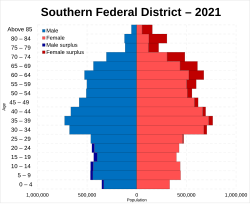
The district is home to a diverse population. According to the 2010 Census, the population was approximately 13.85 million people, with a 62.4% urban residency rate. The ethnic makeup of the region is notably varied, though Russians constitute the largest group.
Ethnic Breakdown (2010 Census)
- Russians: 83.75%
- Armenians: 3.19%
- Ukrainians: 1.54%
- Kazakhs: 1.48%
- Kalmyks: 1.24%
- Tatars: 0.92%
- Other groups: Including Circassians, Azerbaijanis, Turks, and Roma.
![Life expectancy at birth in the Southern Federal District, 1990–2021[16][17]](/images/1e/1a/1e1a546af3971fd376c8b2257b0eb02eecac1b673fc2541585e851fdb3da5525.png)
Governance and Leadership
The district is overseen by a Presidential Envoy, who represents the interests of the central government. Since 2008, Vladimir Ustinov has served in this capacity, making him one of the longest-serving envoys in the district's history.
Frequently Asked Questions
What is the administrative center of the Southern Federal District?
The administrative center of the Southern Federal District is Rostov-on-Don.
How many constituent entities are in the district?
The district contains 6 official constituent entities, though this number increases to 12 if including disputed oblasts and republics.
What is the economic scale of the region?
As of 2024, the district's nominal GDP is estimated at ₽ 12.57 trillion (approximately US$ 170.7 billion), with a per capita GDP of ₽ 757,056.
What is the primary landscape of the Southern Federal District?
The territory lies mostly on the Pontic–Caspian steppe, a vast area of flat grassland.
Who is the current Presidential Envoy?
As of the latest available data, Vladimir Ustinov has served as the Presidential Envoy since May 2008.