South Sandwich Plate: The Dynamics of a Southern Ocean Microplate
Deep in the Southern Ocean lies the South Sandwich plate, a small but geologically active microplate. Unlike the massive tectonic plates that define the Earth's surface, this microplate operates within a complex intersection of larger plates, driving the volcanic activity and seismic shifts that created the South Sandwich Islands.
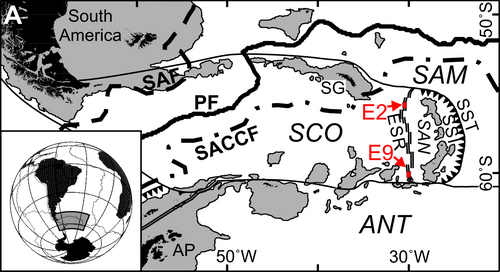
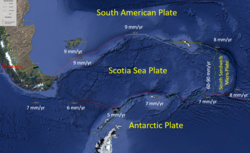
The South Sandwich plate is bounded by three major tectonic entities: the subducting South American plate to the east, the Antarctic plate to the south, and the Scotia plate to the west. Its unique position makes it a critical area for studying how smaller crustal fragments interact with global plate movements.
Key Facts
- Plate Type: Microplate
- Approximate Area: 170,000 km²
- Movement Direction: East
- Movement Speed: 47mm per year
- Primary Features: South Sandwich Islands and the Southern Ocean
Geological Formation and Evolution
The history of this region began approximately 66 million years ago with the initiation of the South Sandwich subduction zone. A subduction zone is a convergent plate margin where one tectonic plate sinks beneath another into the Earth's mantle.
This process was triggered by the regional convergence of the Antarctic and South American plates. Over time, the gradual extension of the Scotia Sea and the subduction roll back—the process where the sinking slab of oceanic lithosphere moves backward away from the overriding plate—led to the creation of the ancestral Scotia plate.
The Separation of the Microplate
Around 15 million years ago, the South Sandwich microplate officially separated from the Scotia plate. This separation occurred as a back-arc basin formed, coinciding with the development of the East Scotia Rise. The East Scotia Rise is a back-arc spreading ridge, a divergent boundary that forms behind a subduction zone.
Theories on Plate Separation
Geologists continue to debate the exact cause of the separation between the South Sandwich and Scotia plates. Currently, two primary mechanisms are proposed:
- Subducting slab roll back: The backward migration of the sinking South American plate.
- Absolute motion: The physical movement of the Scotia plate away from the trench.
It is highly probable that a combination of both mechanisms contributed to the current configuration of the plate boundaries.
Summary of South Sandwich Plate Characteristics
| Attribute | Detail |
|---|---|
| Classification | Microplate |
| Estimated Size | 170,000 km² |
| Velocity | 47mm/year |
| Direction of Motion | Eastward |
| Bordering Plates | South American, Antarctic, and Scotia |
Frequently Asked Questions
What is the South Sandwich plate?
The South Sandwich plate is a small tectonic microplate located in the Southern Ocean, known for hosting the South Sandwich Islands and being bordered by the South American, Antarctic, and Scotia plates.
How fast is the South Sandwich plate moving?
The plate moves eastward at an approximate speed of 47mm per year.
When did the South Sandwich subduction zone begin?
The subduction zone initiated approximately 66 million years ago due to the convergence of the Antarctic and South American plates.
What is the East Scotia Rise?
The East Scotia Rise is a back-arc spreading ridge that separates the South Sandwich microplate from the Scotia plate.
Why did the South Sandwich plate separate from the Scotia plate?
The separation occurred about 15 million years ago, likely due to a combination of subducting slab roll back and the absolute motion of the Scotia plate away from the trench.