South Georgia Island: A Remote Sub-Antarctic Wilderness
Located in the vast expanse of the South Atlantic Ocean, South Georgia is a rugged, mountainous island known for its dramatic landscapes and immense biodiversity. As part of the British Overseas Territory of South Georgia and the South Sandwich Islands, it sits approximately 1,400 kilometres (870 mi) east of the Falkland Islands. With no indigenous population and a climate that challenges human survival, the island remains one of the most isolated and pristine environments on Earth.
The island is characterized by its east-west orientation, stretching 170 kilometres (106 mi) in length and reaching a maximum width of 35 kilometres (22 mi). Its interior is dominated by a central ridge of towering peaks, the highest of which is Mount Paget, reaching an elevation of 2,935 metres (9,629 ft). The coastline is deeply indented with fjords and bays, providing natural harbours in an otherwise inhospitable terrain.
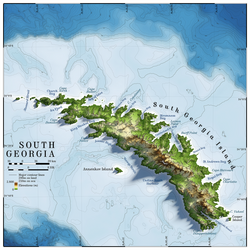
Key Facts
- Administration: British Overseas Territory (claimed by Argentina).
- Highest Point: Mount Paget (2,935 m / 9,629 ft).
- Climate: Polar tundra (Köppen-Geiger ET).
- Population: Approximately 32 in summer and 16 in winter.
- Main Settlement: King Edward Point.
- Endemic Species: South Georgia pintail and South Georgia pipit.
A History of Exploration and Industry
European discovery of the island is attributed to London merchant Anthony de la Roché around 1675, who named it Roche Island. Later, in 1756, it was sighted by a Spanish ship and referred to as Isla San Pedro. However, the first formal landing, survey, and mapping were conducted by Captain James Cook aboard the HMS Resolution. On 17 January 1775, Cook claimed the island for Britain, naming it the "Isle of Georgia" in honor of King George III.

For centuries, South Georgia served as a critical hub for commercial sealing (1786–1913) and industrial whaling (1909–1964). Grytviken emerged as the most historically significant whaling base. Today, the remnants of this era—including iron try pots and hut ruins—are preserved, and the South Georgia Museum, established in 1992, documents this industrial past.
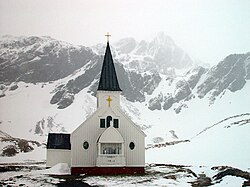
The island is also etched into the annals of polar exploration due to Ernest Shackleton. Following the disaster of the 1916 Imperial Trans-Antarctic Expedition, Shackleton performed a legendary foot crossing of the island with Tom Crean and Frank Worsley to secure the rescue of his crew from Elephant Island. Shackleton is buried in the Grytviken cemetery alongside Frank Wild.
The South Georgia Survey
Between 1951 and 1957, explorer Duncan Carse led a comprehensive survey of the island's interior. Carse's dedication to the region was so profound that he attempted to live as a hermit at Ducloz Head in 1961. Although surge waves destroyed his camp three months into the experiment, he survived 116 days in isolation before being rescued.
Political Disputes and Occupation
The island's sovereignty is disputed, with Argentina claiming it as part of the Tierra del Fuego Province. During the Falklands War in 1982, Argentine forces occupied the island starting on 3 April. British forces subsequently retook the territory on 25 April during Operation Paraquet.
Geography, Climate, and Wildlife
South Georgia possesses a polar tundra climate, meaning it lacks tree cover and is typically snow-covered from April to November. The topography features wave-cut platforms and strandflats, evidence of historical sea-level fluctuations.
The island is a vital breeding ground for king penguins, fur seals, and elephant seals. It is also home to two endemic bird species: the South Georgia pintail and the South Georgia pipit.
Ecological Restoration
In recent decades, significant efforts have been made to restore the island's native ecosystem by removing invasive species:
- Reindeer: Introduced by Norwegian whalers for food and sport, 3,500 reindeer were culled in 2013 to protect native flora.
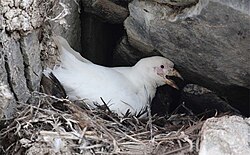
- Rodents: A multiyear extermination project concluded in 2018, declaring the island free of invasive rodents, which led to a recovery in populations of snowy sheathbills and storm petrels.
Despite these successes, the island faces ongoing challenges from introduced predatory ground beetles, such as Merizodus soledadinus and Trechisibus antarcticus, which negatively impact native invertebrates.
The Impact of Icebergs
South Georgia often intersects the path of massive icebergs drifting from Antarctica. In 2004, Iceberg A-38 grounded off the coast, disrupting seafloor life and blocking foraging routes for penguins and seals. In 2020, the colossal Iceberg A-68—roughly the size of the island itself—approached the coast but broke apart before a direct collision occurred.
Island Summary
| Feature | Detail |
|---|---|
| Area | 3,528 km² (1,362 sq mi) |
| Dimensions | 170 km long x 35 km wide |
| Highest Peak | Mount Paget (2,935 m) |
| Climate Type | Polar Tundra (ET) |
| Primary Research Station | King Edward Point |
| Key Wildlife | King penguins, Elephant seals, Fur seals |
Frequently Asked Questions
Who currently administers South Georgia?
South Georgia is administered by the United Kingdom as part of the British Overseas Territory of South Georgia and the South Sandwich Islands, though it is claimed by Argentina.
Why were reindeer removed from the island?
Reindeer were introduced by Norwegian whalers in the early 20th century. They were eventually culled because they were considered a pest that damaged the island's native flora and wider ecosystem.
What is the significance of Grytviken?
Grytviken was historically the most important whaling base on the island. Today, it is the site of the South Georgia Museum and the cemetery where explorer Ernest Shackleton is buried.
Which bird species are endemic to South Georgia?
The South Georgia pintail and the South Georgia pipit are the two bird species endemic to the island.
How does the island's climate affect its vegetation?
Due to its polar tundra climate and harsh weather, the island has no tree cover. It supports 25 native vascular plant species, though 76 non-native species have also been recorded.