South America's Largest Cities by Population
South America is home to some of the world's most vibrant and densely populated urban centers. From the coastal hubs of Brazil to the high-altitude capitals of the Andes, the continent's cities serve as critical economic and cultural engines. Understanding the scale of these cities requires looking at population figures within city limits—the official administrative boundaries—rather than the broader urban agglomerations or metropolitan areas that often extend far beyond the city's legal borders.
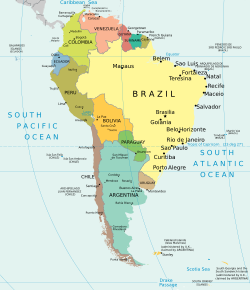
The distribution of population across the continent is heavily concentrated in a few massive hubs, with Brazil and Colombia hosting a significant number of the region's largest urban centers.
Key Facts
- São Paulo is the largest city in South America, with a projected population of over 11.9 million by 2025.
- Brazil dominates the list of the 50 largest cities, featuring numerous hubs with populations exceeding one million.
- Population data varies by source year, with most cities reflecting 2020-2025 estimates, while Chilean data is from 2017 and Venezuelan data from 2015.
- The list distinguishes between the largest city in a country and the national capital.
Analyzing the Largest Urban Centers
The top tier of South American cities is led by São Paulo, Lima, and Bogotá. These three cities are the only ones in the region with populations exceeding 7 million within their administrative limits. While São Paulo remains the undisputed leader in size, Lima and Bogotá follow as primary hubs for Peru and Colombia, respectively.
Regional Population Distribution
Brazil's urban landscape is particularly diverse, with cities like Rio de Janeiro, Brasília, and Fortaleza all ranking among the top 15. In contrast, other nations often have one dominant primate city—such as Santiago in Chile or Buenos Aires in Argentina—that dwarfs other urban centers in the country.
Technical Considerations in Population Counting
It is important to note that population figures can vary based on how a "city" is defined. For example, in Lima, the population refers to the central 30 of the 43 districts of Lima Province. In Colombia, figures for cities like Bogotá and Medellín refer to the cabecera municipal, or the municipal seat. Similarly, the population of Caracas is based on the Metropolitan District, which encompasses five specific municipalities: Libertador, Chacao, Baruta, Sucre, and El Hatillo.
Population Summary Table
| Rank | City | Country | Population | Data Year |
|---|---|---|---|---|
| 1 | São Paulo | Brazil | 11,904,961 | 2025 |
| 2 | Lima | Peru | 10,092,000 | 2023 |
| 3 | Bogotá | Colombia | 7,862,277 | 2024 |
| 4 | Rio de Janeiro | Brazil | 6,730,729 | 2025 |
| 5 | Santiago | Chile | 6,254,314 | 2017 |
| 6 | Caracas | Venezuela | 3,289,886 | 2015 |
| 7 | Buenos Aires | Argentina | 3,121,707 | 2022 |
| 8 | Brasília | Brazil | 2,996,899 | 2025 |
| 9 | Medellín | Colombia | 2,657,772 | 2024 |
| 10 | Guayaquil | Ecuador | 2,650,288 | 2022 |
| 11 | Fortaleza | Brazil | 2,578,483 | 2025 |
| 12 | Salvador | Brazil | 2,564,204 | 2025 |
| 13 | Belo Horizonte | Brazil | 2,415,872 | 2025 |
| 14 | Manaus | Brazil | 2,303,732 | 2025 |
| 15 | Cali | Colombia | 2,270,293 | 2024 |
Frequently Asked Questions
Which is the most populous city in South America?
São Paulo, Brazil, is the most populous city, with a population of 11,904,961 based on 2025 projections.
Do these population numbers include the surrounding suburbs?
No, these figures represent the population within the official city limits and do not include the wider urban agglomeration or metropolitan areas.
Which countries have the most cities in the top 50?
Brazil has the highest number of cities represented in the top 50, followed by countries like Colombia, Peru, and Argentina.
Why are some population dates different from others?
The data relies on the most recent official census or projections available for each specific city; for instance, Chilean data is from 2017 and Venezuelan data is from 2015, while many Brazilian cities use 2025 projections.
What is a "cabecera municipal" in the context of Colombian cities?
A cabecera municipal refers to the municipal seat, which is the primary urban center of a municipality.