São Paulo Macrometropolis: South America's Largest Urban Agglomeration
The São Paulo Macrometropolis, also referred to as the São Paulo Megalopolis or the Expanded Metropolitan Complex, represents one of the most significant urban phenomena in the world. This massive urban cluster emerged through conurbation—the process where separate cities and towns grow toward one another until their boundaries merge into a single continuous built-up area.
Covering approximately 53,000 square kilometers, this megalopolis is the only urban cluster of its kind in South America. It connects 174 municipalities and serves as the primary engine for Brazil's industrial and economic output.
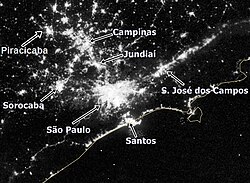
Key Facts
- Total Population: Exceeds 31.5 million inhabitants (some estimates reach 34.5 million).
- State Impact: Accounts for approximately 74% to 75% of the total population of São Paulo State.
- Scale: Spans 53,000 square kilometers and encompasses 174 municipalities.
- Unique Status: The only urban agglomeration of this scale in South America.
The Evolution of Urban Sprawl
The growth of the Macrometropolis was not accidental but the result of decades of economic shifts and changing population preferences. As the capital city of São Paulo became saturated, residents and industries increasingly favored the interior of the state.
While early signs of conurbation were noted in Porto Ferreira (along the Anhanguera highway) and São Carlos (along the Washington Luís highway), the official boundaries of the Macrometropolis begin in Pirassununga. From there, the urban fabric extends through Leme, Araras, Rio Claro, and Limeira. Beyond Limeira, the landscape transitions, as there are no longer green spaces separating the urban areas.
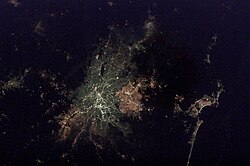
Regional Divisions and Demographics
The Macrometropolis is composed of several integrated metropolitan regions, each centered around a major seat city. While Greater São Paulo remains the dominant core, the surrounding regions provide critical industrial and residential support.
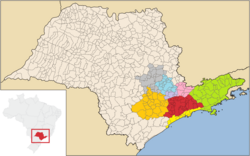
| Region | Total Population | Seat City | Seat City Population |
|---|---|---|---|
| Metropolitan Region of São Paulo | 21,860,000 | São Paulo | 12,310,000 |
| Metropolitan Region of Campinas | 3,300,000 | Campinas | 1,215,000 |
| Metropolitan Region of Vale do Paraíba e Litoral Norte | 2,550,000 | São José dos Campos | 725,000 |
| Metropolitan Region of Sorocaba | 2,150,000 | Sorocaba | 685,000 |
| Metropolitan Region of Baixada Santista | 1,880,000 | Santos | 435,000 |
| Metropolitan Region of Piracicaba | 1,500,000 | Piracicaba | 410,000 |
| Metropolitan Region of Jundiaí | 825,000 | Jundiaí | 425,000 |
| Regional Unit of Bragança Paulista | 480,000 | Bragança Paulista | 170,000 |
Major Municipalities by Population
The urban hierarchy of the region is led by the city of São Paulo, followed by several other high-density hubs. The distribution of population is categorized as follows:
Cities with Over 1 Million Residents
- São Paulo: 12,038,175
- Guarulhos: 1,337,087
- Campinas: 1,173,370
Cities with 500,000 to 999,999 Residents
- São Bernardo do Campo: 822,242
- São José dos Campos: 795,992
- Santo André: 712,749
- Osasco: 696,382
- Sorocaba: 652,481
Key Mid-Sized Hubs (200,000 to 499,999 Residents)
Numerous cities fall into this category, including Mauá, Santos, Mogi das Cruzes, Diadema, and Jundiaí, all contributing to the dense network of the Expanded Metropolitan Complex.
Frequently Asked Questions
What is the São Paulo Macrometropolis?
It is a massive Brazilian megalopolis formed by the conurbation of several metropolitan areas surrounding Greater São Paulo, including Campinas, Sorocaba, and Baixada Santista.
How many people live in this urban cluster?
The total population exceeds 31.5 million inhabitants, which represents approximately 74% to 75% of the entire population of São Paulo State.
What is conurbation in the context of São Paulo?
Conurbation is the process where urban areas grow and merge. In this region, it has resulted in a continuous urban sprawl where green spaces no longer separate many of the cities, particularly between Pirassununga and Limeira.
Which cities are the largest in the Macrometropolis?
The largest is São Paulo (over 12 million), followed by Guarulhos and Campinas, both of which have populations exceeding 1 million.
Why did the Macrometropolis form?
It resulted from decades of economic shifts and a trend of people moving away from the saturated capital of São Paulo toward the interior of the state.