Snare Drum: History, Construction, and Types of the Percussion Staple
The snare drum, also known as a side drum or field drum, is a cornerstone of the percussion family. It is defined by its ability to produce a sharp, staccato sound when the top head is struck. This unique sonic characteristic is created by a series of wires, cords, or a combination of both—known as snares—which are held under tension against the bottom head of the drum.
From the thunderous precision of a marching band to the rhythmic backbeat of a rock concert, the snare drum is incredibly versatile. Because its basic rhythms are accessible, it is frequently used in music education for children and rhythm bands. Its high dynamic range allows a drummer to transition from the softest whispers of a wire brush to the powerful, metallic crack of a rimshot.

Key Facts
- Classification: An unpitched percussion instrument (Hornbostel–Sachs 211.212.11).
- Origins: Descended from the medieval tabor, appearing in its modern cylindrical form by the 15th century.
- Core Components: Consists of a shell, a batter head (top), a resonant head (bottom), and snare wires.
- Common Sizes: Standard kit and orchestral drums are typically 14" in diameter and 5" to 8" deep.
- Materials: Shells are crafted from wood, metal, acrylic, or composites like fiberglass.
The Evolution of the Snare Drum
The snare drum's lineage traces back to the tabor, a medieval drum often played alongside a three-holed pipe flute. Originally used in warfare, the tabor evolved into a larger cylindrical instrument by the 15th century, becoming a staple for Swiss mercenary troops. By the 17th century, the introduction of screws to secure the snares provided a brighter, more controlled sound.
Historically, the snare drum served as a vital communication tool in the military before the invention of electronic communications. Specific drum pieces signaled daily routines: "Three Camps" woke the troops, while "Peas on a Trencher" or "Roast Beef" called them to meals. The "Tattoo" signaled the end of the day, and the "Fatigue Call" was used for camp policing.
While the bugle eventually replaced the drum for most military signals in the 18th and 19th centuries, the snare drum's influence persists. The development of drum rudiments—standardized rhythmic patterns like the single paradiddle, flam, and double stroke roll—is closely tied to this military heritage, with the first written rudiments appearing in Basel, Switzerland, in 1610.
Construction and Mechanics
A snare drum consists of a cylindrical shell with two membranes. The top surface, where the drummer strikes, is the batter head. The bottom surface is the resonant head, which is thinner to allow it to vibrate in response to the batter head.
Modern drums typically use Mylar (plastic) skins, a breakthrough credited to Marion "Chick Evans" in 1956, replacing traditional calfskin. Some high-tension pipe band drums use Kevlar-based heads to achieve a high-pitched cracking sound. To manage overtones, drummers often apply tone control rings or dots to the head surface.
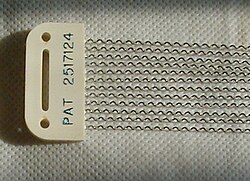
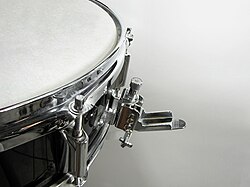
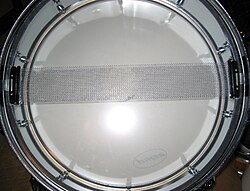
The defining feature is the snare system. These wires are held against the resonant head by a strainer, a lever mechanism that allows the player to engage or disengage the snares. When the snares are "thrown off," the drum sounds more like a tom-tom.
Recent construction innovations include symmetrical venting. Unlike a single vent hole, this allows air to move more freely around the instrument, resulting in a smoother and stronger sound.
Types of Snare Drums
Different musical contexts require different drum dimensions and characteristics. The following table summarizes the most common variations:
| Type | Typical Diameter | Typical Depth | Primary Use / Characteristic |
|---|---|---|---|
| Drum Kit | 14" | 5" - 8" | Pop, Rock, Jazz (Backbeat style) |
| Marching | 14" | 12" | Marching bands; high tension and volume |
| Piccolo | 13" - 14" | ~4" | Higher pitch; sharp "pop" sound |
| Soprano | 12" | ~7" | High-pitched special effects |
| Tabor | 11" - 13" | 4.5" (wide) | Medieval/Orchestral; single snare strand |
| Caixa | 12" - 14" | 8" | Samba (Brazil); snares on top head |

Playing Techniques
While drumsticks are the most common tool, drummers use brushes or rutes to achieve softer, more textured tones. The sensitivity of the instrument allows it to respond to even the lightest touch.
Advanced techniques include the rimshot, where the drummer strikes the head and the rim (counterhoop) simultaneously. This produces a loud, sharp accent essential for contemporary pop and rock music. In orchestral settings, a rimshot may be performed by placing one stick on the head and striking the rim with the opposite stick.
Frequently Asked Questions
What is the difference between a snare drum and a tom-tom?
The primary difference is the presence of snare wires stretched across the bottom head. These wires create the characteristic "snap" or "crack" of the snare drum, whereas a tom-tom has no snares and produces a deeper, more resonant tone.
What is a piccolo snare drum?
A piccolo snare is a shallower drum (typically around 4 inches deep) that produces a higher-pitched, sharper sound than a standard snare. While unique, its sharp tone can sometimes be more challenging to capture effectively during studio recording.
What are drum rudiments?
Rudiments are the basic building blocks of drumming—standardized rhythmic patterns such as the flam, drag, and paradiddle. They originated largely from military drumming and are used to develop technical proficiency and speed.
Can a snare drum be played without the "snap" sound?
Yes. By using the lever on the snare strainer, the drummer can disengage (throw off) the snare wires. This removes the buzzing sound, making the drum sound similar to a tom-tom.
What materials are used for snare drum heads?
Historically, heads were made from calfskin. Modern drums primarily use Mylar (plastic), though some specialized marching or pipe band drums use Kevlar for extreme tension and a higher pitch.