Slavic Native Faith: Theological Stances and Divine Hierarchies
The spiritual landscape of the Slavic peoples has evolved from ancient polytheistic roots into a diverse modern movement known as Rodnovery. While ancient Slavs worshipped a multitude of deities subordinate to a supreme, impersonal creator, contemporary practitioners in Russia and Ukraine hold a wide spectrum of beliefs. These range from strict monotheism and polytheism to atheistic views where gods are seen as symbolic archetypes rather than literal entities.
Despite these differences, most Rodnovers share a pantheistic worldview—the belief that the divine is identical with the universe—creating a holistic understanding of existence. Many reconcile the tension between one god and many by adopting monism, the idea that various deities are simply different manifestations of a single, universal impersonal God.
Key Facts
- Rod is the central concept of the supreme, all-pervading spiritual life force and creator.
- Modern Rodnovery is split between monotheistic, polytheistic, and symbolic/atheistic interpretations.
- Manifestationism suggests that gods do not create the world as external objects but embody themselves as the entities they generate.
- The movement incorporates a mix of attested pre-Christian deities, folk figures, and adapted deities from Hindu and Iranian traditions.
- Ancestor worship is central to many branches, linking divinity genetically to human kinship and bloodlines.
Monotheism vs. Polytheism in Modern Practice
The debate between monotheism and polytheism is particularly prominent in Ukraine. Groups following the tradition of Volodymyr Shaian generally embrace polytheism, mirroring pre-Christian systems. In contrast, Lev Sylenko's Native Ukrainian National Faith (RUNVira) is explicitly monotheistic, focusing worship on Dazhboh, viewed as the life-giving energy of the cosmos.
Sylenko described Dazhboh as a combination of light, eternity, and conscious being. Because of this, some scholars argue that Sylenkoism is actually pantheistic or panentheistic. Sylenko believed that while ancient Slavs were polytheists, human spiritual evolution necessitates a shift toward monotheism, rendering the belief in forest or water spirits obsolete.
Similar monotheistic leanings are found in Russian Ynglism and Kandybaism. However, some polytheist Rodnovers criticize these views as inauthentic to the original Slavic spirit.
Polytheism and the Slavic Pantheons
There is no single, unified pantheon in Rodnovery. Different groups prioritize different deities based on regional traditions or specific texts. For example, some rely on The Lay of Igor's Host to claim that Russians are the grandchildren of Dazhbog (the "Giving God").
The Union of Slavic Rodnover Communities, led by Vadim Kazakov, recognizes over thirty deities emanating from Rod. This expansive list includes:
- Traditional Slavic deities from folk and pre-Christian records.
- Slavicised Hindu deities, such as Vyshen (Vishnu) and Intra (Indra).
- Iranian deities, including Simargl and Khors.
- Literary and folk figures, such as the wizard Koschei or deities from the Book of Veles.
Modern practitioners also adapt the roles of gods to fit contemporary life. For instance, Veles, traditionally the god of poetry and livestock, is often invoked today as the god of communication and literature.
Rod: The Universal Source
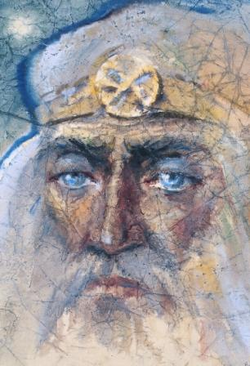
In many theological circles, Rod is the most critical concept. He is not viewed as a master of the universe, but as the universe itself. Other deities are seen as his "faces," incarnations, or hypostases. Depending on the group, the visible manifestation of this force may be called Svarog or Nebo (Heaven).
Rod is also associated with Kolo (Time), reflected in the cyclical nature of days, seasons, and years. The term "rod" itself relates to kinship, birth, and origin. This spiritual life force is contrasted with urod, which refers to anything deformed or outside the spiritual community of Rod.
The Triune Manifestations
Some practitioners view the divine through a triune cosmic manifestation known as Triglav (the Three-Headed One). Common pairings include:
- Prav $\rightarrow$ Yav-Nav
- Svarog $\rightarrow$ Belobog - Chernobog
- Svarog $\rightarrow$ Dazhbog - Stribog
![Northwestern Slavic hierarchy of the divine, as proposed by Ignác Jan Hanuš in 1842.[25]](/images/03/85/0385cd84762ac4a4afc91ebadd71fb887fdf54a4267a6397cd386db67bf9825b.jpg)
![Hierarchy of the divine, with the two categories proceeding from the supreme God, as illustrated by Georg F. Creuzer and Franz J. Mone in 1822.[36] All deities are manifestations of either Belobog or Chernobog, and in both categories they may be either Razi, rede-givers, or Zirnitra, dragon wizards.[37]](/images/4a/d0/4ad0ba7f58e283d8a38cd2ba39b391c2ca103bfafec8719c617de655c683bc6a.jpg)
Manifestationism and Dualism
Manifestationism is the belief in a spirit-matter continuum. In this view, gods do not create the world; they embody it. For example, thunder is not created by the god Perun; thunder is an embodiment of Perun. This leads to the belief that humans are "God's sons" rather than slaves, emphasizing ontological freedom and co-creation.
Some Russian traditions, such as those taught by the volkhv Velimir, introduce a dualism between "white gods" (led by Belobog) and "black gods" (led by Chernobog). This is not a simple battle between absolute good and evil, but rather a struggle between forces of creation and destruction, where "black" gods become evil only when they act against the older, stronger white gods.
Genotheism and Ancestor Worship
Certain leaders, such as Halyna Lozko, propose genotheism (or rodotheism in Ynglism), which posits a genetic link between the divine and humanity. In this framework, God manifests through progenitors and kin lineages. Ethics are derived from this connection, suggesting that harmony is only possible when an ethnic group maintains a relationship with its ancestral land.
This manifests as the worship of great forefathers, such as Or or Oryi. Some practitioners, like the volkhv Dobroslav, emphasize blood heritage, arguing that purity of kinship is essential to maintain the connection with divine ancestors.
| Perspective | Core Belief | Key Figures/Groups |
|---|---|---|
| Monotheism | Worship of a single God (e.g., Dazhboh) as the cosmic energy. | RUNVira, Ynglism, Kandybaism |
| Polytheism | Worship of multiple distinct deities and spirits. | Volodymyr Shaian's tradition |
| Monism | Many gods are manifestations of one supreme God (Rod). | General Rodnover consensus |
| Genotheism | Divinity is genetically linked to human ancestors and bloodlines. | Halyna Lozko, Ynglists |
Frequently Asked Questions
Who is Rod in Slavic Native Faith?
Rod is conceived as the primordial, all-pervading spiritual life force and the supreme impersonal creator. In monistic interpretations, all other gods are seen as manifestations or "faces" of Rod, who is essentially the universe itself.
What is the difference between Belobog and Chernobog?
Belobog (the White God) and Chernobog (the Black God) represent a dualism between the forces of creation and destruction. Rather than absolute good and evil, they symbolize the spiritual and material realms, with the black gods becoming "evil" when they oppose the white gods.
What is manifestationism?
Manifestationism is the theological idea that there is a continuum between spirit and matter. Instead of creating the world as external objects, gods embody themselves as the entities and phenomena they generate, such as Perun embodying thunder.
How does ancestor worship function in Rodnovery?
Ancestor worship is based on the belief that divine ancestors generate and sustain the kin group. Some practitioners believe in a genetic link (genotheism) between the divine and humanity, making blood heritage and kinship purity vital for spiritual connection.
Is Rodnovery strictly polytheistic?
No. While it has polytheistic roots, modern Rodnovery is diverse. It includes monotheists (like those in RUNVira), monists who see many gods as one, and even those who view the deities as symbolic archetypes rather than literal beings.