Skinner's Horse: The Legacy of the Yellow Boys
The 1st Horse (Skinner's Horse) is one of the most storied cavalry regiments in the Indian Army. Known for their distinctive history and striking uniforms, the regiment has evolved from a band of irregular cavalry in the early 19th century into a modern armored unit equipped with T-72 tanks. With a motto that reads Himmat e Mardaan Madad e Khuda ("The bravery of man is by the help of God"), the regiment embodies a unique blend of Mughal traditions and professional military discipline.
Key Facts
- Founded: February 23, 1803, at Hansi, Haryana.
- Founder: Colonel James Skinner (also known as "Sikander Sahib").
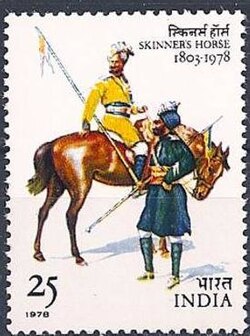
- Nickname: The "Yellow Boys" or "Canaries," derived from their historic mustard-yellow uniforms.
- Current Equipment: T-72 Main Battle Tanks.
- Allegiance: British India (1803–1947), Dominion of India (1947–1950), and the Republic of India (1950–present).
Formation and Early History
The regiment was born out of the Anglo-Maratha War of 1803. After being dismissed from service by Daulat Rao Sindhia, James Skinner was recruited by Lord Lake to raise a regiment of Irregular Cavalry—units that operated with more flexibility than standard regular cavalry. On February 23, 1803, the regiment was officially raised at Hansi, Haryana, for the East India Company.
The initial force consisted of 800 men from Perron's Horse, many of whom were old Muslim comrades of Skinner. The regiment was designed to preserve the traditions of the Mughal Empire's cavalry, serving a political purpose by absorbing skilled horsemen who might otherwise have become disaffected plunderers. This heritage gave the unit an appearance and style reminiscent of the conquering Moguls of Timour.
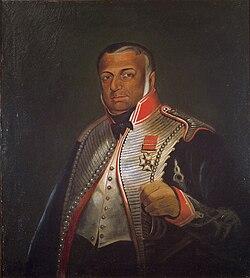
A second regiment was raised by Colonel Skinner in 1814, which later became the 3rd Skinner's Horse. Over the next century, these units participated in numerous pivotal conflicts, including the First and Second Afghan Wars and the First and Second Sikh Wars. During the Indian Mutiny of 1857, the 1st Skinner's Horse remained loyal, distinguishing itself in the Ravi River district at Chichawatni.
Evolution of Composition and Lineage
The ethnic and social makeup of the regiment shifted significantly over time. In 1864, the unit comprised troops of Muslims, Dogras, Sikhs, Jats, Rajputs, and Brahmins. By the end of World War I, the composition had shifted toward Hindustani Muslims, Moghuls, Ranghars, Syeds, and Pathans. Following the partition of India in 1947, the Hindustani Muslim and Ranghar squadrons were transferred to the Pakistan Armoured Corps in exchange for a Sikh Squadron. Today, the regiment primarily recruits Jats, Sikhs, and Rajputs.
| Period/Year | 1st Lancers Lineage | 3rd Skinner's Horse Lineage |
|---|---|---|
| 1803/1814 | Captain Skinner's Corps of Irregular Horse | Second Corps of Lt-Col Skinner's Irregular Horse |
| 1840 | 1st Bengal Irregular Cavalry | 4th Bengal Irregular Cavalry |
| 1861 | 1st Regiment of Bengal Cavalry | 3rd Regiment of Bengal Cavalry |
| 1903 | 1st Duke of York's Own Lancers (Skinner's Horse) | 3rd Skinner's Horse |
| 1921/1922 | Amalgamated as Skinner's Horse (1st Duke of York's Own Cavalry) | |
| 1950 | Designated as 1st Horse (Skinner's Horse) |
Global Engagements and World Wars
The regiment's operational history spans continents. During World War I, the 3rd regiment served in France and Flanders, earning battle honours for its performance before moving to Mesopotamia and eventually returning to India to defend the post at Gumbaz against attacks in 1918.
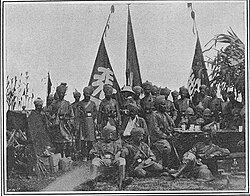
In World War II, the regiment fought across East Africa, North Africa, and Italy. They were awarded battle honours for actions at Agordat, Keren, Amba-Alagi, and the Senio Flood Bank. This era marked a transition in equipment and organization, as the regiment moved away from the traditional sillidar-system (where troopers provided their own horses) to a fully regularized government-issue system.
Post-Independence and Modern Era
After 1947, the regiment continued to serve the Republic of India. During the Indo-Pakistani War of 1965, the unit utilized Sherman tanks, with B Squadron providing critical support to the 50th Parachute Brigade near Dograi. The regiment later modernized its arsenal, converting to T-54 and T-55 tanks before finally adopting the T-72 tanks in 1979.
The regiment also participated in Operation Polo (the Hyderabad Police Action) and the Indo-Pakistani War of 1971, where several members were awarded the Sena Medal for gallantry.
The "Yellow Boys" Uniform
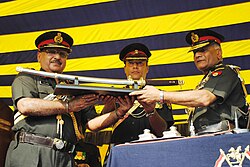
The regiment is most famous for its historic uniforms. The 1st Lancers wore a unique mustard-yellow dress, which earned them the nicknames "Canaries" or "Yellow Boys." This attire included a long Kurta (a traditional long shirt), a turban, and a cummerbund. While these uniforms fell out of general use after 1914, the historic yellow and black colors were restored in 1931. Today, these uniforms are preserved in the National Army Museum.
Frequently Asked Questions
Who founded Skinner's Horse?
The regiment was founded by Colonel James Skinner, also known as "Sikander Sahib," on February 23, 1803, at the request of Lord Lake.
Why is the regiment called the "Yellow Boys"?
The nickname comes from the unique mustard-yellow uniforms worn by the 1st Lancers, a color scheme that was rare within the British Empire.
What equipment does the regiment use today?
The regiment has evolved from irregular cavalry on horseback to a modern armored unit currently equipped with T-72 tanks.
What is the significance of the motto "Himmat e Mardaan Madad e Khuda"?
The motto translates to "The bravery of man is by the help of God," reflecting the regiment's spiritual and professional ethos.
Which major wars has the regiment participated in?
The regiment has seen action in the Anglo-Maratha War, the Afghan and Sikh Wars, World War I, World War II, and the Indo-Pakistani Wars of 1965 and 1971.