Skiffs: A History of Versatile Small Craft Across the Globe
The skiff is a versatile term used to describe a variety of small boats across different cultures and geographies. From the winding rivers of England to the coastal waters of the Americas, these craft have served as essential tools for fishing, transport, and leisure for centuries. While their designs vary—ranging from round-bottomed rowing boats to flat-bottomed fishing vessels—they share a common identity as agile, open-decked boats.
The Skiff in the United Kingdom
In the United Kingdom, skiffs have historically encompassed a wide range of styles, including double-ended rowing boats and small sailing vessels used in both river and sea environments. Literary references highlight their long-standing presence; John Milton mentioned a "night foundered skiff" in Paradise Lost as early as 1670. By the early 19th century, records show skiffs were common on the River Thames and in Oxford.
The poet Percy Bysshe Shelley was a notable enthusiast of the craft. In 1815, he embarked on a skiff expedition from Old Windsor to Lechlade. Later, while living in Marlow, he frequently rowed his skiff through the locks. Tragically, Shelley eventually drowned while sailing a skiff off the coast of Italy. The craft also appears in the works of Sir Walter Scott, specifically in The Lady of the Lake.
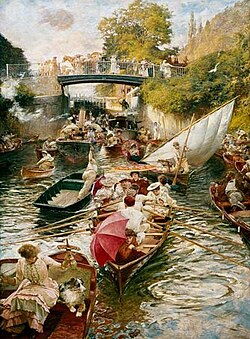
By the early 1800s, the Thames skiff emerged as a formalized design. This specific type is a round-bottomed, clinker-built boat—a method of construction where the edges of hull planks overlap. These boats became a staple of Victorian leisure, famously depicted in Jerome K. Jerome's Three Men in a Boat. These versatile vessels could be equipped with sails and were often used for camping trips.
Modern Usage and Regional Variations
While general usage has declined, skiffs remain popular for leisure and competitive racing. Various riverside towns in England still host skiffing regattas, with the Skiff Championships Regatta at Henley serving as the premier event. Similar traditions exist in Northern Ireland, where regattas are held in Portadown and throughout County Down.
Related craft include the yoal (or yole), a clinker-built fishing boat used in the Orkney and Shetland Islands. The yoal is a derivative of the Norwegian Oselvar. Internationally, terminology varies: the French yole is a leisure craft similar to the Thames skiff, whereas the French skiff, as well as the Dutch and German terms, refers specifically to a single scull. In Czech, skif refers to sculling boats in general.
Skiffs in the Americas
In the Americas, the term skiff typically refers to small, sea-going fishing boats. This usage is immortalized in classic literature, appearing in Herman Melville's Moby-Dick and Ernest Hemingway's The Old Man and the Sea. These vessels may be powered by either oars or sails.
A distinct American variation is the small, flat-bottomed open boat. Characterized by a pointed bow and a flat stern, this design was originally developed as an affordable, easy-to-build option for inshore fishermen. While initially designed for rowing, these boats have evolved to accommodate outboard motors. They continue to be used today for both professional work and recreation, constructed from wood or modern materials.
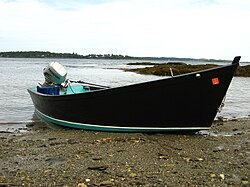
In Mexico and Central America, a similar style of craft is known as a panga.
Key Facts
- Thames Skiff: A round-bottomed, clinker-built rowing boat popular in Victorian England.
- Construction: Clinker-built refers to overlapping hull planks; American skiffs are often flat-bottomed.
- Literary Ties: Mentioned by John Milton, Percy Bysshe Shelley, Herman Melville, and Ernest Hemingway.
- Regional Names: Known as a yoal in the Orkney/Shetland Islands and a panga in Central America/Mexico.
- Modern Use: Used for leisure, professional inshore fishing, and competitive regattas (e.g., Henley).
Summary of Skiff Types
| Region | Common Design | Primary Use | Key Characteristic |
|---|---|---|---|
| UK (Thames) | Round-bottomed | Leisure / Racing | Clinker-built |
| UK (Orkney/Shetland) | Yoal / Yole | Fishing | Norwegian Oselvar derivative |
| Americas | Flat-bottomed | Inshore Fishing | Pointed bow, flat stern |
| Central America | Panga | Fishing / Utility | Similar to American flat-bottom |
Frequently Asked Questions
What does "clinker-built" mean?
Clinker-built refers to a method of boat construction where the edges of the hull planks overlap each other, creating a stepped effect on the exterior of the boat.
How does a Thames skiff differ from an American skiff?
A Thames skiff is typically round-bottomed and clinker-built for river use, whereas an American skiff is often flat-bottomed with a pointed bow and flat stern, designed for inshore sea fishing.
What is a panga?
A panga is a style of small craft used in Mexico and Central America that is similar in design to the flat-bottomed skiffs found in the Americas.
Are skiffs still used for racing today?
Yes, skiffing regattas are still held in England, with the Skiff Championships Regatta at Henley being a major event. Regattas are also held in Northern Ireland, including in Portadown.
Which famous authors have written about skiffs?
Skiffs appear in the works of John Milton (Paradise Lost), Percy Bysshe Shelley, Sir Walter Scott (The Lady of the Lake), Jerome K. Jerome (Three Men in a Boat), Herman Melville (Moby-Dick), and Ernest Hemingway (The Old Man and the Sea).