Six Flags Over Texas: The History of the State's Sovereign Rulers
The phrase "Six Flags Over Texas" is more than just a popular slogan; it is a historical summary of the complex geopolitical shifts that shaped the current territory of the U.S. state of Texas. Over several centuries, six different nations have exercised control over some or all of the region, each leaving a distinct mark on the land's cultural and political identity.
From early European exploration to the establishment of a sovereign republic and eventual integration into the United States, the transition of power in Texas reflects the broader history of North American colonization and conflict.

Key Facts
- Six Nations: Spain, France, Mexico, the Republic of Texas, the Confederate States, and the United States.
- Timeline: Sovereignty shifted from the early 16th century (1519) to the present day.
- Official Recognition: The Texas Historical Commission standardized the designs of these six flags in 1997.
- Cultural Impact: The slogan inspired the Six Flags theme park chain and is featured on the reverse of the Seal of Texas.
The Chronology of Sovereignty
The governance of Texas was rarely static, with power shifting between European empires and emerging republics. The sequence of control began with Spain, which held the territory for the majority of the early colonial period, interrupted briefly by French interests.
The Colonial Era
Spain first established control from 1519 to 1685 and again from 1690 to 1821. During a brief window between 1685 and 1690, France held sway over the region. By 1821, control shifted to Mexico, which governed the territory until 1836.
Independence and Integration
In 1836, the Republic of Texas was formed, operating as an independent nation until 1845, when it joined the United States. This American control was interrupted from 1861 to 1865 when Texas joined the Confederate States during the American Civil War, before returning to the United States in 1865.
Symbols and Legacy in Modern Texas
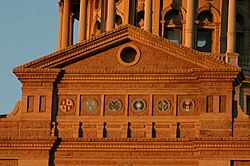
The legacy of these six nations is woven into the physical landscape of Texas. The six flags are prominently displayed at state welcome centers on the borders of Oklahoma, New Mexico, Mexico, Louisiana, and Arkansas. In the capital city of Austin, the Bullock Texas State History Museum flies the flags, and the Texas State Capitol features the six coats of arms on its northern façade.
Further academic tributes can be found at the University of Texas at Austin Life Sciences Library. This site displays plaster emblems of each coat of arms accompanied by excerpts from the respective constitutions of the six nations.
| Nation | Period(s) of Control |
|---|---|
| Spain | 1519–1685; 1690–1821 |
| France | 1685–1690 |
| Mexico | 1821–1836 |
| Republic of Texas | 1836–1845 |
| United States | 1845–1861; 1865–Present |
| Confederate States | 1861–1865 |
The Debate Over a Seventh Flag
While the "Six Flags" narrative is the standard, some historians and local governments point to a potential seventh: the Republic of the Rio Grande. This short-lived entity is not included in the official state count because it claimed part of the same territory as the Republic of Texas in 1840.
Despite its exclusion from the official six, the Republic of the Rio Grande remains a point of local pride in cities like Laredo, which served as the republic's capital.
Frequently Asked Questions
Which six nations have ruled Texas?
The six nations are Spain, France, Mexico, the Republic of Texas, the Confederate States, and the United States.
Why is the Republic of the Rio Grande not counted as one of the six flags?
It is excluded because it claimed the same territory as the Republic of Texas in 1840, leading to a conflict of overlapping claims rather than a distinct sequence of sovereignty.
Where can I see the six coats of arms in Austin?
The six coats of arms are displayed on the northern façade of the Texas State Capitol and as plaster emblems in the University of Texas at Austin Life Sciences Library.
Does the Six Flags theme park still fly the six historical flags?
No. In 2017, the Six Flags Over Texas park in Arlington replaced the six historical flags with six American flags to remove symbols associated with secessionists.
When were the official designs for the six flags standardized?
The Texas Historical Commission adopted the standard designs for representing the six flags in 1997.