Sir John Shea: A Distinguished Career in the British and Indian Armies
General Sir John Stuart Mackenzie Shea was a pivotal figure in the British military establishment, serving with distinction across several continents and conflicts. From his early days in the Royal Irish Regiment to his high-ranking commands in India and the Middle East, Shea's career spanned over four decades of imperial military history. He is perhaps best remembered for his leadership during the First World War, particularly his role in the surrender of Jerusalem.
Key Facts
- Full Name: General Sir John Stuart Mackenzie Shea, GCB, KCMG, DSO.
- Lifespan: 17 January 1869 – 1 May 1966 (aged 97).
- Primary Service: British Army and British Indian Army (1888–1932).
- Major Conflicts: Chitral Expedition, Second Boer War, and World War I.
- Notable Achievement: Received the keys to Jerusalem on 9 December 1917.
- Post-Military Role: Commissioner for London Boy Scouts (1936–1948).
Early Life and Rise Through the Ranks
Born in St John's, Newfoundland, Canada, Shea was educated at Sedbergh School and the Royal Military College, Sandhurst. He began his professional military journey in February 1888 when he was commissioned as a second lieutenant in the Royal Irish Regiment.
In 1891, Shea transferred to the British Indian Army, joining the 15th Bengal Lancers. His early career was marked by active service, including the Chitral Expedition in 1895. By 1899, he had attained the rank of captain, just as the Second Boer War broke out in South Africa.
During the Boer War, Shea demonstrated exceptional bravery by leading 200 South Australians in a night attack on the laager (a fortified camp) of Commandant Jan Smuts. This action earned him the Distinguished Service Order (DSO). His continued service led to a brevet promotion to major in 1902, and by 1906, he was serving as an instructor at the Staff College in Quetta.
Leadership in the First World War
When World War I erupted in 1914, Shea initially served as a General Staff Officer 2nd grade (GSO2) with the British Expeditionary Force (BEF). He quickly rose in responsibility, becoming the General Staff Officer 1st grade (GSO1)—essentially the chief of staff—for the 6th Division in December 1914.
By July 1915, Shea was promoted to temporary brigadier general, taking command of the 151st (Durham Light Infantry) Brigade of the 50th (Northumbrian) Division. This was a Territorial Force formation, consisting of part-time soldiers who had been mobilized for the Western Front.
Shea's leadership expanded in May 1916 when he became the general officer commanding (GOC) of the 30th Division, a formation of Kitchener's Army (volunteer forces raised for the war). He led this division through some of the most grueling engagements of the war, including the Battle of the Somme in 1916 and the Battle of Arras in 1917.
The Middle Eastern Theatre and Jerusalem
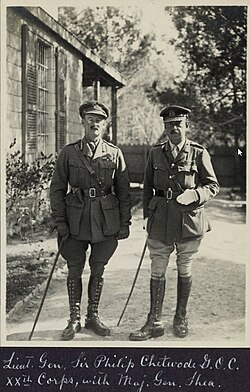
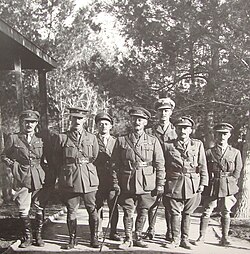
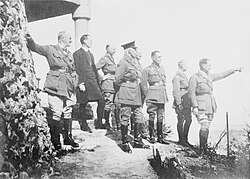
In August 1917, Shea was transferred to Palestine to lead the 60th (2/2nd London) Division. Under his command, the division fought in the Battle of Mughar Ridge (November 1917), the Battle of Jerusalem (December 1917), and the First Battle of Amman (March 1918).
A defining moment of his career occurred on 9 December 1917. While other generals declined the responsibility, Shea accepted the keys to the city of Jerusalem from Mayor Hussein al-Husayni, formally symbolizing the city's surrender.
For his contributions during the war, Shea was appointed a Knight Commander of the Order of St Michael and St George in the 1919 New Year Honours.
Post-War Commands and Retirement
Following the Armistice, Shea continued to hold high-level commands. He served as a corps commander in Palestine in 1918 and led the 3rd (Indian) Division in 1919. In 1921, he was promoted to lieutenant general and appointed GOC of the Central Provinces District in India.
His final years of active service were spent in senior administrative and strategic roles, serving as the adjutant general of India in 1924 and eventually as the General Officer Commanding-in-Chief of Eastern Command, India, in 1928. He retired from the army in 1932.
In his retirement, Shea remained active in public service, serving as the Commissioner for London Boy Scouts from 1936 until 1948. He passed away in Fulham, London, in 1966 at the age of 97.
Career Summary
| Period/Year | Rank/Role | Command/Assignment |
|---|---|---|
| 1888 | Second Lieutenant | Royal Irish Regiment |
| 1891 | Lieutenant | 15th Bengal Lancers (Indian Army) |
| 1906 | Major | Instructor, Staff College, Quetta |
| 1915 | Brigadier General | 151st Brigade, 50th Division |
| 1916 | Major General | 30th Division (Battle of the Somme) |
| 1917 | Major General | 60th Division (Battle of Jerusalem) |
| 1921 | Lieutenant General | Central Provinces District, India |
| 1928 | General | GOC-in-C, Eastern Command, India |
Frequently Asked Questions
What was Sir John Shea's most famous achievement?
Sir John Shea is most noted for receiving the keys to Jerusalem on 9 December 1917, an act that symbolized the city's surrender during the First World War.
Which conflicts did General Shea participate in?
He saw active service in the Chitral Expedition (1895), the Second Boer War in South Africa, and the First World War on both the Western Front and in the Middle East.
What awards did Sir John Shea receive?
He was awarded the Knight Grand Cross of the Order of the Bath (GCB), the Knight Commander of the Order of St Michael and St George (KCMG), and the Distinguished Service Order (DSO).
What did Sir John Shea do after retiring from the army?
After retiring in 1932, he served as the Commissioner for London Boy Scouts from 1936 to 1948.
Which divisions did he command during World War I?
He commanded the 151st Brigade, the 30th Division (leading them at the Somme and Arras), and the 60th Division (leading them in Palestine).