Sir Geoffrey Vickers: From Victoria Cross Hero to Systems Thinking Pioneer
Sir Geoffrey Vickers lived a life of remarkable duality, transitioning from the visceral intensity of the front lines in two World Wars to the intellectual rigor of law and social science. While many know him as a decorated war hero, his lasting legacy lies in his contributions to systems thinking—the study of how complex components interact within a whole—and his development of the concept of Appreciative Systems.
Early Life and Education
Born and raised in Nottingham, Geoffrey Vickers grew up in a supportive environment. His father, Charles Henry Vickers, managed Vickers & Hine Ltd, a successful lace business. Geoffrey recalled his childhood as a time of "unalloyed happiness," characterized by simple pleasures like cycling and staying in farmhouses, and a deep admiration for his father.
His formal education began at Bramcote, a preparatory school near Scarborough, followed by Oundle School. He eventually entered Merton College, Oxford, in 1913 to study Classics, though his academic pursuits were soon interrupted by global conflict.
Military Valor in World War I
When Germany invaded Belgium in August 1914, Geoffrey and his brother, William Burnell Vickers, volunteered for army service. Geoffrey joined the Sherwood Foresters (7th Robin Hood Battalion) and was deployed to France by the end of 1914. He rose steadily through the ranks, from second lieutenant to temporary captain in 1915, and eventually to major as second in command of the 1 Bn, The Lincolnshire Regiment by 1918.
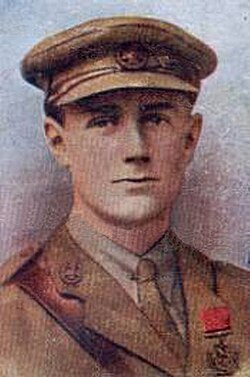
Vickers is most remembered for his extraordinary bravery on October 14, 1915, at the Hohenzollern redoubt. Despite most of his men being killed or wounded, Captain Vickers held a barrier for several hours against heavy German attacks. He prioritized the safety of the trench by ordering a second barrier to be built behind him, even though doing so cut off his own route of retreat. He was severely wounded during the action, but his determination saved a critical situation.
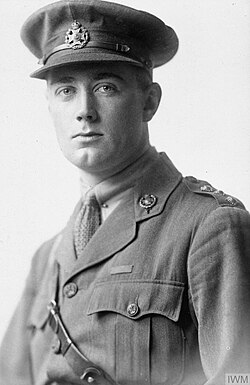
For these actions, he was awarded the Victoria Cross (VC), the highest award for gallantry in the face of the enemy. He also received the Belgian Croix de Guerre in 1918 after commanding a composite battalion during the Second Battle of the Marne. Tragically, his brother Burnell was killed in action on June 21, 1917, while serving with the 184th Siege Battery of the Royal Garrison Artillery.
Inter-war Career and Intellectual Growth
Following the war, Vickers returned to Oxford, earning a pass degree in law, European history, and French in 1919. He qualified as a solicitor in 1923 and became a partner at the prestigious London law firm Slaughter and May by 1926. He specialized in international financial operations and was involved in negotiating the extension of German debt during the 1930s.
Beyond law, Vickers was an early adopter of aviation, taking one of the first five-day Imperial Airways flights from the UK to India in 1930. In 1938, he founded and chaired the Association for Service and Reconstruction, which led him to "The Moot," an intellectual circle including T. S. Eliot, Michael Polanyi, and Karl Mannheim.
Service in World War II and Public Administration
Vickers returned to service during World War II, re-commissioned as a colonel. He served as the Deputy Director General at the Ministry of Economic Warfare, where he managed economic intelligence. From 1941 to 1945, he contributed his expertise to the Joint Intelligence Committee of the Chiefs of Staff.
His administrative capabilities were further recognized through appointments to the London Passenger Transport Board (1942–46) and the Council of Law Society (1938–50).
Pioneering Systems Thinking and Later Years
In the post-war era, Vickers shifted his focus toward management and social organization. He became a prolific author and speaker, introducing Appreciative Systems—a framework used to describe human activity and social systems analysis. His influential books include The Art of Judgement, Freedom in a Rocking Boat, and Human Systems are Different.
His professional contributions extended to several high-level roles:
- National Coal Board: Served as the first Legal Advisor (1946–48) during the nationalization of 800 private companies, and later managed manpower, training, and welfare (1948–55).
- Medical Research: Member of the Medical Research Council (1952–60) and chairman of the Research Committee of the Mental Health Research Fund (1951–67).
- Systems Science: President of the Society for General Systems Research (now the International Society for the Systems Sciences) in 1977.
Vickers also participated in the "Round Table on Man and Industry" (1955–1958) via the University of Toronto, which resulted in the publication The Undirected Society. This work questioned the role of human decision-making in an increasingly automated industrial world.
Key Facts
- Highest Military Honor: Awarded the Victoria Cross for bravery at the Hohenzollern redoubt in 1915.
- Legal Expertise: Partner at Slaughter and May, specializing in international finance.
- Intellectual Contribution: Developed the concept of "Appreciative Systems" for social organization.
- Public Service: Deputy Director General at the Ministry of Economic Warfare during WWII.
- Legacy: The International Society for the Systems Sciences maintains the Sir Geoffrey Vickers Memorial Award.
| Period | Role/Achievement | Key Organization/Event |
|---|---|---|
| 1914–1918 | Major / Victoria Cross Recipient | World War I (Sherwood Foresters) |
| 1926 | Partner | Slaughter and May |
| 1941–1945 | Deputy Director General | Ministry of Economic Warfare |
| 1946–1955 | Legal Advisor / Board Member | National Coal Board |
| 1977 | President | Society for General Systems Research |
Frequently Asked Questions
Why was Geoffrey Vickers awarded the Victoria Cross?
He was awarded the VC for his conspicuous bravery on October 14, 1915, when he held a barrier against heavy German attacks for several hours and ensured the construction of a second barrier to protect the trench, despite being severely wounded and cutting off his own retreat.
What are "Appreciative Systems"?
Appreciative Systems is a concept introduced by Vickers to describe and analyze human activity and the complex patterns of social organization, focusing on how people perceive and interact within social systems.
What role did he play in the National Coal Board?
Vickers was the first Legal Advisor to the National Coal Board during its creation in 1947, overseeing the transition of 750,000 workers from 800 private companies. He later managed manpower, education, health, and welfare for the board from 1948 to 1955.
Where can his legacy be found today?
His military medals are displayed in Nottingham Castle as part of the Sherwood Foresters Collection, his systems thinking papers are archived at the Open University, and he is honored annually through the Sir Geoffrey Vickers Memorial Award.