Sir Edmund Whittaker: A Legacy of Mathematics, Physics, and Science History
Sir Edmund Taylor Whittaker (1873–1956) was a towering figure in early 20th-century scholarship. A British mathematician, physicist, and historian of science, Whittaker's influence spanned multiple disciplines, from the abstract realms of special functions—mathematical functions that solve specific differential equations—to the practical foundations of modern digital signal processing.
Throughout his distinguished career, Whittaker was recognized not only for his research in mathematical physics and numerical analysis but also for his profound contributions to astronomy, celestial mechanics, and the history of physics. His ability to bridge the gap between pure mathematics and applied science made him one of the most versatile scholars of his era.
Key Facts
- Primary Fields: Mathematics, Astronomy, Mathematical Physics, and History of Science.
- Major Academic Posts: Chair of Mathematics at the University of Edinburgh and Royal Astronomer of Ireland.
- Key Contributions: The Whittaker-Shannon interpolation formula, Whittaker functions, and the concept of rapidity.
- Top Honors: Copley Medal (1954), De Morgan Medal (1935), and Sylvester Medal (1931).
- Education: Trinity College, Cambridge, where he graduated as Second Wrangler in 1895.
Early Life and Academic Foundation
Born on October 24, 1873, in Southport, Lancashire, Whittaker's academic journey began at the Manchester Grammar School before he earned an entrance scholarship to Trinity College, Cambridge, in 1891. Under the guidance of Andrew Russell Forsyth and George Howard Darwin, he developed a keen interest in applied mathematics.
Whittaker's undergraduate years were marked by exceptional achievement. He won the Sheepshanks Astronomical Exhibition in 1894 and the Tyson Medal for Mathematics and Astronomy in 1896. In 1895, he achieved the rank of Second Wrangler in the prestigious Cambridge Tripos examination, tying with John Hilton Grace.
Professional Career and Institutional Leadership
Whittaker's career was defined by a series of prestigious appointments across the United Kingdom. After serving as a Fellow of Trinity College, Cambridge, from 1896 to 1906, he moved to Trinity College Dublin, where he served as the Andrews Professor of Astronomy and the Royal Astronomer of Ireland until 1912.
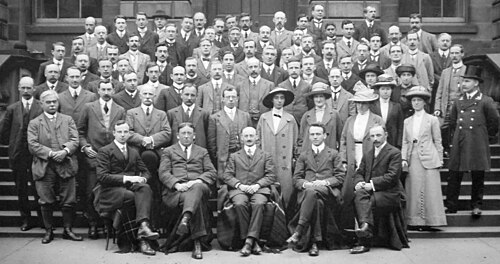
In January 1912, Whittaker began his longest tenure as the Professor of Mathematics at the University of Edinburgh. He remained in this role for over 35 years, where he became a beloved lecturer known for his clear diction and enthusiasm. He also played a pivotal role in the Royal Society of Edinburgh, serving as its President from 1939 to 1944.
Academic Influence and Mentorship
Whittaker's influence extended to a generation of brilliant minds. His doctoral students included G. H. Hardy and G. N. Watson, while other notable students who benefited from his guidance included Freeman Dyson, Arthur Eddington, and James Jeans.
Scientific Contributions and Legacy
Whittaker's research was vast and varied. In pure mathematics, he focused on automorphic functions and special functions. In applied fields, he made significant strides in electromagnetism, general relativity, and numerical analysis. He is perhaps most remembered today in the field of digital signal processing for the Whittaker–Nyquist–Kotelnikov–Shannon theorem and the associated interpolation formula.
Beyond his formulas, Whittaker was a prolific author. His bibliography includes 11 books and monographs, 56 mathematics and physics articles, and numerous works on philosophy and the history of science, including his influential work on the theories of aether and electricity.
Summary of Career and Achievements
| Category | Details |
|---|---|
| Education | Trinity College, Cambridge (Second Wrangler, 1895) |
| Key Roles | Royal Astronomer of Ireland; Professor of Mathematics, University of Edinburgh |
| Major Awards | Copley Medal, De Morgan Medal, Sylvester Medal, Smith's Prize |
| Notable Works | A History of the Theories of Aether and Electricity; Analytical Dynamics of Particles and Rigid Bodies |
| Fellowships | FRS (1905), FRSE (1912) |
Personal Life and Final Years
In 1901, Whittaker married Mary Ferguson Macnaghten Boyd. Together they had five children, including the mathematician John Macnaghten Whittaker. Whittaker's interests were not limited to science; he spent significant time exploring philosophy and theology.
Sir Edmund Whittaker passed away on March 24, 1956, at his home in George Square, Edinburgh. In a final nod to his lifelong pursuit of accuracy, he was buried at Mount Vernon Cemetery at a depth of exactly 6 feet 6 inches.
Frequently Asked Questions
What is the Whittaker-Shannon interpolation formula?
It is a fundamental formula in digital signal processing used to reconstruct a continuous signal from a discrete set of samples, provided the sampling rate is sufficient.
Which universities did Sir Edmund Whittaker serve?
He held major academic positions at Trinity College Cambridge, Trinity College Dublin, and the University of Edinburgh.
What were some of Whittaker's most prestigious awards?
He received the Copley Medal in 1954, the De Morgan Medal in 1935, and the Sylvester Medal in 1931, among others.
Who were some of the notable students taught by Whittaker?
His students and mentees included world-renowned scientists such as Freeman Dyson, Arthur Eddington, and G. H. Hardy.
What was Whittaker's contribution to the history of science?
He wrote extensively on the history of physics, most notably in his comprehensive work regarding the theories of aether and electricity.