Sir Basil Embry: The Gallant Commander of the Royal Air Force
Air Chief Marshal Sir Basil Edward Embry was a distinguished senior commander of the Royal Air Force (RAF) whose career spanned the interwar years and the height of the Second World War. Known for his unconventional flair, personal bravery, and outspoken nature, Embry rose through the ranks to lead some of the most critical air commands in British history, including Fighter Command.
Key Facts
- Highest Rank: Air Chief Marshal.
- Major Commands: Commander-in-Chief of Fighter Command (1949–1953) and Allied Air Forces Central Europe (1953–1956).
- War Record: Served in the North-West Frontier, the Norwegian Campaign, and the Battle of France.
- Notable Feat: Escaped from German captivity in 1940, evading recapture for two months in occupied France.
- Post-Military Life: Emigrated to Western Australia to become a sheep farmer and agricultural political leader.
Early Life and Rise Through the Ranks
Born in Gloucestershire, England, in 1902, Basil Embry developed a passion for aviation during his time at Bromsgrove School. He joined the RAF in 1921 with a short service commission as an acting pilot officer. His early career took him to Mandatory Iraq in 1922, where he served under future Air Marshals Arthur Harris and Robert Saundby.
By 1926, Embry's energy and professional application earned him a permanent commission and the Air Force Cross. After a stint as an instructor at the Central Flying School in Uxbridge, he was posted to India in 1934 to serve in the Indian Wing on the North West Frontier. His service during the Second Mohmand Campaign of 1935 and operations in Waziristan led to his appointment as a Companion of the Distinguished Service Order (DSO) in 1938.
Combat Leadership in the Second World War
At the start of the Second World War, Embry commanded No. 107 Squadron, flying the Bristol Blenheim (a light bomber and reconnaissance aircraft). He led from the front during the Norwegian and French campaigns, often facing overwhelming opposition. In September 1939, he survived a reconnaissance mission into Germany that left his aircraft severely damaged, forcing a one-wheel landing at RAF Wattisham.
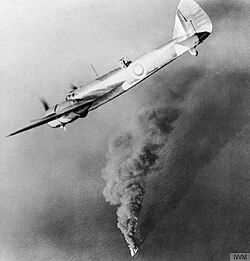
During the Norwegian Campaign, Embry's squadron conducted ten raids in eight days against Stavanger and surrounding airfields, an ordeal that left him suffering from frostbite. As the Battle of France intensified in May 1940, Embry led intensive sorties across the English Channel. On May 12, he led an attack on bridges across the Albert Canal at Maastricht, a mission that saw heavy losses due to ground fire and Messerschmitt fighters.
Capture and Great Escape
On May 27, 1940, during a low-level bombing mission over Saint-Omer, Embry was shot down by anti-aircraft fire. Captured by the German Army, he spotted a road sign reading "Embry, 3 km" while being marched with other prisoners. Viewing this as a sign, he escaped the column and spent two months evading capture in occupied France before successfully returning to England via Spain and Gibraltar. This adventure was later chronicated in the book Wingless Victory.
Command of No. 2 Group and Tactical Innovation
After serving as an adviser to the Desert Air Force in North Africa, Embry took command of No. 2 Group Bomber Command in June 1943. Despite his rank as Air Vice Marshal, he continued to fly operational missions under the pseudonym "Wing Commander Smith." He believed that piloting every aircraft in his service was the only way to truly understand the tools available to his crews.
Embry was a fervent advocate for the De Havilland Mosquito FB VI, a high-speed multi-role aircraft. Under his leadership, No. 2 Group became highly effective in precision daylight bombing. His command targeted V-1 flying bomb sites in France and conducted high-profile raids, including the attack on Amiens jail and the Aarhus Air Raid in Denmark, which targeted the Gestapo headquarters.
| Period | Role/Command | Key Conflict/Location |
|---|---|---|
| 1922–1926 | Pilot Officer / Flight Lieutenant | Mandatory Iraq |
| 1934–1939 | Squadron Leader / Wing Commander | North West Frontier (India) |
| 1939–1940 | CO, No. 107 Squadron | Norway and France |
| 1943–1945 | Air Vice Marshal, No. 2 Group | Western Europe / Denmark |
| 1949–1953 | C-in-C, Fighter Command | United Kingdom |
| 1953–1956 | C-in-C, Allied Air Forces Central Europe | NATO / Central Europe |
Post-War Life and Legacy
Following the war, Embry held several high-ranking positions, including Commander-in-Chief of Fighter Command. However, his tendency for frank and unguarded criticism of the NATO chain of command led to his early retirement from the RAF in 1956.
Embry emigrated to Western Australia with his wife, Margaret, where he transitioned from military command to agriculture. He purchased a 1,400-acre sheep property at Chowerup and later moved to Cape Riche. He remained active in public life, serving as the General President of the Farmers' Union of Western Australia from 1971 to 1973. He also served as the president of the Royal Air Forces Escaping Society before his death in Boyup Brook in 1977.
Frequently Asked Questions
How did Sir Basil Embry escape from German captivity?
While being marched as a prisoner of war in 1940, Embry saw a road sign for a town called "Embry." Taking this as a good omen, he rolled down a bank to escape the guards and spent two months evading recapture in occupied France.
What aircraft was Sir Basil Embry most associated with during the war?
While he began the war flying the Bristol Blenheim, he is highly noted for pushing the re-equipment of No. 2 Group with the high-speed De Havilland Mosquito FB VI.
Why did Sir Basil Embry retire early from the RAF?
His retirement in 1956 was precipitated by his outspoken and critical views regarding the organization and chain of command within NATO.
What did Sir Basil Embry do after leaving the military?
He emigrated to Western Australia, where he became a sheep farmer and a leader in agricultural politics, eventually serving as the General President of the Farmers' Union of Western Australia.
Which international honors did he receive?
Beyond his British knighthoods and medals, he was honored by France (Legion of Honour, Croix de guerre), Denmark (Order of the Dannebrog), and the Netherlands (Order of Orange Nassau).