Signal Lamps: The Evolution of Optical Communication
Long before the digital age, the ability to transmit messages across vast distances using light was a critical strategic advantage. Signal lamps emerged as a sophisticated second generation of communication, evolving from traditional flag signals to high-intensity light beams capable of cutting through the dark and the fog of war.
The Origins of Naval Light Signaling
The Royal Navy pioneered the use of signal lamps in the late 19th century. Prior to this, the Navy relied heavily on flag signals—most notably used to transmit Admiral Nelson's famous rallying cry, "England expects that every man will do his duty," before the Battle of Trafalgar.
In 1867, Captain (and later Vice Admiral) Philip Howard Colomb transformed naval communication by implementing the practice of flashing dots and dashes from a lantern. Colomb's initial design utilized limelight—a high-intensity light produced by heating a mixture of quicklime and calcium chloride—for illumination. While his original code differed from Morse code, the Navy eventually adopted the Morse system for its universality.
Technological Diversification and World War I
As the need for more reliable long-distance communication grew, various lamp designs emerged. One such innovation was the Begbie lamp, which utilized kerosene and a specialized lens to focus light beams over significant distances.
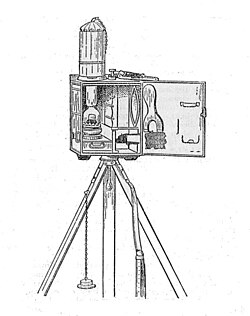
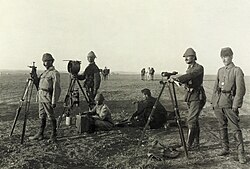
The brutal conditions of World War I further accelerated the development of optical transmitters. During trench warfare, where physical communication wires were frequently severed by shelling, the German military employed three types of optical Morse transmitters known as Blinkgerät. The intermediate model of the Blinkgerät could transmit messages up to 4 km (2.5 mi) during the day and up to 8 km (5 mi) at night. To avoid detection by enemy forces, these devices often used red filters.
Specialized Applications and Modern Innovations
Different military environments required specialized tools. The United States Navy utilized the "Light, Signal, Gun Type" (also known as the Blinker Tube), a device specifically designed for landing parties to communicate with ships while remaining hidden from enemy view.
In 1944, British inventor Arthur Cyril Webb Aldis advanced the technology by patenting a compact, hand-held signal lamp. The Aldis lamp featured an improved shutter mechanism, making it more efficient for rapid signaling.
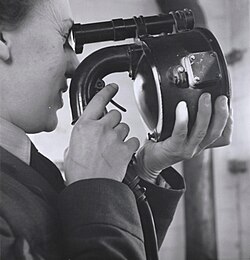
Even in the era of satellite communication, the legacy of the signal lamp persists. As recently as 2017, the United States Navy was experimenting with the automation of signaling lamps to modernize these traditional methods.
Key Facts
- Pioneer: Philip Howard Colomb introduced light signaling to the Royal Navy in 1867.
- Early Tech: Limelight was used in the first designs before the adoption of Morse code.
- WWI Range: German Blinkgerät lamps reached 4 km by day and 8 km by night.
- Stealth: Red filters were used by German forces to prevent detection.
- Innovation: The Aldis lamp, patented in 1944, introduced an improved shutter for hand-held use.
| Lamp Type | Primary User/Inventor | Key Feature | Primary Use Case |
|---|---|---|---|
| Colomb Design | Philip Howard Colomb | Limelight illumination | Early Royal Navy signaling |
| Begbie Lamp | N/A | Kerosene and focusing lens | Long-distance transmission |
| Blinkgerät | German Military | Red filters for stealth | WWI Trench warfare |
| Blinker Tube | US Navy | Low visibility profile | Landing party to ship contact |
| Aldis Lamp | Arthur Cyril Webb Aldis | Improved shutter | Hand-held rapid signaling |
Frequently Asked Questions
What was the primary purpose of the Blinkgerät during World War I?
The Blinkgerät was used by German forces as an optical Morse transmitter during trench warfare, providing a reliable communication method when wire lines were cut.
How did the Aldis lamp improve upon previous designs?
Patented in 1944 by Arthur Cyril Webb Aldis, this lamp was a small, hand-held device that featured a significantly improved shutter for more effective signaling.
Why did the German military use red filters on their signal lamps?
Red filters were employed to ensure that communications remained undetected by the enemy.
Who was responsible for the first practical application of light signaling in the Royal Navy?
Captain (later Vice Admiral) Philip Howard Colomb put the idea of flashing dots and dashes from a lantern into practice in 1867.
Is signal lamp technology still being developed today?
Yes, as of 2017, the United States Navy has been experimenting with the automation of signal lamps.