Shuttleworth Collection Aircraft: A Living History of Aviation
The Shuttleworth Collection stands as one of the world's most prestigious repositories of aviation history, specializing in the preservation of early flight. Unlike many museums where aircraft are static displays, this collection is renowned for maintaining a significant number of its assets in airworthy condition, allowing the roar of early engines to continue echoing through the skies.
The collection spans the entire evolution of flight, from the fragile pioneers of the early 1900s to the high-performance fighters of the Second World War. It includes a diverse array of original machines, meticulous reproductions, and rare survivors that provide an tangible link to the golden age of aviation.
Key Facts
- World's Oldest Airworthy Aircraft: The 1909 Blériot XI holds the title of the oldest flying aircraft in existence.
- Oldest Airworthy British Plane: The 1912 Blackburn Type D is the oldest flying British-built aeroplane.
- Racing Heritage: The collection features legendary racers, including the DH.88 Comet 'Grosvenor House' and the Percival Mew Gull.
- Diverse Fleet: The inventory includes everything from early triplanes and gliders to Soviet Polikarpovs and RAF Spitfires.
- Recent Acquisitions: In 2022, the collection was expanded through donations from the BAE Systems heritage flight.
Early Pioneers and First Flights
The dawn of aviation is represented by aircraft that defined the first decade of flight. The 1909 Blériot XI is a crowning jewel of the collection, representing the era of early monoplanes. Alongside it, the 1910 Deperdussin Type A and the 1912 Blackburn Type D showcase the rapid experimentation of the pre-war period.
The collection also preserves the spirit of early competition. The ANEC II and the English Electric Wren were both built for the 1923 and 1924 Lympne Trials, which were critical events for developing light aircraft efficiency.
The Great War and Interwar Innovation
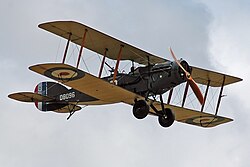
The First World War accelerated aircraft design, and the collection features several iconic combat types. The Royal Aircraft Factory S.E.5a, Sopwith Pup, and Bristol F.2B Fighter represent the cutting edge of 1918 aerial warfare.
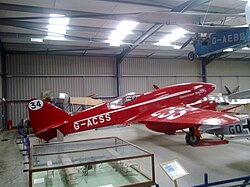
Following the war, the "Golden Age" of aviation saw a surge in private ownership and long-distance racing. The de Havilland DH.60 series, including the Cirrus Moth and the modified Hermes Moth—originally owned by Richard Shuttleworth—illustrates the rise of general aviation. For those seeking speed, the Percival Mew Gull (used by Alex Henshaw for his England to Cape Town record) and the de Havilland DH.88 Comet 'Grosvenor House' represent the pinnacle of 1930s racing technology.
World War II and Post-War Aviation
The collection transitions into the era of high-performance military aviation with legendary fighters like the Supermarine Spitfire LF.Mk.Vc and the Hawker Hurricane. The Hurricane in the collection is particularly notable for its conversion to a Sea Hurricane in 1941.
Beyond the fighters, the collection includes specialized aircraft such as the Westland Lysander Mk.IIIa, used for army cooperation and clandestine operations, and the Polikarpov Po-2, a versatile Soviet aircraft from 1924.
Gliders and Specialized Craft
Aviation history is not limited to powered flight. The collection includes the Elliotts Primary EoN, a primary glider based on the German SG38, and the Slingsby Kirby Kite, used for sport and training. Even the unusual Mignet HM.14 'Flying Flea' is preserved, though it currently remains unairworthy and suspended from the hangar roof.
Collection Summary
| Aircraft Type | Year | Significance |
|---|---|---|
| Blériot XI | 1909 | World's oldest airworthy aircraft |
| Blackburn Type D | 1912 | Oldest airworthy British aeroplane |
| DH.88 Comet | 1934 | Winner of 1934 England-Australia Race |
| Supermarine Spitfire | 1942 | Iconic WWII LF.Mk.Vc fighter |
| Percival Mew Gull | 1934 | England - Cape Town racer |
Frequently Asked Questions
What is the oldest flying aircraft in the collection?
The oldest airworthy aircraft in the collection is the 1909 Blériot XI, while the oldest airworthy British-built aircraft is the 1912 Blackburn Type D.
Are all the aircraft in the collection original?
No, the collection includes a mix of original aircraft and high-quality reproductions. For example, the Roe IV Triplane, Bristol Boxkite, and Sopwith Camel are replicas.
Which aircraft won the England-Australia Race?
The de Havilland DH.88 Comet, known as 'Grosvenor House', won the 1934 England-Australia Race.
What happened to the de Havilland DH.53 Humming Bird?
The DH.53 Humming Bird crashed on July 1, 2012, resulting in the death of the pilot. It is currently awaiting the completion of a rebuild.
How did the BAE Systems aircraft join the collection?
Several aircraft formerly part of the BAE Systems heritage flight were resident at Old Warden; the final three were officially donated to the Shuttleworth Collection in March 2022.