Shia Mourning Rituals: Commemorating the Events of Karbala
For Shia Muslims, the annual commemoration of the events of Karbala is a profound expression of faith, grief, and remembrance. While pilgrimage to the shrine of Husayn in Karbala, Iraq, is a central act of devotion, the months of Muharram and Safar are marked by a series of intense mourning rituals designed to keep the memory of the tragedy alive across generations.
The Structure of Muharram Observances
The majority of these rituals occur during the first ten days of Muharram, reaching a spiritual and emotional peak on Ashura. These observances often center around majalis (singular: majlis), which are mourning gatherings held in dedicated structures known as Husayniya, takiya, imambarah, or azakhana.
The primary purpose of a majlis is to evoke sympathy and tears through the narration of the stories of Karbala, a practice known as rawza-khwani or qiraya. This is complemented by the recitation of nawha, niyaha, or marsia-khwani—rhythmic elegies and dirges that recount the suffering of the martyrs.
Physical Expressions of Grief
Mourning in the Shia tradition often involves physical manifestations of sorrow, rooted in ancient Arab practices. These range from mild to extreme forms of self-flagellation performed to the rhythm of elegies.
- Mild forms: Common practices include latm, sina-zani, or matam, where participants strike their chests or faces in grief.
- Extreme forms: Practices such as tatbir, tiq-zani, or qama-zani involve striking the forehead or back with knives, swords, or chains equipped with razor blades.
It is important to note that instrumental self-flagellation is a subject of significant debate. It has been condemned by many Shia clerics and has been banned in Iran and within Lebanese Shia communities since the mid-1990s.
Dramatic Reenactments and Processions
Beyond the majlis, the tragedy of Karbala is brought to life through ta'ziyeh or shabih-khani. These are dramatic passion plays practiced primarily in Iran, Lebanon, and along the western Gulf shore. On Tasu'a (the ninth day of Muharram), these plays often focus on Abbas ibn Ali, the half-brother and standard-bearer of Husayn.
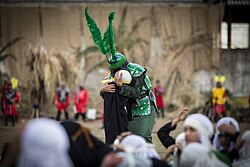
Public processions, known as dasta or mawkib, are another cornerstone of the observance. During Ashura, mourners march through major cities chanting dirges. In Najaf, Iraq, a specific tradition occurs on the evening of Tasu'a, where mourners carry decorative torches toward the shrine of Ali ibn Abi Talib, the first Shia imam.
These processions often feature symbolic objects that represent the events of the battle:
- Alam: A flag representing the ensign of Husayn.
- Nakhl, Ta'ziya, and Tadjah: Objects that symbolize the bier or tomb of Husayn.
Key Facts
- Primary Timing: Rituals occur during Muharram and Safar, peaking on Ashura.
- Core Activities: Storytelling (rawza-khwani), rhythmic elegies (nawha), and dramatic plays (ta'ziyeh).
- Sacred Spaces: Gatherings take place in buildings called Husayniya, takiya, imambarah, or azakhana.
- Symbolism: The alam represents the flag of Husayn, while the nakhl symbolizes his tomb.
- Regional Variations: Rituals vary by location, with specific torchlight processions in Najaf, Iraq.
| Ritual Type | Key Terms | Primary Purpose/Symbolism |
|---|---|---|
| Gatherings | Majalis / Husayniya | Narration of Karbala stories to evoke grief |
| Recitations | Nawha / Marsia-khwani | Rhythmic elegies and dirges |
| Drama | Ta'ziyeh / Shabih-khani | Dramatic reenactment of the Battle of Karbala |
| Physical Grief | Latm / Tatbir | Self-flagellation ranging from chest-striking to instrumental |
| Processions | Dasta / Mawkib | Public marches with symbolic objects (Alam, Nakhl) |
Frequently Asked Questions
What is the difference between latm and tatbir?
Latm refers to mild forms of self-flagellation, such as striking one's chest or face in grief. Tatbir refers to extreme forms involving the use of knives, swords, or razor blades to strike the body.
What is the significance of Tasu'a?
Tasu'a is the ninth day of Muharram. It is often marked by dramatic plays dedicated to Abbas ibn Ali, the standard-bearer for Husayn, and specific processions, such as those in Najaf.
Where are ta'ziyeh plays typically performed?
These dramatic reenactments of the Karbala narratives are primarily practiced in Iran, Lebanon, and the western Gulf shore.
What do the objects carried in processions symbolize?
The alam represents the ensign (flag) of Husayn, while the nakhl, ta'ziya, and tadjah serve as symbols of his bier or tomb.
Are all forms of self-flagellation accepted in Shia communities?
No. While mild forms are common, extreme instrumental self-flagellation is controversial and has been condemned by many clerics; it is banned in Iran and Lebanese Shia communities since the mid-90s.