Sexual Dimorphism: The Biological Divergence of Sexes
In the natural world, members of the same species are not always identical in appearance. Sexual dimorphism is the biological condition where the two sexes of a species exhibit different morphological characteristics. These differences extend beyond the primary reproductive organs to include a wide array of physical, behavioral, and cognitive traits.
This phenomenon is most common in dioecious species—those with distinct male and female individuals—which encompasses the majority of animals and some plant species. When the sexes are phenotypically indistinguishable, the condition is known as monomorphism.
Key Facts
- Scope: Includes differences in size, weight, color, markings, and behavior.
- Drivers: Primarily evolved through sexual selection and natural selection.
- Competition: Male-male competition often leads to "battle" traits like reinforced heads or teeth.
- Display: Ornamental features, such as bright plumage or complex songs, serve as passive mating displays.
- RSD: Reversed Sexual Dimorphism occurs when females are larger or more ornate than males.
Mechanisms of Divergence
Sexual dimorphism is often the result of evolutionary pressures. Male-male reproductive competition frequently drives the development of aggressive utility traits. For example, some species evolve blunt heads that act as battering rams or specialized teeth used as weapons during rivalries.
Conversely, passive displays evolve to attract mates. These include ornamental feathering and song-calling, which are shaped by sexual selection to signal fitness to potential partners.
Examples Across the Animal Kingdom
Birds and Avian Diversity
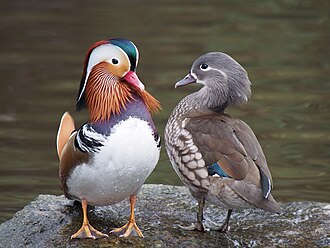
Birds provide some of the most striking examples of sexual dichromatism (differences in color). In many species, males possess vibrant plumage to attract females, while females remain camouflaged to protect the nest.
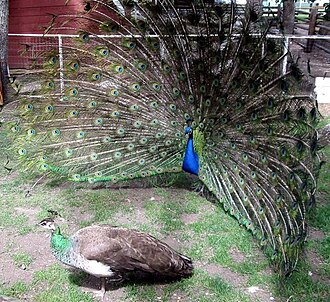
The peacock is a classic example of extreme ornamentation used in courtship.
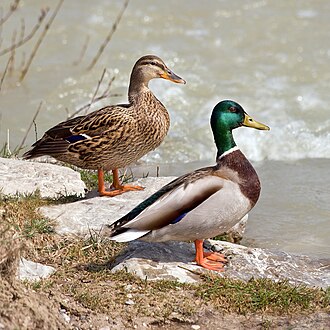
In mallards, the male is easily identified by his bottle-green head during breeding season.
However, some birds exhibit Reversed Sexual Dimorphism (RSD). In the eclectus parrot, the female is more colorful than the male, whose green plumage helps him avoid predators like peregrine falcons.
![The eclectus parrot is an example of a bird where the female (right) is more colorful than the male (left), whose mostly-green plumage helps it blend in with surrounding vegetation and avoid predators such as peregrine falcons.[82]](/images/c3/d9/c3d936bb3710993dc25bb0879b0af2cc60af076ea0beab669a16b018f7eb7aee.jpg)
Other avian examples include the golden-shouldered parrot, where the male is significantly more colorful.
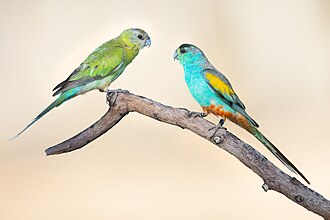
Insects and Arachnids
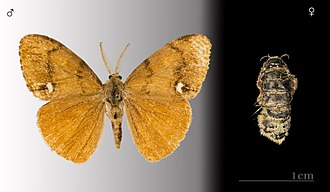
In the insect world, dimorphism can affect wing development and color. Some moths exhibit males with developed wings and females with vestigial wings.
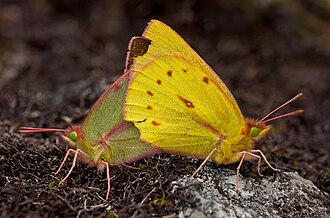
Butterflies, such as Colias dimera, often show color variations where males are brighter than females.
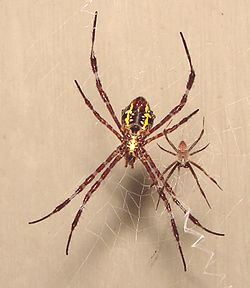
Spiders frequently exhibit extreme RSD, where females are dramatically larger than males. This size disparity is sometimes linked to sexual cannibalism.
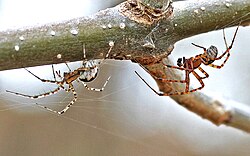
Courtship behaviors in spiders also highlight these differences, as seen in hammock spiders.
Mammals and Reptiles
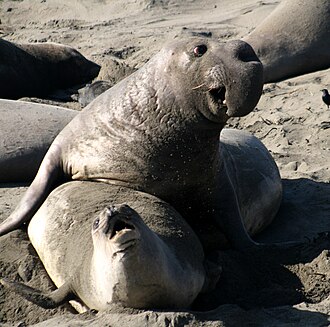
Among mammals, size is a primary dimorphic trait. In northern elephant seals, males are much larger and possess a prominent proboscis.
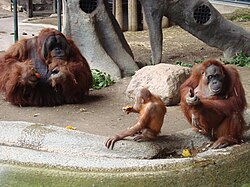
Primates also show significant variation; for instance, male Sumatran orangutans differ greatly in size and appearance from females.
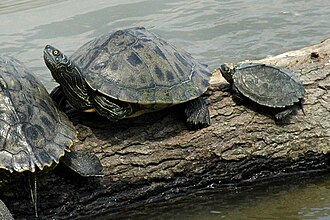
In reptiles, such as the Mississippi map turtle, adult females and males maintain distinct physical differences.
Fish and Ancient Life
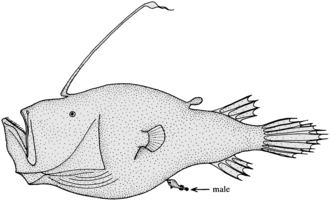
Fish exhibit a vast range of dimorphism, including extreme cases like the triplewart seadevil, where the tiny male attaches himself to the female.
Evidence of sexual dimorphism extends back millions of years, appearing in the fossil records of Cambrian trilobites.
![Sexual dimorphism in Cambrian trilobites[163]](/images/25/49/254945afe6795a00082f7c0abe1b1b56c9e6111876f104864933baa0a3860d7c.jpg)
Comparative Summary of Sexual Dimorphism
| Trait Type | Typical Male Expression | Typical Female Expression | Example Species |
|---|---|---|---|
| Coloration | Bright/Ornamental | Dull/Camouflaged | Peacocks, Mallards |
| Size (Standard) | Larger | Smaller | Elephant Seals, Orangutans |
| Size (Reversed) | Smaller | Larger | Spiders, Raptors |
| Morphology | Weaponized (Horns/Teeth) | Nurturing/Egg-bearing | Various Ungulates |
Internal and Cellular Differences
Beyond visible traits, sexual dimorphism occurs at the cellular and systemic levels. This includes differences in immune function and the transcriptome of the immune system. In humans, these differences can manifest in brain connectivity and the way pain is perceived.
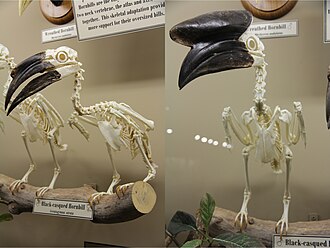
Skeletal differences are also common; for example, black-casqued hornbills show distinct differences in the casque on top of their bills.
Frequently Asked Questions
What is the difference between sexual dimorphism and monomorphism?
Sexual dimorphism occurs when males and females of a species have different physical characteristics. Monomorphism is the opposite, where the two sexes are phenotypically indistinguishable.
What is Reversed Sexual Dimorphism (RSD)?
RSD is a condition where the females of a species are larger, more colorful, or more ornamented than the males. This is common in spiders, raptors, and leopard seals.
Why do some males evolve "battle" traits?
Traits such as reinforced heads or specialized teeth evolve through male-male reproductive competition, serving as weapons to win fights against rivals for mating access.
Does sexual dimorphism only affect physical appearance?
No. It also includes differences in behavior, cognitive traits, immune system function, and cellular structures.
How does natural selection influence these traits?
While sexual selection drives traits that attract mates or defeat rivals, natural selection may favor traits that aid survival, such as the camouflaged plumage of female birds which protects them from predators.