Serbia and Montenegro National Football Team: A History of the Plavi
The Serbia and Montenegro national football team, affectionately known as the Plavi (The Blues), represented the State Union of Serbia and Montenegro from 1992 to 2006. For much of its existence, the team operated under the name of the Federal Republic of Yugoslavia (FR Yugoslavia) until a political rebranding in February 2003. The team's journey was marked by immense talent, political turmoil, and the eventual dissolution of the state union in 2006.
Key Facts
- Active Years: 1992–2006
- Most Caps & Top Scorer: Savo Milošević (101 caps, 38 goals)
- Highest FIFA Ranking: 6th (December 1998)
- Best World Cup Result: Round of 16 (1998)
- Best European Championship Result: Quarter-finals (2000)
- Final Captain: Dejan Stanković
- Final Head Coach: Ilija Petković
The Early Years and FIFA Sanctions (1992–1998)
Although the Federal Republic of Yugoslavia was formed in April 1992, the national team faced an immediate hurdle: FIFA sanctions resulting from the Yugoslav Wars. These sanctions banned the team from all international sporting events, including the 1994 FIFA World Cup and UEFA Euro 1996 qualifiers.
The team finally returned to the pitch on December 23, 1994, in a friendly match against Brazil in Porto Alegre, which ended in a 2–0 defeat. Under the leadership of manager Slobodan Santrač, the team slowly rebuilt its international presence. Their first official victory came on March 31, 1995, a 1–0 win over Uruguay, featuring the first-ever goal scored by Savo Milošević.
The team's resurgence peaked during the 1998 FIFA World Cup qualification. After a dominant 8–1 victory over the Faroe Islands—the biggest win in the team's history—and a convincing aggregate win over Hungary (12–1), FR Yugoslavia secured its first World Cup appearance as a new country.
The 1998 FIFA World Cup
Entering the 1998 tournament in France, the team was viewed as a "shadow favorite" due to a roster filled with stars from top European clubs. They progressed past the group stage, finishing second behind Germany after victories over Iran and the United States. Their journey ended in the Round of 16 following a narrow 2–1 loss to the Netherlands.
European Success at Euro 2000
The road to UEFA Euro 2000 was fraught with tension, as the draw placed Yugoslavia in a group with Croatia, marking the first meeting between the two nations after the breakup of the original Yugoslavia. Despite political instability and the NATO bombing of Yugoslavia—which forced some matches to be moved to Greece—the team qualified for the tournament.
At the finals, the team displayed remarkable resilience. After recovering from a 3–0 deficit to draw 3–3 with Slovenia and defeating Norway 1–0, they faced Spain in a dramatic final group match. Despite leading three times, they eventually lost 4–3. However, they advanced to the quarter-finals, marking their best-ever finish in a European Championship.
Transition to Serbia and Montenegro (2003–2006)
Following a period of political transformation and a failure to qualify for the 2002 World Cup, the team was renamed the Serbia and Montenegro national team in February 2003. Under head coach Ilija Petković, the team struggled during the Euro 2004 qualifiers, failing to advance due to unexpected results against Azerbaijan.
The team found its footing again during the 2006 World Cup qualifiers. They boasted a formidable defensive unit known as the "Famous Four"—Nemanja Vidić, Mladen Krstajić, Goran Gavrančić, and Ivica Dragutinović—supported by goalkeeper Dragoslav Jevrić. This defense allowed only one goal in ten matches, leading the team to finish first in their group ahead of Spain.
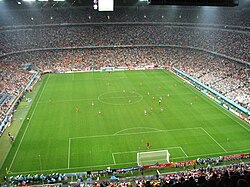
However, the 2006 World Cup took place during a period of national dissolution. Following a referendum on June 3, 2006, Montenegro declared independence. The team competed in the tournament representing a state that no longer existed, with Jevrić being the only Montenegrin player in the squad.
The campaign was disappointing, consisting of three losses: 1–0 to the Netherlands, a crushing 6–0 defeat to Argentina (the team's worst-ever result), and a 3–2 loss to the Ivory Coast.
Dissolution and Legacy
Following the 2006 World Cup, the team officially split. The Football Association of Serbia inherited the place of Serbia and Montenegro in UEFA and FIFA, while the Football Association of Montenegro applied for separate membership. By August 2006, the Serbia national team began its independent journey, followed by Montenegro in March 2007.
| Competition | Appearances | Best Result | Year |
|---|---|---|---|
| FIFA World Cup | 2 | Round of 16 | 1998 |
| UEFA European Championship | 1 | Quarter-finals | 2000 |
Frequently Asked Questions
Why was the team banned from the 1994 World Cup?
The team was banned due to international sanctions imposed by the United Nations and FIFA resulting from the Yugoslav Wars.
Who is the all-time leading scorer for the team?
Savo Milošević is the top scorer with 38 goals and also holds the record for the most caps with 101.
What was the team's biggest victory?
Their biggest win was an 8–1 victory over the Faroe Islands on October 6, 1996.
What happened to the team after the 2006 World Cup?
The team dissolved into two separate national teams: the Serbia national team and the Montenegro national team, following Montenegro's declaration of independence.
Who were the "Famous Four"?
The "Famous Four" referred to the defensive line of Nemanja Vidić, Mladen Krstajić, Goran Gavrančić, and Ivica Dragutinović, who allowed only one goal during the 2006 World Cup qualification process.