Seoul Subway Line 1: A Comprehensive Overview of South Korea's Historic Transit Artery
Seoul Subway Line 1, often referred to as "The Dark Blue Line," serves as a vital backbone for the Seoul Metropolitan Area. As a hybrid of rapid transit and commuter rail, it connects the heart of central Seoul to diverse regions including Yeoncheon in the northeast, Incheon in the southwest, and Sinchang in the south. Spanning a massive 218.3 km (135.6 mi), this line is a cornerstone of South Korean infrastructure, facilitating the movement of millions of passengers every year.
The line is unique in its dual-operator structure. The central underground section, which runs beneath the historic avenues of Sejongno, Jongno, and Wangsan-ro, is managed by Seoul Metro. The extensive portions extending into the suburbs are operated by Korail. This central underground segment is actually the oldest subway-operated section in the entire Seoul Metropolitan Subway system.
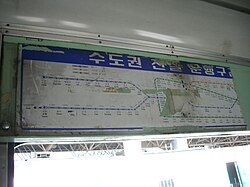
Key Facts
- First Opened: August 15, 1974
- Total Length: 218.3 km (Seoul Metro: 7.8 km; Korail: 210.5 km)
- Daily Ridership: 405,564 (2024 data)
- Electrification: Dual system (1,500 V DC for Seoul Metro; 25 kV AC 60 Hz for Korail)
- Track Gauge: 1,435 mm (Standard Gauge)
- Termini: Yeoncheon, Incheon, Sinchang, Gwangmyeong, and Seodongtan
Technical Specifications and Electrification
One of the most technically complex aspects of Line 1 is its electrification system. To prevent potential telecommunication malfunctions caused by alternating current (AC) on telephone lines, the underground section between Cheongnyangni and Seoul Station utilizes a 1,500 V direct current (DC) system. The rest of the line operates on a 25,000 V alternating current (AC) at 60 Hz.
Because of these two different power standards, the line features neutral sections—specialized areas where the power source switches—located between Cheongnyangni and Hoegi, and between Seoul Station and Namyeong. Consequently, all rolling stock (train cars) used on Line 1 must be multi-system compatible to handle both DC and AC power seamlessly.
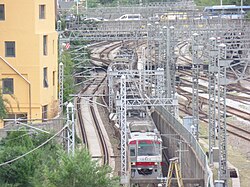
Service Types and Express Trains
Line 1 offers a variety of service patterns to accommodate different travel needs. While local trains stop at every station, Korail operates several express services to speed up long-distance travel. These include:
- Gyeongwon Express (GW): Connecting Dongducheon to Incheon.
- Gyeongin Express (GI): Connecting Yongsan to Dongincheon.
- Gyeongbu Express (GB A & B): Connecting Cheongnyangni or Seoul to Cheonan or Sinchang.
Note that express services are exclusively operated by Korail trains.
Historical Evolution
Line 1 holds a significant place in history as the first electrified rapid transit line in South Korea. When it opened on August 15, 1974, it initially consisted of 9 stations from Seoul to Cheongnyangni, with through services to the national mainline railways. This made it the second electrified rapid transit service in the entire Korean Peninsula, following the Pyongyang Metro.
Over the decades, the line has undergone numerous extensions and station renamings. The most recent extension was completed in 2023. The system has evolved from the original Korean National Railroad (now Korail) into the sophisticated multi-operator network seen today.
Summary of Line 1 Operations
| Feature | Details |
|---|---|
| Total Stations | 102 (Seoul Metro: 10, Korail: 92) |
| Operating Speed | Up to 110 km/h (68 mph) |
| Primary Operators | Seoul Metro, Korail |
| Rolling Stock | Seoul Metro 1000 series, Korail Class 311000 series |
Frequently Asked Questions
Why does Line 1 use two different types of electricity?
The underground section uses 1,500 V DC to prevent electrical interference with telecommunication lines, while the mainline Korail sections use 25 kV AC to support long-distance, high-capacity commuter rail operations.
What are the neutral sections on the line?
Neutral sections are specific points on the track where the train must transition from one electrification system (DC) to another (AC). These are located near Hoegi and Namyeong stations.
How can I tell the difference between local and express trains?
Local trains stop at every station along the route. Express trains, operated by Korail, skip certain stations to provide faster travel between major hubs. Station maps use specific symbols (● for stops, | for no stops) to indicate service patterns.
Which operator runs the central underground part of the line?
The 7.8 km underground section between Seoul Station and Cheongnyangni is operated by Seoul Metro.
Is Line 1 the oldest subway in Seoul?
Yes, the central underground portion of Line 1 is the oldest subway-operated section in the Seoul Metropolitan Subway system, having opened in 1974.