Gyeongui Line: A Historical and Modern Link Between Seoul and the Border
The Gyeongui Line is a vital railway artery in South Korea, stretching from the bustling heart of Seoul to the edge of the Demilitarized Zone (DMZ) at Dorasan Station. While it serves as a critical component of the Seoul Metropolitan Subway system today, its history is deeply intertwined with the complex geopolitical shifts of the Korean Peninsula.
Spanning 56.1 km, the line connects major urban centers like Goyang and Paju to Seoul, facilitating both regional passenger travel and freight movement. Though often referred to as a "subway," the line is primarily a heavy rail service that traverses vast stretches of countryside, including rice paddies and forests, with less than 3% of its route running underground.
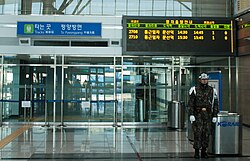
Key Facts
- Termini: Seoul and Dorasan
- Total Length: 56.1 km (34.9 mi)
- Operator: Korail
- Track Gauge: 1,435 mm (standard gauge)
- Electrification: 25 kV/60 Hz AC catenary
- Service Type: Heavy rail, passenger/freight regional rail
Historical Evolution
The origins of the Gyeongui Line date back to the early 20th century. Although the Korean Empire initially intended to build the line, funding shortages led to the project being taken over by the Empire of Japan. Construction was heavily influenced by military considerations during the Russo-Japanese War, with the line serving as a strategic route for troop movements.
Originally, the line was part of a much larger network that extended to P'yŏngyang and Sinŭiju, connecting the Korean railway system to the South Manchuria Railway and, by extension, to Asia and Europe. However, the division of Korea in 1945 halted all cross-border operations, effectively severing the link between the north and south.
Reconnection Efforts and the DMZ
Following the Korean War, the line was truncated, with southern services terminating near Munsan. In recent decades, significant efforts have been made to restore the connection. Since the 2000 summit between the two Koreas, tracks have been rebuilt across the DMZ. In 2007, a historic test run saw a delegation travel from Munsan Station in the South to Kaesong in the North, signaling a potential for future regular passenger and freight services.
Modern Upgrades and Services
To meet the demands of a growing metropolitan area, the South Korean government undertook massive upgrades to the line. Work began in 1999 to convert the section between Seoul and Munsan into an electrified, double-tracked railway. This modernization included a new, straighter 48.6 km alignment to improve efficiency.
In 2009, the line was integrated into the Seoul Metropolitan Subway system. Following further extensions, the service was merged with the Jungang Line, officially becoming the Gyeongui–Jungang Line. As part of a broader strategic plan, there have also been considerations to upgrade the line to support speeds of up to 230 km/h (140 mph).
Current Rail Services
Today, the line supports a variety of services:
- Seoul Metropolitan Subway: Provides high-capacity commuter service connecting Seoul, Digital Media City, Ilsan, Paju, and Munsan.
- Regular Rail: Includes limited Tonggeun services and Saemaeul-ho trains.
- KTX: The line features a depot for Korea Train Express (KTX) trains at Haengsin station, with some services terminating there.
- DMZ-Train: Specialized services reaching toward the border areas.
Technical Specifications Summary
| Feature | Details |
|---|---|
| Line Length | 56.1 km |
| Track Configuration | Double track (Seoul–Munsan); Single track (beyond Munsan) |
| Gauge | 1,435 mm (Standard) |
| Electrification | 25 kV/60 Hz AC |
| Major Depots | Munsan, Goyang |
Frequently Asked Questions
Is the Gyeongui Line a subway?
While it is operated as part of the Seoul Metropolitan Subway, it is technically a heavy rail line. Most of its route runs at-grade through rural areas rather than underground.
Where does the line end?
The southern terminus is Seoul, and the northernmost terminus in South Korea is Dorasan Station, located near the border.
Can trains still travel to North Korea?
While tracks have been rebuilt across the DMZ and test runs have occurred, regular cross-border service is not currently operational.
What is the Gyeongui-Jungang Line?
This is the name of the service following the merger of the Gyeongui Line and the Jungang Line, providing extended connectivity across the region.
Does the line serve high-speed trains?
Yes, the Haengsin station serves as a depot for KTX (Korea Train Express) trains, and some KTX services terminate at this station.