Gyeongui–Jungang Line: Connecting Seoul's East and West
The Gyeongui–Jungang Line is a vital artery of the Seoul Metropolitan Subway system, serving as a primary commuter rail link that spans the metropolitan area from east to west. By integrating the Gyeongui Line and the Jungang Line, this service provides essential connectivity between the outskirts of Gyeonggi Province and the heart of Seoul.
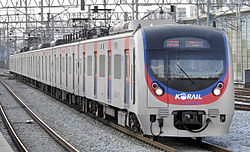
Operating under the management of Korail, the line is characterized by its jade-colored branding on transit maps. It utilizes a standard track gauge of 1,435 mm and is powered by a 25 kV AC 60 Hz electrification system. The service is designed to handle high passenger volumes using 8-car trains for most routes, though shorter 4-car trains are utilized for specific branches.
Key Facts
- Total Length: 134 km (83 mi).
- Total Stations: 57 stations.
- Primary Termini: Munsan (or Imjingang/Dorasan) to Yongmun (or Jipyeong/Seoul Station).
- Operator: Korail.
- Rolling Stock: Korail Class 321000 (21 trains) and Class 331000 (27 trains).
- Travel Time: Approximately 3 hours for the full journey, reducible to 2 hours 15 minutes via express services.
Route Structure and Operations
The Gyeongui–Jungang Line is a complex network that traverses several distinct rail segments. Trains travel along the Gyeongui Line (Munsan to Seoul Station/Gajwa), the Yongsan Line (Gajwa to Yongsan), the Gyeongwon Line (Yongsan to Hoegi), and the Jungang Line (Hoegi to Jipyeong). Following the standard for Korail-run lines in Seoul, trains operate on the left-hand side of the track.
Service Variations
While most trains run between Munsan and Yongmun, the line features several operational nuances:
- Branch Lines: Some services split east of Gajwa station to serve Seoul Station.
- Short-Turn Services: Many trains terminate early at key hubs such as Ilsan, Neunggok, Daegok, Yongsan, Cheongnyangni, Deokso, and Paldang.
- Extended Reach: Select weekday and weekend services extend beyond Yongmun to reach Jipyeong.
Shuttle Services
To serve the furthest reaches of the line near the border, Korail operates specialized shuttle services. An "I" shuttle connects Munsan to Imjingang, while a "D" shuttle operates between Imjingang and Dorasan, replacing the former "Commuter Train" service.
Rapid (Express) Services
To reduce travel times for regional commuters, Korail operates rapid trains (급행), which skip several local stations. These are categorized into three main types:
- Gyeongui Line Express (via Seoul Station): Runs express between Munsan and Gajwa before operating as a local service to Seoul Station.
- Gyeongui Line Express (via Yongsan Line): Runs express between Munsan and Yongsan, then continues as a local service on the Jungang Line.
- Jungang Line Express: Runs express between Yongmun and Yongsan, then continues as a local service on the Gyeongui Line.
Historical Development
The line was formed through a gradual expansion and eventual merger of two separate lines. The Jungang Line section began operating from Yongsan to Deokso in December 2005, extending eastward to Paldang in 2007, Guksu in 2008, and Yongmun in 2009. The Gyeongui Line section opened in July 2009, initially running from Munsan to Digital Media City.
The two lines were officially merged into the present Gyeongui–Jungang Line on December 27, 2014, following the extension of the Gyeongui Line from Gongdeok to Yongsan. Subsequent years saw the addition of in-fill stations—stations added to existing tracks to serve new developments—such as Yadang (2015) and Hyochang Park (2016). The line reached Jipyeong in January 2017.
Line Summary Table
| Feature | Details |
|---|---|
| Status | Operational |
| Line Length | 134 km |
| Track Configuration | 2 tracks (most sections); 4 tracks (Neunggok–Gajwa) |
| Electrification | 25 kV AC 60 Hz |
| Rolling Stock | Class 321000 & Class 331000 |
| Future Expansion | Hyang-dong in-fill station (Expected 2025) |
Frequently Asked Questions
How long does it take to travel the entire line?
A full journey takes approximately 3 hours, although express services can reduce this time to about 2 hours and 15 minutes.
Which stations serve as the main termini?
Most trains run between Munsan and Yongmun, though select services extend to Imjingang, Dorasan, Jipyeong, or Seoul Station.
What is the difference between the Gyeongui and Jungang sections?
The Gyeongui section generally handles the western portion (Munsan to Yongsan), while the Jungang section handles the eastern portion (Yongsan to Jipyeong).
Are there express trains available?
Yes, Korail operates several rapid services that skip local stations to speed up travel between major hubs like Munsan, Yongsan, and Yongmun.
How do I get to Dorasan station?
Passengers must take the main line to Munsan, then transfer to the Imjingang shuttle, and finally take the Dorasan shuttle from Imjingang.