Sentinel-2A: Advancing Earth Observation through the Copernicus Programme
The Sentinel-2A is a sophisticated European optical imaging satellite designed to provide high-resolution data about our planet's surface. Launched as the first of the Sentinel-2 series, it operates under the European Space Agency (ESA) and forms a critical component of the European Commission's Copernicus Programme, a massive initiative dedicated to monitoring the Earth's environment.
Equipped with a wide-swath Multi-Spectral Imager (MSI)—an instrument capable of capturing data across 13 different spectral bands—Sentinel-2A allows scientists and policymakers to observe the world in detail. These observations are vital for forest monitoring, detecting changes in land cover, managing natural disasters, and monitoring water quality.
Key Facts
- Operator: European Space Agency (ESA).
- Launch Date: June 23, 2015.
- Primary Instrument: Multi-Spectral Imager (MSI) with 13 spectral bands.
- Orbit: Low Earth Orbit (LEO) with an inclination of 98.5623°.
- Mission Duration: Planned for 7 years, but has operated for over 11 years.
- Launch Vehicle: Vega (VV05) rocket from Kourou SLV.
Technical Specifications and Design
Manufactured by Airbus Defence and Space, Sentinel-2A is a robust piece of engineering designed for precision. The spacecraft has a launch mass of 1,140 kg and a dry mass of 1,017 kg, with physical dimensions measuring 3.4 m by 1.8 m by 2.35 m. To power its complex imaging systems, the satellite utilizes a 1700-watt power system.
Data transmission is handled through a combination of bands. The S band is used for Telemetry, Tracking, and Command (TT&C) support, while the X band and optical lasers via the European Data Relay System (EDRS) handle the heavy lifting of data acquisition, reaching downlink speeds of up to 520 Mbit/s.
| Parameter | Detail |
|---|---|
| COSPAR ID / SATCAT | 2015-028A / 40697 |
| Perigee / Apogee Altitude | 788.06 km / 789.87 km |
| Orbital Period | 100.65 minutes |
| Semi-major Axis | 7,167.10 km |
| Manufacturer | Airbus Defence and Space |
Mission History and Operational Milestones
Launch and Early Operations
Sentinel-2A began its journey on June 23, 2015, launched by a Vega VV05 rocket from the Kourou Space Launch Center. The satellite successfully separated from the rocket's upper stage approximately 54 minutes and 43 seconds after liftoff. Just 100 hours later, it captured its first image, a massive 290 km wide swath stretching from Sweden through Central Europe to Algeria. The official commissioning of the satellite was completed in October 2015.
Challenges and Evolution
The mission has not been without hurdles. Between January 20 and 23, 2017, a mission planning anomaly occurred, which led to a temporary loss of data from the Multi-Spectral Imager. However, the satellite continued its primary mission, eventually joined in orbit by its sister satellite, Sentinel-2B, on March 7, 2017.
Experimental Night Observations
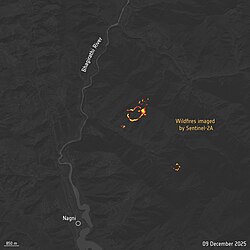
While Sentinel-2A was not originally designed for night-time imaging, ESA used the satellite in December 2025 to conduct experimental observations. These tests were intended to pave the way for the Sentinel-2 Next Generation mission. During these trials, the satellite successfully imaged gas flares from oil production in the Middle East, fishing boats near South Korea, and wildfires in India.
Frequently Asked Questions
What is the primary purpose of Sentinel-2A?
Sentinel-2A is designed for high-resolution Earth observation, specifically supporting land-based services such as forest monitoring, water quality analysis, natural disaster management, and land cover change detection.
What is the Multi-Spectral Imager (MSI)?
The MSI is the satellite's main instrument, which captures images across 13 different spectral bands, allowing for detailed analysis of the Earth's surface that goes beyond what the human eye can see.
How long was the Sentinel-2A mission planned to last?
The mission was originally planned for a duration of 7 years, though it has significantly exceeded this, operating for over 11 years.
Can Sentinel-2A take photos at night?
It was not designed for night imaging; however, it successfully performed experimental night observations in December 2025 to test capabilities for future missions.
Which rocket was used to launch Sentinel-2A?
Sentinel-2A was launched using the Vega (VV05) rocket from the Kourou launch site.