Seleucid Empire: The Hellenistic Power of the East
The Seleucid Empire (312–63 BC) was one of the largest and most influential successor states established after the death of Alexander the Great. Founded by Seleucus I Nicator, a Macedonian general, the empire served as a bridge between the Mediterranean world and Central Asia, blending Greek administration with the diverse cultures of the Near East.
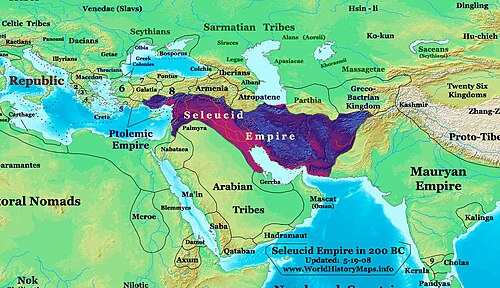
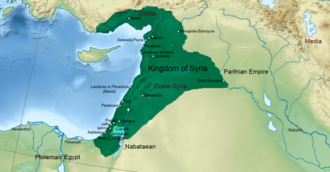
At its zenith, the empire spanned millions of square kilometers, encompassing territories that today include Syria, Iraq, Iran, and parts of Turkey and Central Asia. It was characterized by the spread of Hellenism—the fusion of Greek culture with local Eastern traditions—and the establishment of numerous Greek-style cities across Asia.
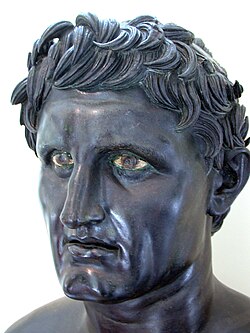
Key Facts
- Founder: Seleucus I Nicator.
- Capitals: Seleucia (305–240 BC) and Antioch (240–63 BC).
- Official Language: Greek, though Old Persian and Middle Aramaic remained widely used.
- Military Core: The Macedonian phalanx, supplemented by native and mercenary troops.
- Peak Population: Over 30 million people around 301 BC.
- End of Empire: Annexed by Rome in 63 BC.
The Rise of Seleucus I and Early Conquests
The empire emerged from the Wars of the Diadochi (the successors of Alexander), a period of intense conflict among Alexander's generals. Seleucus I established his power base in Babylon, though he faced significant challenges from Antigonos and his son Demetrius. Between 311 and 309 BC, a large-scale war broke out in Babylon, eventually resulting in Seleucid control of the region.
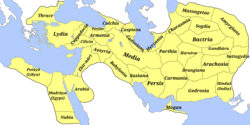
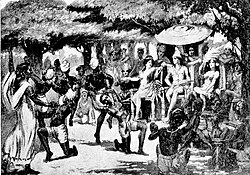
Following his success in Mesopotamia, Seleucus expanded eastward. This led to a confrontation with the Maurya Empire under Chandragupta Maurya. Facing a massive Indian army reportedly consisting of 600,000 men and 9,000 war elephants, Seleucus opted for a diplomatic resolution. A marriage agreement was struck, and Seleucus ceded territories in the Indus River region in exchange for 500 war elephants.
Imperial Expansion and Fragmentation
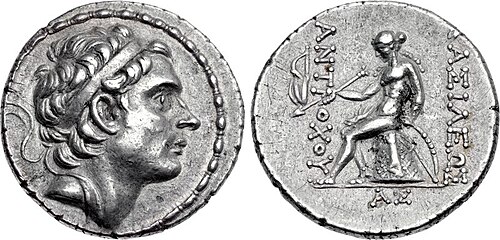
Under the early Seleucid kings, the empire reached its greatest extent. However, maintaining control over such a vast area proved difficult. During the reigns of Antiochus I and Antiochus II, the empire faced internal instability and external threats, including Celtic invasions in Asia Minor and wars with the Ptolemies of Egypt.
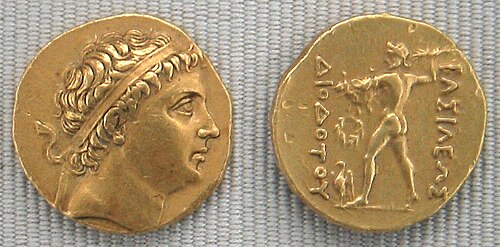
By the mid-3rd century BC, several provinces asserted their independence. The Greco-Bactrian Kingdom formed under Diodotus around 245 BC, while Parthia and Cappadocia also broke away. The loss of these eastern territories marked the beginning of a gradual contraction of Seleucid power.
![Drachm of the Frataraka ruler Vahbarz (Oborzos), thought to have initiated the independence of Persis from the Seleucid Empire. The coin shows on the reverse an Achaemenid king slaying an armoured, possibly Greek, soldier.[45][46] This possibly refers to the events related by Polyainos (Strat. 7.40), in which Vahbarz (Oborzos) is said to have killed 3000 Seleucid settlers.[47][45][46]](/images/fc/5b/fc5b0e3e47b15062b41aa0b3abfc34be799a15efda5c9df9176f202def6fd97f.jpg)
The Revival under Antiochus III the Great
The empire experienced a significant resurgence under Antiochus III (reigned 223–187 BC). He sought to reclaim the lost eastern satrapies and restore the empire's prestige. However, his ambitions eventually brought him into conflict with the rising power of the Roman Republic.
Encouraged by the Carthaginian general Hannibal, Antiochus III invaded Greece. This campaign ended in resounding defeats at the battles of Thermopylae (191 BC) and Magnesia (190 BC). The resulting Treaty of Apamea (188 BC) forced the Seleucids to pay a massive indemnity and retreat from Anatolia, effectively limiting their influence west of the Taurus Mountains.
Cultural and Economic Infrastructure
The Seleucids governed through a Greco-Macedonian elite, but they generally respected the religious sensibilities of their subjects. The empire was a melting pot of religions, including Olympianism, Zoroastrianism, and Babylonian traditions.
Military Organization
The backbone of the Seleucid army was the phalanx, a dense formation of infantry armed with the sarissa (a long pike). Because Greek manpower was limited, the kings relied heavily on native levies and mercenaries, with army sizes typically ranging from 70,000 to 200,000 men.
Economy and Currency
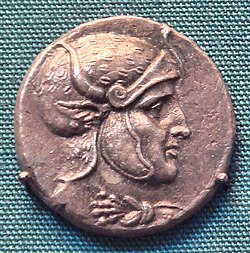
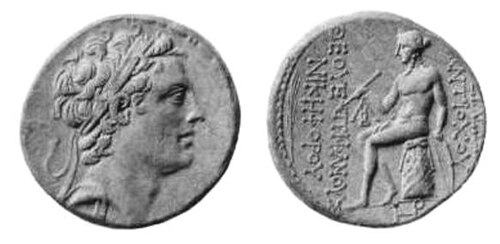
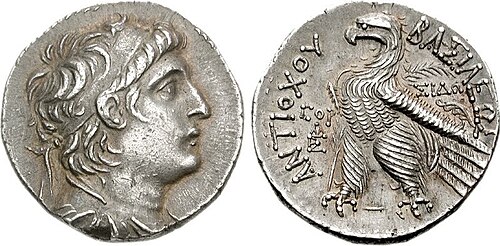
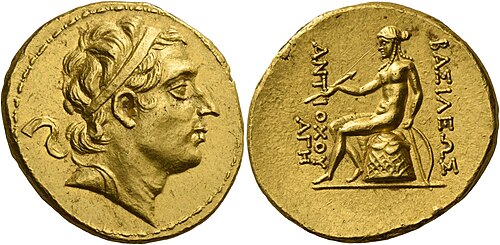
The empire utilized a complex monetary system. While the Attic standard (the common Mediterranean currency) was used in coastal regions like Syria, the traditional silver shekel remained dominant in Mesopotamia due to local bartering customs. To combat silver shortages, the empire introduced bronze coinage for small-scale daily transactions.
State Revenue
The state funded itself through heavy tributes levied on cities (poleis) and temples. While annual tribute was standard, demands increased sharply during wartime. For example, during a civil war in 149 BC, the province of Judaea was demanded to pay 300 talents of silver.
The Final Decline and Collapse
The later years of the empire were marked by debilitating civil wars and the steady encroachment of the Parthian Empire. By the 1st century BC, the Seleucid realm had shrunk to a small portion of its former self, centered primarily in Syria.
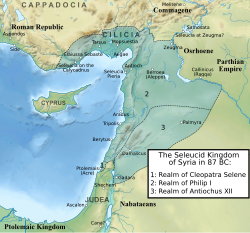
The end came in 63 BC when the Roman general Pompey annexed the remaining Seleucid territories, transforming the region into a Roman province.
![The Antiochus Cylinder written in Akkadian cuneiform c. 250 BC, mentioning Antiochus I, son of Seleucus I "the Macedonian", who restored the temples of Esagila and Ezida in Babylon.[61]](/images/a5/0d/a50d7981bed362e4ecc1753d58721b48f45ff65544fed70bdc0a7cde08649c61.jpg)
![Bagadates I (Minted 290–280 BC) was the first native Seleucid satrap to be appointed.[67]](/images/6a/f5/6af5e6d42a5b65ac005bfb46e3ace0276b7b4dec99056009940ccb0ecaf67497.jpg)
Empire Summary
| Feature | Details |
|---|---|
| Duration | 312–63 BC |
| Key Rulers | Seleucus I, Antiochus I, Antiochus III, Antiochus IV |
| Major Rivals | Ptolemaic Egypt, Parthian Empire, Roman Republic, Maurya Empire |
| Core Military Unit | Macedonian Phalanx (Sarissa) |
| Primary Languages | Greek (Official), Aramaic, Old Persian |
Frequently Asked Questions
Who founded the Seleucid Empire?
The empire was founded by Seleucus I Nicator, one of Alexander the Great's generals, who established his rule starting around 312 BC.
What was the significance of the Treaty of Apamea?
Signed in 188 BC after the defeat of Antiochus III by Rome, the treaty forced the Seleucids to pay a large indemnity and prohibited them from expanding west of the Taurus Mountains, significantly reducing their power in Anatolia.
How did the Seleucids handle the diverse cultures of their empire?
They promoted Hellenism and used Greek as the official language of administration, but they generally allowed local religions and languages, such as Aramaic and Zoroastrianism, to persist.
What happened to the Seleucid Empire in the end?
After centuries of civil war and losses to the Parthians, the remaining Seleucid territories in Syria were annexed by the Roman Republic in 63 BC.
What was the 'phalanx' used by the Seleucid army?
The phalanx was a dense infantry formation where soldiers carried small shields and very long pikes called sarissas, a tactic inherited from Philip II of Macedon and Alexander the Great.