Understanding Seedlings: From Embryo to Independent Plant
Every great forest and every garden begins with a single, critical stage of life: the seedling. A seedling is a young sporophyte—the diploid, multicellular stage of a plant—that develops from a plant embryo contained within a seed. This transition from a dormant embryo to a self-sustaining plant is a complex biological journey that begins with germination and ends when the plant can support itself through photosynthesis.
The Anatomy of a Young Seedling
A typical young seedling is composed of three primary structural components that allow it to establish itself in the environment:
- Radicle: The embryonic root, which is usually the first part to emerge from the seed to anchor the plant and absorb water.
- Hypocotyl: The embryonic shoot that pushes the plant upward toward the surface.
- Cotyledons: Often called "seed leaves," these are the first leaves to appear and provide essential nutrients to the developing plant.
Flowering plants, known as angiosperms, are categorized based on the number of cotyledons they possess. Monocotyledons (monocots) have a single blade-shaped cotyledon, while dicotyledons (dicots) have two round cotyledons.
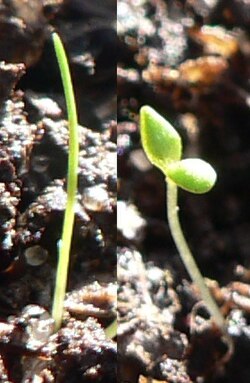
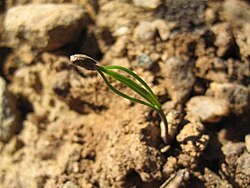
Other plant groups show more variety. Gymnosperms, such as pines, can have up to eight cotyledons. Conversely, some flowering plants are classified as acotyledons because they possess no cotyledons at all.
The Plumule and Germination Strategies
The plumule is the specific part of the seed embryo that eventually develops into the shoot and bears the plant's first true leaves. Depending on the species, the plumule and cotyledons emerge in different ways:
Epigeal Germination
In epigeal germination, the cotyledons grow above the soil surface. For example, in sunflowers, the plumule is a small conical structure that does not grow until the cotyledons have cleared the ground.
Hypogeal Germination
In hypogeal germination, the cotyledons remain below the soil surface. In plants like the broad bean, the plumule already has a visible leaf structure within the seed, allowing it to grow upward through the soil while the seed leaves stay underground.
The Role of Light: Photomorphogenesis and Etiolation
Light acts as a primary signal that tells a seedling how to grow. This process is managed by light receptors called phytochrome (which senses red and far-red light) and cryptochrome (which senses blue light).
When a seedling is underground, it undergoes skotomorphogenesis (or etiolation). During this phase, the plant grows a long hypocotyl and forms an apical hook—a tight curve that protects the shoot apical meristem (the growth tip) from damage as it pushes through the soil. Etiolated seedlings are typically yellowish because chlorophyll synthesis and chloroplast development require light.
Once the seedling breaks the surface and hits the light, it switches to photomorphogenesis. The apical hook straightens, the cotyledons open and turn green, and they begin functioning as the plant's first photosynthetic organs.
Growth, Maturation, and Environmental Factors
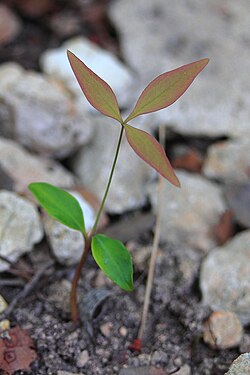
Once photosynthesis begins, the seedling no longer relies on the energy reserves stored in the seed. The apical meristems drive the growth of the root and shoot, and the first "true" leaves expand. These true leaves differ from the round cotyledons in shape and are species-specific. Over time, the cotyledons senesce (biologically age and deteriorate) and fall off.
Seedling growth is influenced by several external factors:
- Mechanical Stimulation: Through a process called thigmomorphogenesis, physical contact or wind can alter how a seedling grows.
- Light and Temperature: For some species, a day/night temperature of 28 °C/13 °C is effective at low light levels (40 lumens/m). Photoperiods (the length of light exposure) shorter than 14 hours can stop growth, while 16 hours or more can lead to continuous growth. High light intensities (10,000 to 20,000 lumens/m) significantly increase dry matter production.
- Nutrients and CO2: Nitrogen supply strongly impacts biomass, height, and leaf area. In species like the white spruce, carbon dioxide (CO2) enrichment can increase leaf and total biomass, particularly when nitrogen levels are high.
Challenges to Survival: Pests, Disease, and Mortality
The first year of a plant's life is precarious. Drought is the leading cause of mortality, as roots may fail to reach moist soil. Interestingly, some research indicates that mortality can be higher in moist habitats than in dry ones due to competition from other vegetation and frost heave (the movement of soil during freeze-thaw cycles).
Seedlings are also highly susceptible to biological threats:
- Diseases: "Damping off" is a particularly damaging disease for young seedlings.
- Pests: Cutworms, pillbugs, slugs, and snails frequently attack vulnerable young plants.
Transplanting and Care
The process of moving a seedling to a new location is generally done when the first pair of true leaves appears. In the UK, this is commonly referred to as pricking out. To reduce "transplant shock," gardeners may provide shade in hot climates or use vitamin hormone concentrates containing thiamine hydrochloride, 1-Naphthaleneacetic acid, and indole butyric acid.
Key Facts
- Three Main Parts: Seedlings consist of the radicle (root), hypocotyl (shoot), and cotyledons (seed leaves).
- Classification: Monocots have one cotyledon; dicots have two.
- Light Receptors: Phytochromes (red/far-red) and cryptochromes (blue) trigger the switch from dark-growth to light-growth.
- Etiolation: Seedlings grown in the dark develop long stems and a protective apical hook.
- Critical Timing: Transplanting typically occurs once the first true leaves emerge.
| Plant Group | Number of Cotyledons | Key Characteristics |
|---|---|---|
| Monocots | One | Blade-shaped seed leaf |
| Dicots | Two | Round seed leaves |
| Gymnosperms | Varied | Example: Pine seedlings can have up to eight |
| Acotyledons | Zero | No cotyledons present |
Frequently Asked Questions
What is the difference between a cotyledon and a true leaf?
Cotyledons are embryonic seed leaves that provide initial energy reserves. True leaves develop later from the plumule, have species-specific shapes, and take over the primary role of photosynthesis once the cotyledons senesce and fall off.
What happens if a seedling is grown in total darkness?
The seedling undergoes skotomorphogenesis (etiolation), resulting in a yellowish color due to a lack of chlorophyll and an abnormally long hypocotyl as the plant attempts to reach a light source.
Why is the "apical hook" important?
The apical hook protects the shoot apical meristem—the delicate growth point of the plant—from being damaged by friction and soil particles as the seedling pushes upward through the earth.
What is "damping off"?
Damping off is a destructive disease that specifically targets seedlings, often causing them to collapse and die shortly after germination.
When is the best time to transplant a seedling?
Seedlings are generally transplanted, or "pricked out," once the first pair of true leaves has appeared, signaling that the plant is developing beyond its initial embryonic stage.