Seafood Watch: Promoting Sustainable Seafood Choices
Making informed decisions about what we eat can have a profound impact on the health of our oceans. Seafood Watch is a leading sustainable seafood advisory list designed to help consumers, chefs, and business professionals navigate the complexities of the seafood market. By providing science-based recommendations, the program empowers individuals to choose seafood that supports healthy marine and freshwater ecosystems.
Based in Monterey, California, Seafood Watch operates as a 501(c)(3) nonprofit program of the Monterey Bay Aquarium. Its origins date back to the late 1990s, stemming from the aquarium's "Fishing for Solutions" exhibit (1997–1999), which first implemented a sustainable menu in its own cafeteria. Following the success of this initiative and alongside early efforts like the Audubon Society's guides, the official public outreach campaign was launched in October 1999.
Key Facts
- Founded: 1999 by the Monterey Bay Aquarium.
- Purpose: To provide science-based seafood recommendations to reduce environmental impact.
- Scope: Assesses both wild-caught fisheries and aquaculture (fish farming).
- Market Focus: Primarily targets the North American seafood market.
- Updates: Regional guides are updated twice annually, while the website is updated more frequently.
How Seafood Recommendations are Determined
To determine a rating, Seafood Watch conducts rigorous assessments of the impacts that fisheries and aquaculture (the farming of aquatic organisms) have on their respective ecosystems. These evaluations consider various factors, including the specific fishing gear used and the methods employed in farming operations.
These calculations result in a final score, which places the seafood into one of four primary categories:
- Best Choice (Green): Seafood that is well-managed and caught responsibly.
- Certified (Blue): Responsibly caught seafood that aligns with the certification definitions provided by the United Nations’ Food and Agriculture Organization (FAO).
- Good Alternative (Yellow): Seafood that is acceptable but still presents some concerns regarding management or farming tactics.
- Avoid (Red): Seafood that is overfished or produced in ways that harm the environment or other marine life.
Additionally, the program provides health alerts for species containing high levels of contaminants, such as PCBs, dioxins, or mercury, regardless of their sustainability rating.
The Super Green List
Introduced in 2010, the "Super Green" list identifies seafood that is both environmentally sustainable and beneficial for human health. To qualify, a product must be on the "Best Choice" list, be low in environmental contaminants, and serve as a good source of long-chain omega-3 fatty acids.
Resources and Global Impact
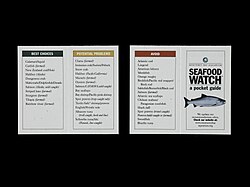
Seafood Watch provides a variety of tools to make sustainability accessible. The official website offers country-wide, regional, and sushi guides for the United States, with several regional versions available in Spanish. Pocket guides are also distributed via the Monterey Bay Aquarium.
Beyond consumer guides, the program targets the entire supply chain. Through educational initiatives, Seafood Watch works with retailers, distributors, and food service professionals to shift the marketplace toward responsible sourcing. They also provide technical assistance and policy management to help producers improve their fishing and farming habits.
| Rating | Color | Meaning |
|---|---|---|
| Best Choice | Green | Responsibly caught and well managed |
| Certified | Blue | Aligns with FAO certification standards |
| Good Alternative | Yellow | Decent, but some management concerns exist |
| Avoid | Red | Overfished or environmentally harmful |
Collaborations and Industry Perspectives
To amplify its reach, Seafood Watch partners with science museums, nature centers, zoos, and other nonprofits. The Monterey Bay Aquarium's Ocean Conservation Policy team further supports these goals by advocating for policies that eliminate illegal, unreported, and unregulated fishing, improve supply chain traceability, and restore populations of bluefin tuna and sharks.
Despite its influence, the program has faced criticism from industry groups. For example, the National Fisheries Institute, a seafood trade group, has argued that some guides are contradictory and fail to fully account for the social and economic dimensions of sustainability.
Frequently Asked Questions
What is the difference between "Best Choice" and "Certified"?
While both indicate responsibly caught seafood, "Best Choice" is based on Seafood Watch's internal science-based criteria, whereas "Certified" specifically aligns with the definitions set by the United Nations’ Food and Agriculture Organization (FAO).
How often are the seafood guides updated?
The regional guides are updated twice a year, though the Seafood Watch website is updated more frequently to reflect the latest data.
Does Seafood Watch only look at wild fish?
No, the program assesses both wild-caught fisheries and aquaculture (farmed seafood) operations, including the methods used to raise the seafood.
What does the "Super Green" list signify?
The Super Green list highlights seafood that is environmentally sustainable (Best Choice), low in contaminants, and high in healthy long-chain omega-3 fatty acids.
Are there guides available for sushi?
Yes, Seafood Watch provides specific sushi guides for the United States to help consumers make sustainable choices at sushi restaurants.