Sea Pens: The Fascinating Colonial Cnidarians of the Deep
Sea pens are captivating marine organisms that resemble delicate feathers or quills swaying in the ocean currents. Despite their appearance, they are not plants, but colonial cnidarians—animals related to jellyfish and corals. Belonging to the superfamily Pennatuloidea, these creatures are benthic filter feeders, meaning they live on the ocean floor and strain food particles from the water.
Found in tropical and temperate waters worldwide, sea pens are truly cosmopolitan. They inhabit a vast range of environments, from shallow intertidal zones to the extreme depths of the abyss, with some recorded at depths exceeding 6,100 meters (20,000 ft).
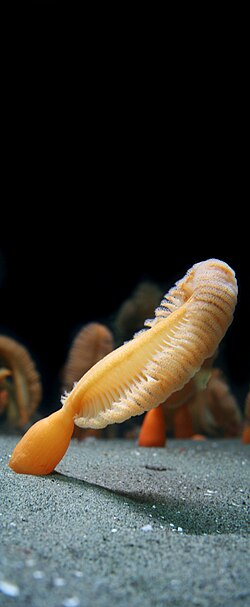
Key Facts
- Classification: Members of the superfamily Pennatuloidea within the order Scleralcyonacea.
- Structure: Colonial organisms consisting of specialized polyps.
- Habitat: Global distribution from shallow coasts to depths over 6,100 meters.
- Diet: Filter feeders that primarily consume plankton.
- Longevity: Potential lifespan of 100 years or more based on growth ring analysis.
- Defense: Capable of bioluminescence and rapid deflation to retreat into the seabed.
Taxonomy and Evolutionary History
Sea pens have a long evolutionary lineage, with the earliest accepted fossils, such as Thaumaptilon, dating back to the Cambrian period in the Burgess Shale. Some researchers suggest that fossils from the Ediacaran period may represent the very dawn of these organisms, though this remains a subject of scientific debate.
Currently, the order Scleralcyonacea comprises 16 families and 44 extant genera, encompassing approximately 235 accepted species. These families include diverse groups such as the Pennatulidae, Renillidae, and Virgulariidae.
Biology and Anatomy
As octocorals, sea pens are composed of multiple polyps, each typically possessing eight tentacles. However, unlike other octocorals, sea pen polyps are highly specialized for different roles within the colony:
- Rachis: A single polyp that transforms into a rigid, erect central stalk.
- Peduncle: A bulbous "root" at the base of the rachis used for anchoring in sandy or muddy substrates.
- Autozooids: Feeding polyps equipped with nematocysts (stinging cells) to capture prey.
- Siphonozooids: Specialized structures used for water intake.
- Reproductive structures: Polyps dedicated to the production of gametes.
The colony is reinforced by a central axial rod and spicules made of calcium carbonate. Some species, such as the tall sea pen (Funiculina quadrangularis), can reach heights of up to 2 meters (6.6 ft). Others, like the orange sea pen (Ptilosarcus gurneyi), are known for their vibrant coloration.
Survival and Behavior
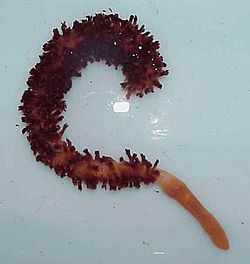
While they appear stationary, sea pens are not entirely sessile; they can relocate and re-anchor themselves to better align with currents for optimal plankton feeding. To defend themselves, some species exhibit bioluminescence, emitting a bright greenish light when touched. Others can rapidly expel water from their bodies to deflate and retreat into their peduncle.
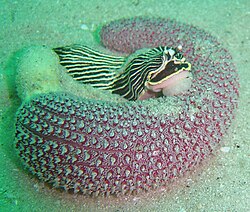
Their primary predators include sea stars and nudibranchs. Interestingly, some nudibranchs feed exclusively on sea pens. To counter this, sea pens often grow in unpredictable clumps, which can hinder the hunting efficiency of sea stars.
Reproduction and Life Cycle
Sea pens reproduce by releasing eggs and sperm into the water column, a process that occurs either seasonally or year-round. Once fertilized, the eggs develop into free-swimming larvae called planulae. These larvae drift for about a week before settling on the seabed to grow into mature colonies. Once established, mature sea pens often provide critical shelter for other marine life, including juvenile fish.
Summary of Sea Pen Characteristics
| Feature | Description |
|---|---|
| Feeding Method | Benthic filter feeding (Plankton) |
| Symmetry | Some exhibit rare glide reflection symmetry |
| Structural Support | Calcium carbonate spicules and axial rod |
| Depth Range | 10m to over 6,100m |
| Defense Mechanisms | Bioluminescence, rapid deflation, nematocysts |
Aquarium Trade
Sea pens are occasionally available in the aquarium trade, but they are considered difficult to maintain. Their specialized dietary needs and the requirement for very deep substrates make them challenging for most hobbyists.
Frequently Asked Questions
Are sea pens plants?
No, sea pens are colonial animals belonging to the phylum Cnidaria, making them relatives of corals and sea anemones.
How do sea pens anchor themselves?
They use a specialized bulbous root called a peduncle to secure themselves in sandy or muddy ocean floors.
What is the purpose of bioluminescence in sea pens?
Bioluminescence is used as a defense mechanism, emitting a greenish light when the organism is touched or disturbed.
How long can a sea pen live?
Analysis of growth rings in the rachis suggests that some sea pens may live for 100 years or more.
What do sea pens eat?
They are filter feeders that capture plankton from the water using specialized feeding polyps called autozooids.