Comb Jellies: The Ancient and Ethereal World of Ctenophores
Floating through the world's oceans are some of the most visually stunning and biologically enigmatic creatures on Earth: the comb jellies. Belonging to the phylum Ctenophora, these gelatinous organisms are often mistaken for true jellyfish, but they possess a unique set of biological characteristics that set them apart from all other animal life.
From their shimmering rows of cilia to their complex predatory habits, ctenophores represent a distinct lineage of animal evolution. With a temporal range extending from the Cambrian Stage 3 (approximately 518 million years ago) to the present, they offer a window into the early history of multicellular life.
![Pelagic ctenophoresa Beroe ovata, b unidentified cydippid, c "Tortugas red" cydippid, d Bathocyroe fosteri, e Mnemiopsis leidyi, and f Ocyropsis sp.[19]](/images/c9/54/c954d76d18afb097a039d01817f85288309cfa770a9a95c143e2cb361b1fdc91.png)
Key Facts
- Phylum: Ctenophora.
- Distinguishing Feature: Eight rows of cilia (combs) used for locomotion.
- Predation: Use sticky cells called colloblasts rather than stinging cells.
- Timeline: Present in the fossil record since the Cambrian period (518–0 Ma).
- Body Plan: Two main cell layers with a jelly-like middle layer.
- Senses: Possess an apical organ and, in some species, ocelli (simple eyes).
Biological Architecture and Anatomy
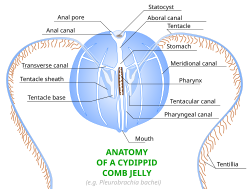
The body of a ctenophore is a marvel of biological engineering. Unlike many animals, they are composed of two primary cell layers with a thick, jelly-like middle layer containing numerous cells. This structure allows them to maintain buoyancy and flexibility in the water column.
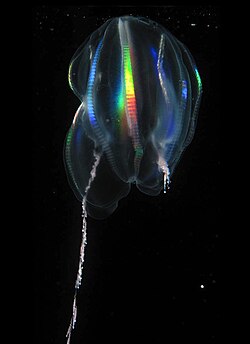
One of the most defining features of the phylum is the presence of comb rows. These are longitudinal bands of fused cilia that beat in coordinated waves, propelling the animal through the water. As light diffracts along these rows, it often creates a shimmering, rainbow-like effect.
Locomotion and Senses
Ctenophores are among the largest animals to move primarily via cilia. Beyond movement, they possess a specialized apical organ—a sensory structure found in species with primary ciliated larvae. Some species also have ocelli, which are simple light-sensing organs that help them navigate their environment.
Feeding and Predation
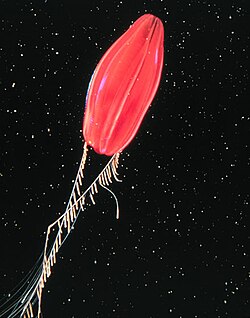
While true jellyfish use cnidocytes (stinging cells) to capture prey, most ctenophores utilize colloblasts. These are specialized adhesive cells that glue prey to the tentacles upon contact. Interestingly, some ctenophores can obtain cnidocytes by ingesting cnidarians and incorporating the stinging cells into their own tissues.
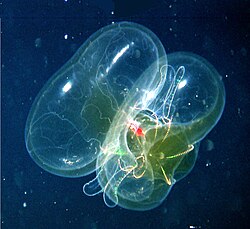
The feeding mechanisms vary by class. For example, the Tentaculata often use long tentacles to snare plankton, while the Lobata utilize paired thick lobes to capture prey.
Taxonomy and Classification
The phylum Ctenophora is divided into several classes, including the Tentaculata, Nuda, and the extinct Scleroctenophora. The Tentaculata class is further subdivided into eight orders based on their physical characteristics:
- Cydippida: Egg-shaped animals characterized by long tentacles.
- Lobata: Distinguished by their paired thick lobes.
- Ganeshida: Feature small lobes around the mouth and an extended pharynx.
- Thalassocalycida: Possess short tentacles and a jellyfish-like "umbrella."
- Cestida: Ribbon-shaped and the largest of all ctenophores.
- Cambojiida, Cryptolobiferida, and others: Specialized groups within the Tentaculata.
Comparison with Other Early Animals
| Feature | Sponges | Cnidarians | Ctenophores |
|---|---|---|---|
| Cnidocytes (Stinging Cells) | No | Yes | Only in some (ingested) |
| Colloblasts (Sticky Cells) | No | No | In most species |
| microRNA | Yes | No | Yes |
| Hox Genes | No | Yes | No |
| Nervous System | No | Yes, simple | Simple to complex |
Life Cycle and Ecology
Ctenophores are primarily gelatinous zooplankton, drifting with ocean currents. They are known for their striking bioluminescence, producing light through photoproteins to communicate or deter predators. Their reproduction is diverse; while many are hermaphrodites, some species, such as Ocyropsis, have separate sexes.
Development is often direct, meaning they do not have a complex larval metamorphosis. However, larval forms, such as those of Bolinopsis sp., are only a few millimeters long and already possess light-sensing organs.
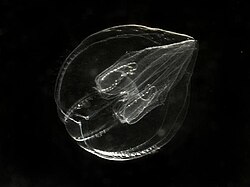
In the wild, ctenophores like Beroe ovata can be found in diverse environments, from the deep sea to the surface of the Black Sea coast, where they play a significant role in the marine food web as both predators and prey.
Frequently Asked Questions
Are comb jellies the same as jellyfish?
No. While they look similar, comb jellies (Ctenophora) are a separate phylum from true jellyfish (Cnidaria). The primary difference is that comb jellies use cilia for movement and sticky colloblasts for hunting, whereas jellyfish use stinging cnidocytes.
How do comb jellies move?
They move using eight rows of cilia, known as comb rows. These hair-like structures beat in a coordinated fashion to propel the animal through the water.
Do comb jellies have a brain?
They do not have a centralized brain like mammals, but they possess a nervous system that ranges from simple to complex, including a specialized apical organ for sensing the environment.
What do comb jellies eat?
Most ctenophores are carnivorous, feeding on other plankton, small crustaceans, and sometimes even other ctenophores, using their sticky tentacles or lobes to capture prey.
Why do comb jellies glow?
Many ctenophores are bioluminescent, meaning they can produce their own light. This is typically used for defense or as a way to interact with their environment in the dark depths of the ocean.