Scilla sect. Chionodoxa: The Vibrant Glory-of-the-Snow
Among the first splashes of color to emerge as winter fades, Scilla sect. Chionodoxa, commonly known as the glory-of-the-snow, stands out as a beacon of early spring. These small, bulbous perennial flowering plants are prized by gardeners for their ability to bloom while snow may still linger on the ground, a habit that earned them their evocative common name.
Native to the eastern Mediterranean—specifically Turkey, Cyprus, and Crete—these plants bring a delicate beauty to the landscape with flowers in shades of blue, white, and pink. While they were once classified as their own distinct genus, modern botanical research has integrated them into the broader Scilla genus.
Key Facts
- Common Name: Glory-of-the-snow.
- Native Range: Eastern Mediterranean (Crete, Cyprus, and Turkey).
- Flower Colors: Blue, white, and pink.
- Bloom Time: Early spring, often coinciding with melting snow.
- Classification: Now a section of the genus Scilla, formerly the genus Chionodoxa.
- Garden Status: Highly valued as hardy ornamentals, often naturalizing in Europe.
Botanical Description
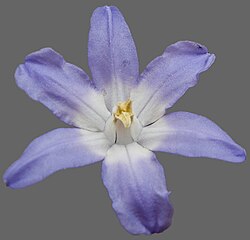
Plants within Scilla sect. Chionodoxa are characterized by their short bulbs. Each bulb typically produces two leaves that are narrow at the base and widen toward the tip. The most striking feature is the flower, where the tepals (petals and sepals that look identical) are joined at the base for approximately 15% to 40% of their total length.
The internal structure of the flower is equally unique. The filaments of the stamens are broadened and usually white, though they can occasionally be blue toward the top. These filaments are joined to the perianth at the base, creating a distinct cup-like appearance in the center of the bloom. The anthers are typically yellow with pale yellow pollen, while the pistil remains hidden behind the stamens.
Taxonomy and Classification
The classification of these plants has been a subject of significant botanical debate. First described as the genus Chionodoxa by Pierre Edmond Boissier in 1844, they were distinguished from Scilla by their joined tepals and flattened stamen stalks.
However, starting in the 1970s, researchers argued that these physical traits were not sufficient to maintain a separate genus. A pivotal 1999 phylogenetic study using plastid DNA (DNA found in chloroplasts) revealed that Chionodoxa species were actually embedded within the Scilla lineage. Consequently, in 2009, Bohumil Trávníček and colleagues proposed treating the group as Scilla sect. Chionodoxa, a classification that is now widely accepted.
Species and Distribution
Identifying specific species within this section can be challenging due to their similarity. For example, plants in Crete were once split into three species (C. albescens, C. cretica, and C. nana), but later checklists reduced this to two, and eventually just one: Scilla nana.
As of March 2020, the World Checklist of Selected Plant Families recognizes the following species:
| Scientific Name | Common Name | Native Region |
|---|---|---|
| Scilla cretica | Cretan glory-of-the-snow | Crete |
| Scilla forbesii | Forbes' glory-of-the-snow | South-west and west Turkey |
| Scilla lochiae | Loch's glory-of-the-snow | Cyprus |
| Scilla luciliae | Lucile's glory-of-the-snow | West Turkey |
| Scilla nana | Dwarf glory-of-the-snow | Crete |
| Scilla sardensis | Lesser glory-of-the-snow | West Turkey |
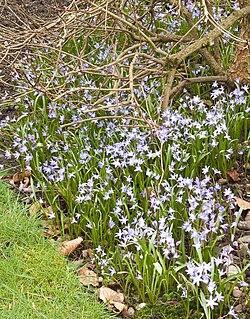
Beyond their native Mediterranean range, these plants have naturalized in several European countries, including the UK, Germany, Austria, and the Netherlands.
Cultivation and Gardening
For the home gardener, Scilla sect. Chionodoxa is a rewarding choice. There has been historical confusion regarding names—specifically between S. luciliae, S. forbesii, and S. siehei—but current consensus often treats S. siehei as a synonym of S. forbesii.
Three species—S. luciliae, S. sardensis, and S. forbesii—have received the RHS Award of Garden Merit, confirming their reliability and beauty in the garden. To grow them successfully, follow these guidelines:
- Planting: Plant dry bulbs while dormant in late summer or early autumn.
- Depth: Set bulbs at a depth of 8–10 cm.
- Light: They require light during their growth phase.
- Placement: They are ideal for planting under deciduous trees or shrubs, as their foliage dies back after flowering, allowing the canopy to provide shade for other plants later in the season.
- Growth Habit: S. forbesii is particularly known for seeding freely, which can create a stunning naturalized carpet of blue flowers.
Frequently Asked Questions
Is Chionodoxa the same as Scilla?
Yes, plants formerly known as Chionodoxa are now classified as a section within the genus Scilla (Scilla sect. Chionodoxa) based on DNA evidence showing they are closely related to other squills.
When is the best time to plant glory-of-the-snow bulbs?
The best time to plant these bulbs is in late summer or early autumn while they are still dormant.
Can these plants grow in the shade?
While they need light during their active growth period in early spring, they are excellent for planting under deciduous shrubs or trees because their foliage disappears before the trees fully leaf out.
Which species is the earliest to bloom?
Among the common species, Scilla sardensis is usually the first to flower in the spring.
What colors are available for garden cultivars?
While purplish-blue is the most common color, Scilla forbesii is also available in pink and white cultivars.