Asparagus: The Complete Guide to the "Royal Vegetable"
As spring arrives, few vegetables are as highly anticipated as asparagus. Known in some circles as "white gold" or the "royal vegetable," this perennial plant is prized for its tender shoots and distinct flavor. From its ancient roots in Eurasia to its status as a global culinary staple, asparagus combines fascinating botany with a rich cultural history.
Botanical Overview and Description
The garden asparagus, scientifically known as Asparagus officinalis, is a perennial flowering plant native to Eurasia. It typically grows between 100 and 150 centimeters tall, though some specimens can reach up to 3.5 meters. The plant is characterized by stout stems and feathery foliage.
Interestingly, what appear to be leaves are actually cladodes—modified stems that are needle-like and clustered in rose-like shapes. The plant's root system, often called a "crown," is fasciculated (growing in bundles) and adventitious. The flowers are small, bell-shaped, and range from greenish-white to yellowish. While the plant produces small red berries, these are toxic to humans.
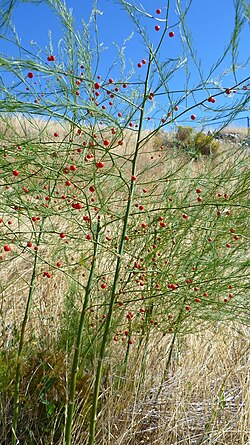
In terms of taxonomy, asparagus was once grouped with lilies. However, modern genetic research has placed it in its own family, Asparagaceae, within the order Asparagales. A specific subspecies, A. officinalis subsp. prostratus, is found along the western coasts of Europe and is distinguished by its lower-growing, prostrate stems.
Key Facts
- Scientific Name: Asparagus officinalis.
- Primary Production: China produces 87% of the world's asparagus.
- Nutritional Powerhouse: Exceptionally high in Vitamin K (35% DV) and Copper (21% DV).
- Edible Part: Only the young shoots, or "spears," are consumed.
- Toxic Element: The red berries produced by the adult plant are toxic to humans.
- Conservation Status: Listed as Least Concern by the IUCN.
Varieties of Asparagus
While most people are familiar with green asparagus, there are several distinct varieties based on cultivation and genetics:
Green Asparagus
The most common variety worldwide, green asparagus grows with exposure to sunlight, allowing it to undergo photosynthesis.
White Asparagus
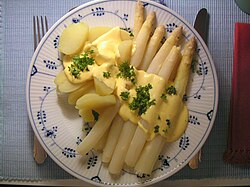
White asparagus is created through a process called blanching. Growers cover the shoots with soil (earthing up) to prevent sunlight from reaching them. Because no photosynthesis occurs, the spears remain white. This variety is often considered more tender and less bitter than green asparagus.
Purple Asparagus
Originally developed in Italy near Albenga (the 'Violetto d' Albenga' variety), purple asparagus is characterized by higher sugar levels and lower fiber. Notably, it can turn green when cooked due to its sensitivity to heat.
Cultivation and Global Production
Asparagus thrives in maritime environments and can tolerate saline soils that often suppress common weeds. Growers plant "crowns" in the winter, and the first shoots emerge in spring. The very first thin pickings of the season are referred to as sprue asparagus.
In the garden, asparagus is an excellent companion plant for tomatoes. The tomato plant helps repel the asparagus beetle, while asparagus may repel certain root nematodes that harm tomatoes.
Global production is dominated by a few key regions. In 2023, world production reached 8.6 million tonnes.
| Country | Production (Million Tonnes) |
|---|---|
| China | 7.44 |
| Peru | 0.36 |
| Mexico | 0.35 |
| Germany | 0.11 |
| World Total | 8.59 |
Nutrition and Culinary Uses
Raw asparagus is composed of 93% water and is very low in calories (20 kcal per 100g). It is a rich source of Vitamin K and copper, and provides moderate amounts of iron, folate, thiamine, and riboflavin.
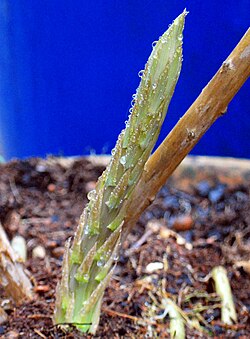
In the kitchen, only the young spears are eaten. Once the buds begin to open—a process known as ferning out—the shoots quickly become woody and inedible. Stem thickness is determined by the age of the plant rather than the age of the stalk; older plants produce thicker stems.
Preparation methods vary by region:
- Asian Style: Often stir-fried with proteins like chicken, shrimp, or beef.
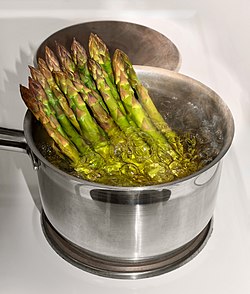
- French Style: Typically boiled or steamed and served with Hollandaise sauce, melted butter, or Parmesan cheese.
- Preservation: Asparagus can be pickled or marinated for long-term storage.
To ensure the best texture, some chefs peel the skin at the base of thicker stalks to remove the tough outer layer, which also allows the spears to poach faster.
The Science of the "Asparagus Smell"
One of the most famous characteristics of asparagus is its effect on urine. This occurs because asparagus contains asparagusic acid. During digestion, this acid is broken down into volatile sulfur-containing compounds, such as methanethiol and dimethyl sulfide.
Interestingly, not everyone experiences or detects this scent. Research suggests that a small portion of the population does not produce these compounds, while others possess a single-nucleotide polymorphism in their olfactory receptors that prevents them from smelling the odor.
Cultural History and Traditions
Asparagus has been enjoyed since antiquity. Emperor Augustus reportedly used the phrase "faster than cooking asparagus" to describe quick action, and the 1st-century Roman cookbook De re coquinaria by Apicius includes asparagus recipes. It was later popular in the Byzantine Empire and was brought to North America by European settlers as early as 1655.
Today, the harvest is celebrated with various festivals. Michigan's Oceana County and the Vale of Evesham in the UK both claim titles as "asparagus capitals," while many German cities host Spargelfest to celebrate the white asparagus harvest.
Frequently Asked Questions
Why is white asparagus white?
White asparagus is grown using a technique called blanching, where the shoots are covered with soil to block sunlight. This prevents photosynthesis, keeping the spears white and often resulting in a more tender flavor.
Are all parts of the asparagus plant edible?
No. Only the young shoots (spears) are commonly eaten. The adult plant produces red berries that are toxic to humans.
Why does my urine smell after eating asparagus?
The smell is caused by the breakdown of asparagusic acid into volatile sulfur compounds. Whether you can smell this is determined by both your body's metabolism and your genetic ability to detect those specific odors.
How can I tell if asparagus is too old to eat?
When the tips of the spears begin to open and spread into feathery foliage (a process called "ferning out"), the stalk becomes woody and loses its culinary appeal.
What is the difference between purple and green asparagus?
Purple asparagus generally has higher sugar levels and lower fiber than green asparagus. It is also heat-sensitive and may turn green during the cooking process.