Scientific American: A Legacy of Popular Science and Innovation
Founded in 1845, Scientific American stands as one of the oldest and most influential publications in the United States. What began as a modest four-page weekly newspaper has evolved into a global authority on popular science, bridging the gap between complex academic research and the general public for nearly 180 years.
Key Facts
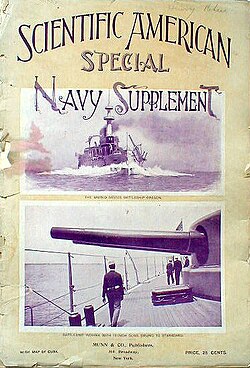
- Founded: August 28, 1845, by Rufus Porter.
- Current Publisher: LabX Media Group.
- Frequency: Monthly (transitioned from weekly in 1921).
- Global Reach: Multiple international editions including Italian, Japanese, Spanish, French, German, and Russian.
- Notable Recognition: Recipient of seven Telly Awards in 2024 for excellence in video and television content.
The Early Years and the Age of Invention
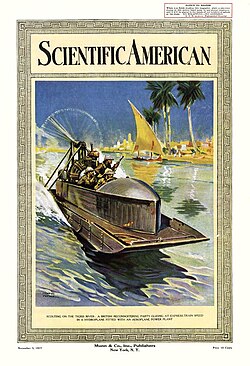
The magazine was launched in New York City by inventor and publisher Rufus Porter. In its infancy, the publication served as a vital record of the U.S. Patent Office, documenting the rapid technological advancements of the 19th century. It covered a diverse array of inventions, ranging from the universal joint—a component now standard in almost every modern automobile—to an 1860 vessel-buoying device created by Abraham Lincoln.
During this era, the magazine celebrated the pioneers of American industry and engineering, often featuring the inventors who shaped the modern world.
!["Men of Progress", published by the magazine in 1862, showing American inventors such as Samuel Morse, Samuel Colt, Cyrus McCormick, Charles Goodyear, Peter Cooper, and others[1]](/images/90/8c/908cd4dc7a4a5928b183a26d84f349dad797bdd079fee0b2c830092e27cf9147.jpg)
Evolution of the New York Offices
As the publication grew, so did its physical presence in Manhattan. Early offices were located at 361 Broadway and 37 Park Row.
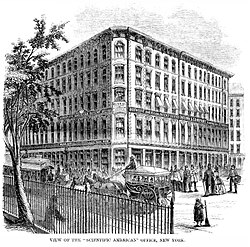
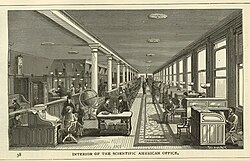
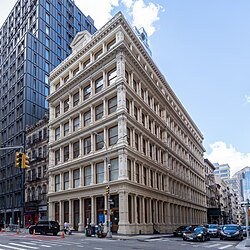
By 1915, the magazine moved into the Woolworth Building, which was constructed in 1913 by Frank Winfield Woolworth. At the time of its completion, the Woolworth Building was the tallest skyscraper in the world. Later, in 1924, Munn and Co. commissioned a dedicated building at 24-26 West 40th Street.
![A 2011 photo of Scientific American's office at the Woolworth Building in New York City, built in 1913 by Frank Winfield Woolworth[7]](/images/0a/f3/0af30d7963e29f645b587af37d7fc2ae7c58eb650b6a9a5f7b801540cb10a5c4.jpg)
![The Scientific American building at 24-26 West 40th Street, commissioned by Munn and Co. in 1924[7]](/images/2b/9b/2b9b94102ecfc6591a8d622af292ac0780f74d704cec132193505b9c9b095954.jpg)
Mid-Century Transformation and Growth
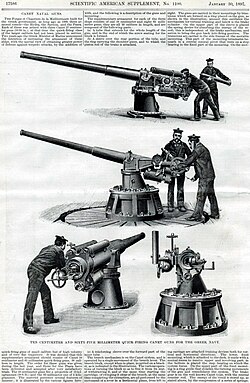
Following World War II, the magazine experienced a period of decline. This trend reversed in 1948 when Gerard Piel, Dennis Flanagan, and Donald H. Miller Jr. purchased the assets of the publication. Originally intending to start a new magazine called The Sciences, the trio instead applied their modern designs and editorial vision to the established Scientific American brand.
This strategic pivot led to an explosion in popularity; by the time Jonathan Piel took over as president and editor in 1984, circulation had increased fifteen-fold compared to 1948 levels.
Global Expansion and Specializations
Scientific American expanded its reach far beyond U.S. borders. While its first foreign-language attempt (a Spanish edition titled La América Científica é Industrial) began in 1890 and ended in the early 1900s, later efforts were more sustainable.
The magazine established a strong international network, including Le Scienze (Italy, 1968), Nikkei Science (Japan, 1971), Investigación y Ciencia (Spain, 1976), Pour la Science (France, 1977), Spektrum der Wissenschaft (Germany, 1978), and V Mire Nauki (Russia).
Special Issues and Notable Columns
The publication is well-known for its quarterly special editions, which dive deep into themes such as climate change, economics, evolution, and space settlement. Recent 2024 issues have explored the "cosmic nothing," the cosmological constant, and early-human hunter-gatherer social structures.
The magazine has also hosted legendary columns that challenged readers' intellects, including Martin Gardner's Mathematical Games, Douglas Hofstadter's Metamagical Themas, and Michael Shermer's Skeptic column.
Political Engagement and Modern Era
While historically neutral, the magazine has recently taken unprecedented steps into political endorsement based on scientific integrity. In October 2020, it endorsed Joe Biden, citing the rejection of scientific evidence during the COVID-19 pandemic. In September 2024, it issued its second-ever endorsement, backing Kamala Harris for the same reasons.
In the digital age, the publication has expanded into multimedia, producing the Scientific American Library encyclopedia set (1983–1997) and winning numerous Telly Awards for its visual scientific compositions.
| Attribute | Details |
|---|---|
| Founded | August 28, 1845 |
| Founder | Rufus Porter |
| Current Publisher | LabX Media Group |
| Format | Monthly Magazine & Website |
| ISSN | 0036-8733 |
Frequently Asked Questions
Who founded Scientific American?
The magazine was founded by inventor and publisher Rufus Porter on August 28, 1845, originally as a four-page weekly newspaper in New York City.
How has the publication frequency changed over time?
Scientific American began as a weekly publication in 1845 and transitioned to a monthly format in November 1921.
Does the magazine have international versions?
Yes, it has several international editions, including versions in Italian (Le Scienze), Japanese (Nikkei Science), Spanish (Investigación y Ciencia), French (Pour la Science), German (Spektrum der Wissenschaft), and Russian (V Mire Nauki).
Has Scientific American ever endorsed political candidates?
Yes. Despite a 175-year history of neutrality, the magazine endorsed Joe Biden in 2020 and Kamala Harris in 2024, citing the importance of adhering to scientific evidence in governance.
What are some of the most famous columns in the magazine's history?
Notable features include Martin Gardner's Mathematical Games, Douglas Hofstadter's Metamagical Themas, and the Amateur Scientist column.