Saint Columba: The Apostle to the Picts and Founder of Iona
Saint Columba, also known as Colmcille, was a pivotal Irish abbot and missionary who shaped the spiritual landscape of the early Middle Ages. Recognized as the Apostle to the Picts, he spearheaded the Hiberno-Scottish mission, bringing Christianity to the regions of what is now Scotland. His most enduring legacy is the foundation of the abbey on Iona, which served as a dominant religious and political powerhouse for centuries.
Venerated across the Catholic, Eastern Orthodox, Anglican, and Lutheran churches, Columba is remembered as one of the Twelve Apostles of Ireland and serves as a patron saint for Derry, bookbinders, poets, and the nations of Ireland and Scotland.
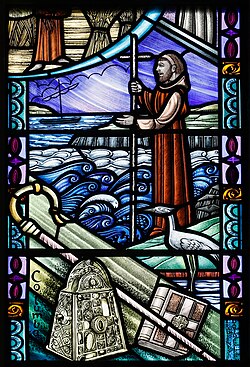
Key Facts
- Born: December 7, 521 AD in Gartan, Tyrconnell, Ireland.
- Died: June 9, 597 AD (aged 75) on Iona, Dál Riata.
- Major Achievement: Founded the monastery on Iona, a center of European learning.
- Patronage: Derry, Ireland, Scotland, poets, bookbinders, and protection against floods.
- Feast Day: June 9.
Early Life and Conflict in Ireland
Columba's early years were marked by a deep commitment to scholarship and monasticism. However, tradition recounts a famous dispute around 560 AD with Finnian of Moville over a psalter (a book of psalms). Columba had copied the manuscript in the scriptorium and wished to keep the copy, a right Finnian disputed. This manuscript is traditionally identified as the Cathach of St. Columba.
Some accounts suggest this quarrel led to the Battle of Cúl Dreimhne in 561 AD, resulting in significant loss of life. While some historians caution against linking the battle directly to the psalter dispute, annals indicate Columba supported his own king against the high king. Other political tensions existed, including the violation of Columba's right of sanctuary as a monk during the murder of his kinsman, Prince Curnan.
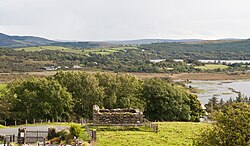
Despite these conflicts, Columba continued his religious work in Ireland, founding the monastery of Drumcliff in County Sligo around 574/575 AD during his return for the Synod of Drum Ceat.
Mission to Scotland and the Picts
Columba's move to Scotland marked the beginning of a transformative era for the region. He established his abbey on Iona, which became a beacon of literacy and faith. His efforts to convert the Picts are legendary, often blending historical mission work with tales of the supernatural.
One of the most famous stories from 565 AD describes Columba encountering a ferocious "water beast" in the River Ness. After the creature killed a Pict and attempted to attack Columba's disciple, Lugne, the saint is said to have banished the beast to the depths. This account is frequently cited in modern discussions regarding the Loch Ness Monster.
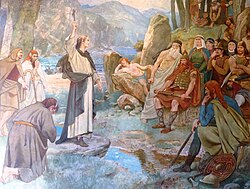
Columba's influence extended to the highest levels of power. Both the Vita Columbae (Life of Columba) and the writings of the historian Bede record his visit to King Bridei. While the Vita Columbae focuses on the visit, Bede records a tradition that Columba successfully converted the Pictish king.
Death, Relics, and Viking Raids
Traditional sources state that Columba died on Sunday, June 9, 597, and was buried within his abbey on Iona. However, some scholars, such as Dr. Daniel P. Mc Carthy, suggest an earlier death date of 593 AD.
The sanctuary of Iona eventually became a target for invaders. The Annals record the first Viking raid in 795 AD, with subsequent attacks in 802, 806, and 825 AD. To protect the saint's remains, his relics were removed in 849 AD and divided between Scotland and Ireland.
Enduring Legacy
Influence in Ireland
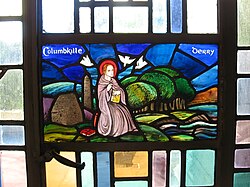
In Ireland, Colmcille is the patron saint of Derry, where he founded a monastic settlement around 540 AD. The city's Irish name, Doire Cholm Cille, reflects this association. His legacy persists in the city's landmarks, including St. Columb's Cathedral and St. Columb's College. Additionally, the town of Swords in County Dublin is reputedly his foundation from 560 AD. As of June 2025, a new public holiday in his honor is pending approval from the Irish Government.
Cultural and Artistic Impact
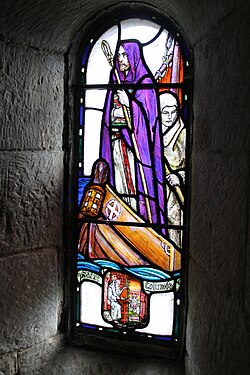
Columba's intellectual legacy is preserved in poetry and music. The Amra Coluim Chille, written shortly after his death, is considered the earliest vernacular poem in European history. He is also credited with the Latin poem "Adiutor Laborantium," an Abecedarian hymn addressing God as a protector of the good. In 1962, composer Benjamin Britten honored the 1,400th anniversary of Columba's voyage to Iona with A Hymn of St Columba.
The Warrior Saint and the Brecbennoch
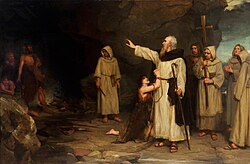
Historically, Columba was revered as a warrior saint. His relics were often carried into battle for victory. The Brecbennoch, a reliquary made at Iona in the mid-8th century, was allegedly carried by the Scottish army at the Battle of Bannockburn in 1314. While the Monymusk Reliquary was long identified as the Brecbennoch, modern scholars now doubt this connection.
| Category | Details |
|---|---|
| Primary Role | Abbot, Missionary, Apostle to the Picts |
| Key Foundations | Iona Abbey (Scotland), Derry (Ireland), Drumcliff (Ireland) |
| Major Source | Vita Columbae by Adomnán |
| Key Relic | Brecbennoch (Reliquary) |
| Associated Legend | Banishment of the River Ness water beast |
Frequently Asked Questions
Who was Saint Columba?
Saint Columba (or Colmcille) was an Irish abbot and missionary who spread Christianity in Scotland and founded the influential monastery on Iona. He is one of the patron saints of Ireland and the patron saint of Derry.
What is the significance of the psalter dispute?
The dispute involved a disagreement between Columba and Finnian of Moville over the ownership of a copied manuscript of the psalms. Tradition suggests this conflict may have contributed to the Battle of Cúl Dreimhne in 561 AD.
Did Saint Columba encounter the Loch Ness Monster?
While not the "monster" as known today, the Vita Columbae records that in 565 AD, Columba banished a ferocious water beast in the River Ness after it had killed a Pict and threatened his disciple.
What is the Vita Columbae?
The Vita Columbae (Life of Columba) is a hagiography written by Adomnán, one of Columba's successors at Iona. It is the primary historical source for information regarding the saint's life and miracles.
What happened to the relics of Saint Columba?
Following a series of Viking raids on Iona between 795 and 825 AD, Columba's relics were removed in 849 AD and divided between Ireland and Scotland for safekeeping.