Bridei I: The Enigmatic King of the Picts
In the misty landscape of 6th-century Scotland, few figures are as intriguing yet elusive as Bridei I. Ruling as King of the Picts from 554 to 584, Bridei presided over a period of significant cultural and religious transition. While historical records from this era are often contradictory or vague, Bridei remains a pivotal figure in the early history of the British Isles, particularly through his association with the spread of Christianity.
Key Facts
- Reign: 554–584 AD.
- Title: King of the Picts.
- Successor: Gartnait II (son of Domelch).
- Key Association: Contemporary of Saint Columba.
- Death: Circa 586, possibly in battle in Circinn (the Mearns).
Historical Records and Identity
Our knowledge of Bridei comes primarily from early Irish annals and hagiographies. In the Annals of Ulster, he is mentioned between 558 and 560, where records describe a "migration" or "flight of the Scots" before him. Variations of his name appear across different sources, including Brude son of Melcho and the Irish Bruide son of Maelchú.
There is some academic debate regarding his lineage. While some sources identify him as the son of Maelchon, the author John Morris suggested he was the son of Maelgwn Gwynedd, a powerful king of north Wales. However, many historians view Morris's claims as unreliable and lacking rigorous evidence.
Political Power and the Pictish Court
Bridei's authority was significant, but he was not the sole ruler claiming the title of "King of the Picts." For instance, the Annals of Ulster record the death of another king, Galam Cennalath, in 580—four years before Bridei's own passing. Furthermore, the presence of an "under-king of Orkney" at Bridei's court suggests a complex hierarchy of power and vassalage.
The exact location of Bridei's royal seat remains a subject of archaeological debate. Adomnán, in his Life of Saint Columba, describes the court as being situated atop a steep rock near the River Ness. This led some to propose Craig Phadrig (near modern Inverness) as the site. However, excavations indicate that the ramparts there were in poor repair during Bridei's era, making it an unlikely royal fortress. It is possible his kingdom corresponded with the region later known as Fortriu.
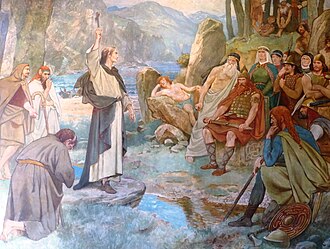
Faith and the Influence of Saint Columba
One of the most enduring narratives surrounding Bridei is his relationship with Saint Columba. Adomnán's accounts are ambiguous regarding whether Bridei was already a Christian or if he was converted by the saint. While the later historian Bede explicitly states that Columba converted him, contemporary scholars remain divided.
Archaeological evidence provides a clue: discoveries at Portmahomack reveal a monastic community existing from around 550. This suggests that Christianity had already established a foothold in the region, supporting the theory that Bridei may have been a Christian—at least nominally—prior to or during Columba's mission.
| Attribute | Details |
|---|---|
| Reign Dates | 554–584 AD |
| Predecessor | Galam Cennalath |
| Successor | Gartnait II |
| Probable Court Location | Near Loch Ness / Fortriu |
| Religious Affiliation | Christian (confirmed or converted) |
Legacy in Popular Culture
Beyond the academic texts, Bridei has inspired modern storytelling. Juliet Marillier's The Bridei Chronicles trilogy blends historical facts with fiction to imagine the king's rise to power and his subsequent rule, bringing the enigmatic figure of the 6th century to a wider audience.
Frequently Asked Questions
Who was Bridei I?
Bridei I was the King of the Picts who ruled from 554 to 584 AD. He is best known for his interactions with Saint Columba and his role as a primary leader in early Scotland.
Did Saint Columba convert King Bridei?
The records are contradictory. While Bede claims Columba converted him, Adomnán's accounts are vague, and archaeological evidence of a monastic community at Portmahomack suggests Christianity may have already been present.
Where was Bridei's court located?
It is believed to have been near the River Ness. While Craig Phadrig was once a candidate, archaeological evidence suggests it was not a royal fortress at the time; his kingdom likely aligned with the later region of Fortriu.
How did Bridei I die?
Bridei died around 584–586 AD. Some historical sources, such as the Annals of Tigernach, suggest he may have fallen in battle against Pictish rivals in the area of Circinn (the Mearns).
Was he the only King of the Picts?
No. During his lifetime, other individuals also claimed the title, including Galam Cennalath, who died in 580 AD.