Sahih al-Bukhari: The Compilation and Transmission of an Authentic Hadith Collection
The Sahih al-Bukhari stands as one of the most significant works in Islamic scholarship, representing a rigorous effort to preserve the authentic traditions of the Prophet Muhammad. Compiled by Muhammad ibn Isma'il al-Bukhari, this collection was born from a desire to separate sound narrations from those that were weak or unreliable.
Bukhari's journey began at the age of 16, as he traveled extensively throughout the Abbasid Caliphate. During these travels, he encountered various hadith collections containing a mix of ṣaḥīḥ (authentic/sound), hasan (good), and daʻīf (weak) narrations. This observation sparked his ambition to create a definitive volume consisting exclusively of narrations whose authenticity was beyond doubt.
Two pivotal moments solidified his resolve. First, his teacher, Ishaq Ibn Rahwayh, suggested the compilation of a book containing only authentic narrations. Second, Bukhari recounted a dream in which he stood before the Prophet, protecting him with a fan. Dream interpreters explained this as a sign that he would protect the Prophet from lies. Driven by these experiences, Bukhari began his monumental task.
The Rigorous Standards of Collection
To ensure the highest level of accuracy, Bukhari established four strict conditions that every narrator in a chain of transmission had to meet for a hadith to be included in the Sahih:
- Moral Integrity: The narrator must be just.
- Intellectual Capacity: The narrator must possess a strong memory, and scholars of hadith must agree on their ability to learn, memorize, and report accurately.
- Complete Isnad: The isnad (chain of narrators) must be complete, with no missing links.
- Direct Connection: Consecutive narrators in the chain must have actually met one another.
Bukhari began organizing the work in the Masjid al-Haram in Mecca and continued in the Al-Masjid an-Nabawi in Medina. He completed the book in Bukhara around 846 CE (232 AH). Following its completion, he presented the work to esteemed scholars including Ali ibn al-Madini, Ahmad ibn Hanbal, and Yahya ibn Ma'in. While they initially questioned four hadiths, they eventually testified to the authenticity of the entire collection.
Bukhari spent the final twenty-four years of his life revising the text and teaching it to thousands of students across various cities.
Transmission and Versions
The Sahih al-Bukhari was transmitted through various students, and each version is typically named after its narrator. While the scholar Ibn Hajar asserted that the number of narrations remains consistent across versions, other works, most notably Fath al-Bari, document specific differences between them.
The most influential version today is that transmitted by Muhammad ibn Yusuf al-Firabri (died 932), a trusted student of Bukhari. Al-Khatib al-Baghdadi noted that approximately seventy thousand people heard the Sahih from al-Firabri. All modern printed editions are derived from this specific transmission. Other notable transmitters include Ibrahim ibn Ma'qal, Hammad ibn Shakir, Mansur Burduzi, and Husain Mahamili.
Example Chain of Transmission
The transmission of the Sahih from Imam Bukhari to the present day follows a precise lineage. One such chain progresses from Abu ʿAbd Allāh Muḥammad ibn Yūsuf ibn Maṭar al-Farabrī to subsequent scholars including Ibn Hajar al-ʿAsqalānī, and continuing through generations to contemporary figures such as Sheikh Ali al-Jifri.
Manuscripts and Historical Records
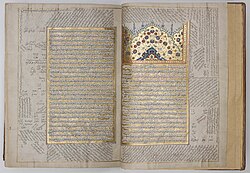
The sheer volume of extant manuscripts makes a precise count difficult. A 1991 catalog from the Royal Āl al-Bayt Institute listed 2,327 manuscripts, and a 2016 study found over 1,500 in Turkey alone.
| Manuscript / Source | Date (AH/CE) | Key Detail |
|---|---|---|
| Oldest Known Copy | 360–390 AH / 970–1000 CE | Transmitted via al-Marwazī; analyzed by Anas Wakāk. |
| Süleymaniye Library Copy | 550 AH / 1155 CE | Oldest complete surviving manuscript; completed in Al-Andalus. |
| Al-Ṣadafī Copy | 508 AH / 1114 CE | Written on 21 Muharram. |
| Ibn Sa'ada Copy | 492 AH / 1098-1099 CE | Three of five volumes survive in Morocco. |
Key Facts
- Completion Date: Approximately 846 CE (232 AH).
- Primary Goal: To compile only authentic (ṣaḥīḥ) narrations, excluding weak (daʻīf) ones.
- Core Requirement: Narrators must be just, have strong memories, and have a continuous, unbroken chain of meeting.
- Primary Transmission: Most modern prints are based on the version by Muhammad ibn Yusuf al-Firabri.
- Manuscript Volume: Thousands of copies exist, with over 1,500 in Turkey alone.
Frequently Asked Questions
What motivated Imam Bukhari to write the Sahih?
Bukhari was motivated by the presence of weak narrations in existing collections, a suggestion from his teacher Ishaq Ibn Rahwayh to compile only authentic hadiths, and a dream in which he protected the Prophet from lies.
What are the four conditions for a hadith to be included in the Sahih?
The narrator must be just; they must have a strong memory recognized by scholars; the isnad (chain) must be complete; and the narrators in the chain must have met each other.
Which version of the Sahih is most commonly used today?
The version transmitted by Muhammad ibn Yusuf al-Firabri is the most famous and serves as the basis for all modern printed editions.
Where is the oldest complete manuscript located?
The oldest complete surviving manuscript is housed at the Süleymaniye Library, completed in Al-Andalus on October 2, 1155 CE (3rd Sha'ban 550 AH).
How did other scholars react to the completed work?
Scholars such as Ali ibn al-Madini and Ahmad ibn Hanbal examined the work and testified to its authenticity, eventually agreeing that even the few questioned hadiths were authentic.