Safavid Dynasty: The Architects of Modern Iran
The Safavid dynasty was a transformative power that ruled Iran from 1501 to 1722, with brief restorations occurring between 1729 and 1736 and again from 1750 to 1773. At the zenith of its power, the empire extended far beyond the borders of modern Iran, controlling Azerbaijan, Bahrain, Armenia, eastern Georgia, parts of the North Caucasus (including Russia), Iraq, Kuwait, and Afghanistan, as well as territories in Turkey, Syria, Pakistan, Turkmenistan, and Uzbekistan.
Founded by Ismail I, the dynasty is credited with reviving the concept of Iran as a centralized political state and establishing Twelver Shia Islam as the official state religion, a move that fundamentally reshaped the cultural and religious landscape of the region.

Key Facts
- Founded: December 22, 1501, by Ismail I.
- Capital/Origin: Originated in Ardabil, Iran.
- State Religion: Twelver Shia Islam.
- Peak Territory: Spanned from the North Caucasus to Afghanistan and Iraq.
- Final Ruler: Abbas III (ruled 1732–1736).
- Regnal Titles: Shahanshah of Iran, Shadow of God, Soltan, and Mirza.
Genealogy and the Quest for Legitimacy
The Safavids underwent a significant shift in how they justified their right to rule. Upon capturing the Iranian throne in 1501, the source of their legitimacy transitioned from the Chinggisids (descendants of Genghis Khan) to the Alids (descendants of Ali, the cousin and son-in-law of the Prophet Muhammad).
Historical records suggest the dynasty had Sunni Kurdish origins. However, during their revolutionary phase between 1447 and 1501, leaders of the Safavid order began claiming ancestry from the family of Muhammad. This was formalized by altering the Safvat al-safa, a hagiography of the order's ancestor, Safi al-Din Ardabili, written by Ibn Bazzaz in 1350. These revisions replaced their Kurdish background with Arab descent to strengthen their religious and political authority.
![Portrait of Shah Ismail I, painted from life by Kamal al-din Behzad, his director of the royal atelier (posthumous copy). Topkapı Palace Museum, H.2169.[17][18][19]](/images/b7/b3/b7b3cf156df3151162dc71821706f66fde24604764f2adffc2fd3a7d4cbb15e0.jpg)
Culture and the Revival of the Iranian State
Following the fall of the Sasanian Empire in the 7th century, Iran ceased to exist as a formal political state, though national sentiment persisted. This notion of a unified Iranian identity was revived under the Mongol Ilkhanate (1256–1335), where Mongol patrons supported the Shahnameh (the Book of Kings), the national epic of Iran.
The Safavids synthesized these historical currents, utilizing the New Persian language as a primary cultural tool. By directing centuries of cultural achievements into a cohesive state identity, the Safavids created a resilient heritage that survived the eventual collapse of their government and the later pressures of Russian cultural expansion in the 19th century.
Art and Patronage
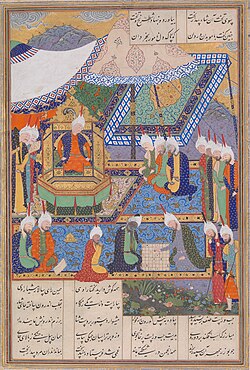
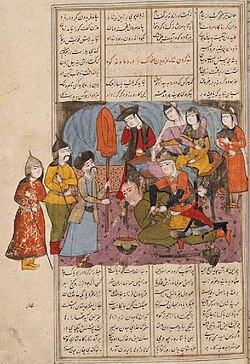
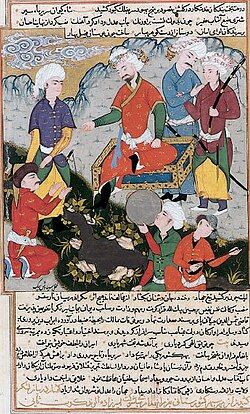
The dynasty is renowned for its sponsorship of an Iran-Islamic style of culture. This included monumental architecture, court poetry, and intricate painting. The Safavids commissioned elaborate copies of the Shahnameh to bolster the prestige of the state and link their monarchy to the glory of ancient Persian traditions.
The Safavid Rulers
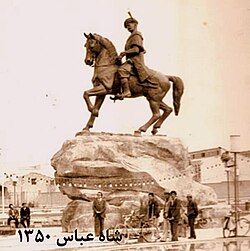
The dynasty was led by a series of Shahs who navigated the complexities of empire-building and internal power struggles. While Ismail I established the foundation, Shah Abbas I (the Great) is often remembered for his efforts toward centralization and military strength.
| Ruler | Reign Period |
|---|---|
| Ismail I | 1501–1524 |
| Tahmasp I | 1524–1576 |
| Ismail II | 1576–1578 |
| Mohammad Khodabanda | 1578–1587 |
| Abbas I | 1587–1629 |
| Safi | 1629–1642 |
| Abbas II | 1642–1666 |
| Suleiman I | 1666–1694 |
| Soltan Hoseyn | 1694–1722 |
| Tahmasp II | 1722–1732 |
| Abbas III | 1732–1736 |
Cadet Branches and the Bahrami-Safavids
To maintain central control, Safavid shahs often confined princes to the harem. Despite this, the Bahrami-Safavid line—descendants of Bahram Mirza Safavi (son of Ismail I)—maintained significant power from 1517 to 1593. Under pressure from Shah Abbas I's centralization policies, this branch migrated to India in the 1590s.
In India, they remained influential for two centuries. Notable members included Rustam Mirza Safavi, a courtier and subahdar, as well as Dilras Banu Begum and Kandahari Begum, who became wives of Mughal emperors.
Frequently Asked Questions
Who founded the Safavid dynasty?
The dynasty was founded by Ismail I on December 22, 1501, who established the state in Ardabil and declared Twelver Shia Islam as the official religion.
What was the significance of the Shahnameh to the Safavids?
The Safavids used the Shahnameh, the Iranian national epic, as a tool for political legitimacy, commissioning elaborate copies to link their regime to the historic Iranian monarchy and ancient Persian glory.
How did the Safavids change their family history?
Originally of Sunni Kurdish background, the Safavids altered their hagiographies during their revolutionary phase (1447–1501) to claim Alid ancestry, tracing their lineage back to the family of the Prophet Muhammad.
Which territories did the Safavid Empire control at its peak?
At its height, the empire controlled all of modern Iran, Azerbaijan, Bahrain, Armenia, eastern Georgia, Iraq, Kuwait, Afghanistan, and parts of Turkey, Syria, Pakistan, Turkmenistan, and Uzbekistan.
What happened to the Bahrami-Safavid branch?
Due to centralization efforts by Shah Abbas I, the Bahrami-Safavid line migrated to India in the 1590s, where they remained influential in the Mughal court for two centuries.