Royal Mint of Denmark: A Millennium of Coinage History
The production of coins in Denmark is a tradition spanning approximately 1,000 years. While early coinage was decentralized across various towns, the evolution of the Royal Mint reflects the growth of Copenhagen and the shifting administrative needs of the Danish monarchy. From humble cellars to purpose-built industrial facilities, the journey of Danish currency is etched into the very geography of the capital.
The Early Years in Copenhagen
The first king to establish coin production within Copenhagen was King Hans. Historical records suggest that this early operation took place in the cellar of his residence. Today, these vaulted premises are located at Vingårdstræde 6, owned by Magasin du Nord and serving as part of the restaurant Kong Hans Kælder.
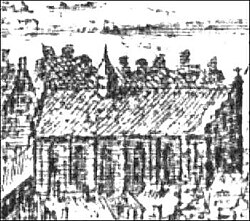
In 1541, the Royal Mint moved to the grounds of the former St. Clare's Monastery. This site had been confiscated in 1536 during Denmark's official transition to a Lutheran nation. The legacy of this location persists in the city's layout; the street Gammel Mønt (Old Mint) was named to commemorate the mint's occupation of the monastery gardens.
A Period of Transition and New Currency
The mint's location shifted frequently during the late 16th and 17th centuries. In 1575, the monastery site was handed over to a German congregation, prompting a move to Bremerholm, the Royal Naval dockyards. The operation likely utilized the anchor forge, a building that was later converted into the Church of Holmen. By 1593, the mint returned to the former monastery.
Between 1614 and 1661, production primarily shifted to Copenhagen Castle, though other sites remained in use. A significant milestone occurred in 1625 with the introduction of the Danish rigsdaler, a new currency for the realm.
The Borgergade Era and the Heart Symbol
From 1664 to 1680, Gotfred Krüger served as the king's mint master. In 1671, he acquired a property in Borgergade, while coin production continued in a neighboring building until 1749. The Mint Master's House was eventually dismantled in 1943 and later reconstructed at the Old Town open-air museum in Aarhus.
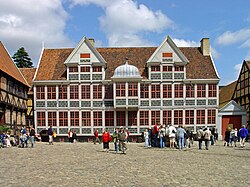
It was during the Borgergade period that the tradition of printing a heart on Danish coins began. While the origin of the symbol is debated, it is widely assumed to represent the locality rather than the mint master's family, as the initials "CW" for Winekes frequently appear alongside the heart on coins from this era.
Expansion at Gammelholm and Holbergsgade
In 1749, a new Mint was established at Nyhavn within the royal mews behind Charlottenborg Palace. These buildings, situated where Holbergsgade crosses the Nyhavn Bridge, were demolished in the early 1870s during the redevelopment of the Gammelholm area.
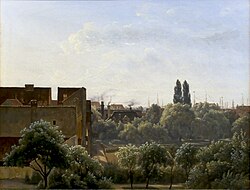
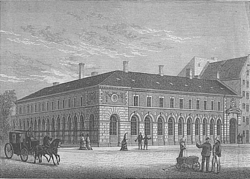
A dedicated Mint building was completed in 1873 at the corner of Holbergsgade and Herluf Trolles Gade. Designed by Ferdinand Meldahl—who also planned the surrounding neighborhood—in collaboration with City Architect Ludvig Fenger, this building still stands today.
During this period, specialized coinage was also produced. Starting in 1894, the company Fritz Meyer in Gothersgade (No. 14) manufactured specific coins for use in Angmagssalik, Greenland.
Modernization and the Move to Amager
In 1923, the Royal Mint moved to a new facility at Amager Boulevard 115 on Amager, designed by Martin Borch. This building has since transitioned from industrial use to residential and commercial space; it is currently owned by M. Goldschmidt Holding and houses 150 youth housing units and 23 offices.
The administrative structure changed in 1975 when the Danish government placed the Royal Mint under the control of the Danish Central Bank. In 1978, the mint relocated to Solmarksvej in Brøndby. Most recently, in March 2012, the mint's offices returned to Copenhagen, moving into the Danish Central Bank building on Havnegade.
Key Facts
- Longevity: Coin production in Denmark dates back approximately 1,000 years.
- First Copenhagen Site: Began in the cellar of King Hans' house (now Kong Hans Kælder).
- Currency Milestone: The Danish rigsdaler was introduced in 1625.
- Iconic Symbol: The heart symbol on coins originated during the Borgergade period.
- Modern Governance: The mint has been under the Danish Central Bank since 1975.
| Period | Location | Key Detail |
|---|---|---|
| Early Years | King Hans' Cellar | First production in Copenhagen |
| 1541–1575 / 1593 | St. Clare's Monastery | Site of the Gammel Mønt street |
| 1575–1593 | Bremerholm | Located in the anchor forge |
| 1614–1661 | Copenhagen Castle | Primary production site |
| 1671–1749 | Borgergade | Introduction of the heart symbol |
| 1749–1870s | Nyhavn / Charlottenborg | Located in the royal mews |
| 1873–1923 | Holbergsgade | Designed by Ferdinand Meldahl |
| 1923–1978 | Amager Boulevard | Designed by Martin Borch |
| 1978–Present | Brøndby / Havnegade | Under Danish Central Bank control |
Frequently Asked Questions
Where was the first coin production in Copenhagen located?
It is believed that the first production took place in the cellar of King Hans' house, which is now part of the restaurant Kong Hans Kælder at Vingårdstræde 6.
What is the significance of the heart symbol on Danish coins?
The heart symbol began appearing during the mint's time at Borgergade. While its exact meaning is debated, it is generally assumed to signify the locality, often appearing alongside the initials "CW" for Winekes.
When was the Danish rigsdaler introduced?
The Danish rigsdaler was introduced as a new currency in 1625.
Who designed the 1873 Royal Mint building?
The building at the corner of Holbergsgade and Herluf Trolles Gade was designed by Ferdinand Meldahl in collaboration with City Architect Ludvig Fenger.
Who currently controls the Royal Mint?
Since 1975, the Royal Mint has been under the control of the Danish Central Bank.