Rosario Norte Railway Station
Located in the heart of the Barrio Pichincha neighborhood, Rosario Norte is a pivotal railway hub in Rosario, Santa Fe, Argentina. Situated at the intersection of Aristóbulo del Valle Avenue and Callao Street, this station serves as a critical link in the national transport network, blending a rich architectural legacy with modern transit operations.
Today, the station is part of the Ferrocarril Mitre (Mitre Railway) network. Its operations are split between two primary entities: the state-owned Trenes Argentinos, which manages passenger services, and the private company Nuevo Central Argentino (NCA), which handles freight logistics.
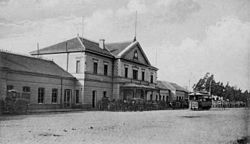
Key Facts
- Opened: 1885.
- Location: Barrio Pichincha, Rosario, Santa Fe.
- Infrastructure: 6 platforms.
- Current Operators: Trenes Argentinos (Passengers) and NCA (Freight).
- Primary Line: Mitre.
Historical Evolution
The Early Years and Golden Age
The station originally served as the terminus for the Buenos Aires and Rosario Railway (BARR). Upon its opening in 1885, it established the first rail connection between Rosario and Buenos Aires, a distance of approximately 300 km to the south-southeast. From this hub, the line extended northwest, traversing several provinces to reach Tucumán.
Following the 1908 merger of the BARR and the Central Argentine Railway, Rosario Norte was designated specifically for express and long-distance services. During the "golden age" of Argentine rail, between 1935 and 1940, the station was a bustling center of activity, handling roughly 326,000 passengers annually—averaging more than 800 travelers per day.
Decline and Transition
The latter half of the 20th century brought significant challenges. In 1977, most local and mid-distance services were cancelled, leaving Rosario Norte to manage only a few remaining routes. By 1991, passenger rail services were eliminated nationwide as cargo lines underwent privatization. This led to the closure of the Rosario Norte–Retiro (Buenos Aires) line in July 1992, followed by the Tucumán services in March 1993.
Reactivation and Modern Era
The station saw a revival in October 1997 when the government of Tucumán granted passenger service rights to the firm Tucumán Ferrocarriles. During this period, the municipality of Rosario repurposed much of the building for administrative use, installing the Municipal Secretariat of Culture and Education in June 1999.
Infrastructure restoration continued into the 2000s. By 2007, the station managed multiple passenger services to Buenos Aires, Tucumán, and Córdoba via operators such as TBA and Ferrocentral. A major milestone occurred in June 2016, when Rosario Norte became the official terminus for the Buenos Aires–Rosario service, a role previously held by Rosario Sur.
Station Overview
| Feature | Details |
|---|---|
| Ownership | Government of Argentina |
| Passenger Operator | Trenes Argentinos |
| Freight Operator | Nuevo Central Argentino (NCA) |
| Number of Platforms | 6 |
| Key Destinations | Buenos Aires (Retiro), Tucumán, Córdoba |
Operator Timeline
The management of Rosario Norte has shifted through various entities over the last century:
- 1885–1908: Buenos Aires and Rosario Railway
- 1908–1948: Central Argentine Railway
- 1948–1993: Ferrocarriles Argentinos
- 1997–2000: Tucumán Ferrocarriles
- 2004–2014: Ferrocentral
- 2014–Present: Trenes Argentinos Operaciones
Frequently Asked Questions
Where is Rosario Norte station located?
It is located in the Barrio Pichincha neighborhood of Rosario, Santa Fe, Argentina, specifically at the junction of Aristóbulo del Valle Avenue and Callao Street.
Who currently operates the passenger services?
Passenger services are operated by the state-owned company Operadora Ferroviaria Sociedad del Estado (Trenes Argentinos).
Does the station handle cargo?
Yes, freight operations are managed by the private company Nuevo Central Argentino (NCA).
When did the station first open?
The station opened in 1885 as the terminus for the Buenos Aires and Rosario Railway.
What happened to the station in the early 1990s?
Passenger services were largely eliminated nationwide; the line to Retiro closed in July 1992, and the line to Tucumán closed in March 1993.