Rondeau Boulevard: A Key Arterial Road in Rosario
In the heart of the northeastern sector of Rosario, Santa Fe, lies Rondeau Boulevard (officially Boulevard General José Rondeau). This critical two-way, four-lane arterial road serves as a vital transportation link, connecting the city's interior with its northern borders and the surrounding region.
The boulevard begins as a continuation of Alberdi Avenue within Barrio Lisandro de la Torre. It stretches in a straight line, running roughly parallel to the Paraná River and defining the western boundary of Barrio Alberdi. Its journey concludes at a major transit node where Beltway Avenue, the access to the Rosario-Victoria Bridge, and National Route 11 converge, marking the municipal boundary between Rosario and the city of Granadero Baigorria.
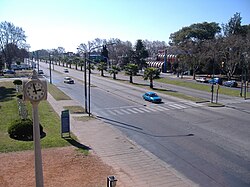
Key Facts
- Full Name: Boulevard General José Rondeau.
- Location: Rosario, Santa Fe, Argentina.
- Configuration: Two-way, four-lane arterial road.
- Historical Origin: Built upon a former 1888 Santa Fe Railway line.
- Key Termini: Starts at Alberdi Avenue; ends at the Rosario-Victoria Bridge access and National Route 11.
History and Development
From Railway to Roadway
The current path of Rondeau Boulevard follows the route of a former railway operated by the Santa Fe Railway company, established in 1888. This rail line originally served Pueblo Alberdi, a settlement that was eventually absorbed into the growing city of Rosario.
Urban Transformation
The transition from a railway corridor to a modern arterial road occurred during the administration of mayor Luis Cándido Carballo between 1958 and 1959. As part of an extensive public works program, the route was widened and paved to accommodate the city's increasing vehicular traffic.
Landmarks and Geography
The boulevard is anchored by several significant markers. At its starting junction—where Alberdi Avenue, Portugal Avenue, and Juan B. Justo Street meet—visitors will find a bust of Lisandro de la Torre. At the northern terminus, the road is marked by a statue of the Virgin of the Rosary and a welcoming sign for those entering Rosario from the north.
The road is named in honor of General José Rondeau (1773–1844), a prominent figure in the Argentine War of Independence and the first appointed Supreme Director of the United Provinces of the Río de la Plata.
| Feature | Detail |
|---|---|
| Road Type | Two-way, four-lane arterial |
| Primary Neighborhood | Barrio Alberdi (Western limit) |
| Historical Basis | Santa Fe Railway (est. 1888) |
| Key Connection | Rosario-Victoria Bridge / National Route 11 |
| Named After | General José Rondeau |
Frequently Asked Questions
Where is Rondeau Boulevard located?
It is located in the northeastern part of Rosario, in the province of Santa Fe, Argentina, forming the western border of Barrio Alberdi.
Who was General José Rondeau?
General José Rondeau (1773–1844) was a soldier in the Argentine War of Independence and served as the first appointed Supreme Director of the United Provinces of the Río de la Plata.
What was the original purpose of the land where the boulevard sits?
The boulevard follows the path of a railway line established in 1888 by the Santa Fe Railway company, which once had a stop in the settlement of Pueblo Alberdi.
When was the boulevard converted into an arterial road?
The road was widened and transformed into an arterial road between 1958 and 1959 under the administration of mayor Luis Cándido Carballo.
What major landmarks are found at the ends of the boulevard?
The southern start is marked by a bust of Lisandro de la Torre, while the northern end features a statue of the Virgin of the Rosary and a city welcome sign.