Roman Religion: From Polytheistic Traditions to Christian Hegemony

Roman Religion: From Polytheistic Traditions to Christian Hegemony

Ancient Roman religion was a complex tapestry of imperial and provincial practices, woven together by the diverse peoples under Roman rule. The Romans viewed themselves as deeply religious, believing that their ascent as a global superpower was a direct result of their pietas—a collective piety and commitment to maintaining harmonious relations with the gods.

This polytheistic system was not static; it evolved through the absorption of neighboring cultures. The presence of Greeks on the Italian Peninsula introduced fundamental cults, such as that of Apollo, and led to interpretatio graeca, the process of identifying Roman deities with Greek counterparts to adapt their myths and iconography. Similarly, the Etruscans heavily influenced Roman ritual, particularly the practice of augury used by the state to discern divine will.

At its core lay the mos maiorum ("the way of the ancestors"), a traditionalist framework attributed to Rome's early founders, including the Sabine king Numa Pompilius. This ancestral tradition served as the bedrock of Roman identity and social order.
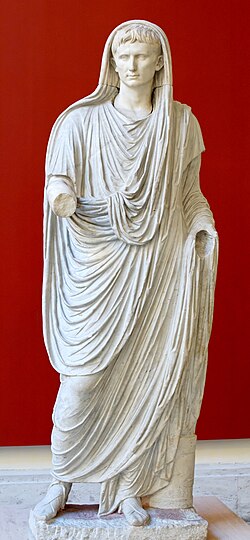
Augustus as Pontifex Maximus (Via Labicana Augustus)

Key Facts

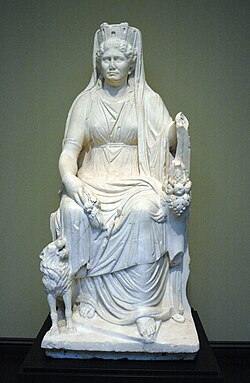
Cybele enthroned, with lion, cornucopia and Mural crown. Roman marble, c. 50 AD (Getty Museum)
  • Pietas: The Roman virtue of duty and religious devotion, seen as essential for the state's success.
  • Interpretatio Graeca: The adaptation of Greek gods and myths into the Roman religious framework.
  • Mos Maiorum: The "way of the ancestors," which emphasized tradition as the center of Roman identity.
  • State Divination: The use of augury and haruspicy to ascertain the will of the gods before official actions.
  • Transition: A shift from a polytheistic state religion to Christian hegemony under Emperor Constantine I.

The Divine Hierarchy and Roman Deities
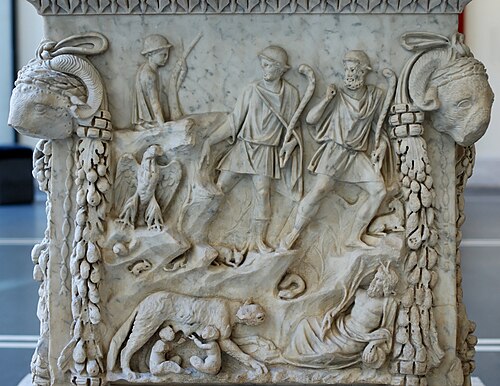
Relief panel from an altar to Venus and Mars depicting Romulus and Remus suckling the she-wolf, and gods representing Roman topography such as the Tiber and Palatine Hill

Roman religion honored a vast array of deities, ranging from the Di Consentes (the twelve principal gods) to local spirits and household protectors. These gods governed every aspect of existence, from the marriage of Jupiter and Juno to the agricultural abundance brought by Ceres and Bacchus.
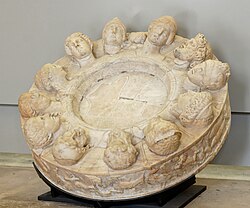
Twelve principal deities (Di Consentes) corresponding to those honoured at the lectisternium of 217 BC, represented on a 1st-century altar from Gabii that is rimmed by the zodiac.

Beyond the major Olympian-style gods, Romans venerated the Penates (household gods) and the Genius (the divine spirit of a person or group), ensuring that the divine was present in both the grand temple and the private home.
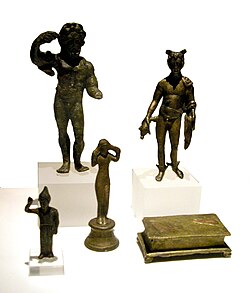
Small bronze statues of gods for a lararium (1st to 3rd century AD, Vindobona)

Religious Practice and State Ritual

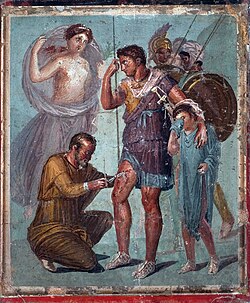
Pompeian fresco; Iapyx removing an arrowhead from Aeneas' thigh, watched by Venus Velificans (veiled)

Temples and Public Worship

Temples served as the homes of the gods, housing cult statues and serving as centers for public worship. These structures, such as the well-preserved Maison Carrée, were often linked to the Imperial cult, which venerated the emperor as a divine or semi-divine figure to ensure political loyalty.
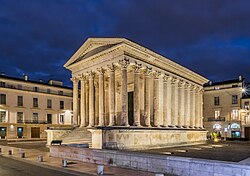
The Maison Carrée in Nîmes, one of the best-preserved Roman temples. It is a mid-sized Augustan provincial temple of the Imperial cult.

Sacrifice and Prayer

The central act of Roman worship was sacrifice. This included libations (liquid offerings) and animal sacrifices, where the victimarius handled the sacrificial axe. These rituals were not intended to "buy" favor but to maintain a contractual relationship with the divine.
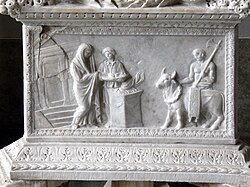
Roman relief depicting a scene of sacrifice, with libations at a flaming altar and the victimarius carrying the sacrificial axe

Priesthoods and the Vestals

Public religion was managed by official priesthoods. The Pontifex Maximus held the highest religious authority. Among the most prestigious were the Vestal Virgins, priestesses dedicated to Vesta, the goddess of the hearth, whose purity was believed to be essential for the safety of Rome.
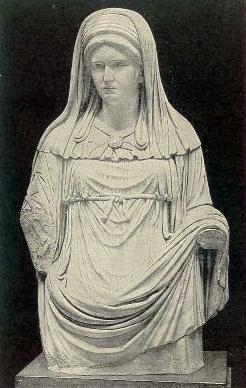
A Roman sculpture depicting a Vestal

Divination: Seeking the Divine Will

Aeneas urged by the Penates to continue his journey to found Rome (4th century AD illustration)[13]

The Roman state relied heavily on divination to make critical decisions. This was divided into two primary methods:

  • Augury: The interpretation of signs, such as the flight of birds, to determine if the gods approved of a proposed action.
  • Haruspicy: The inspection of the entrails (exta) of sacrificed animals, often using instructional models like the Liver of Piacenza to identify omens.

The bronze Liver of Piacenza is an Etruscan artifact that probably served as an instructional model for the haruspex

Superstition, Magic, and Mystery Cults
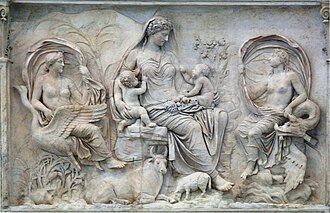
Three goddesses on a panel of the Augustan Ara Pacis, consecrated in 9 BC; the iconography is open to multiple interpretations

While state religion was public and orderly, superstitio referred to "excessive" or "unauthorized" religious practices. This included private magic, astrology, and the use of defixiones (curse tablets). The state frequently banned astrologers and "Egyptian rites," viewing them as subversive, though these practices persisted across all social classes.
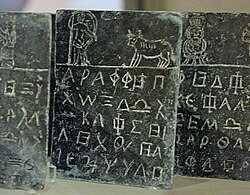
Bound tablets with magic inscriptions from late antiquity

Simultaneously, "Mystery Religions" gained popularity. These were secretive cults, such as those of Mithras or Bacchus, offering personal salvation and a more intimate connection to the divine than the formal state rituals provided.
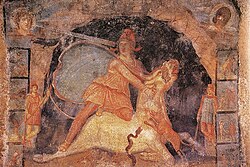
Mithras in a Roman wall painting

The Transition to Christianity

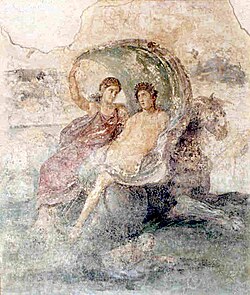
Bacchus, or Liber, and Ceres, mounted on a leopard. Fresco in Stabiae, 1st century

The Roman religious landscape shifted dramatically with the arrival of Judaism and Christianity. Initially, Judaism was viewed with suspicion or mockery, though it eventually gained a level of legitimacy. Christianity, however, faced periods of intense persecution, as its refusal to participate in the Imperial cult was seen as political treason.
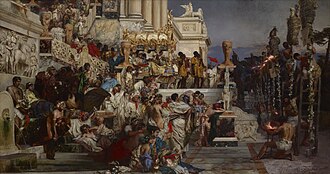
Nero's Torches, by Henryk Siemiradzki (1876). According to Tacitus, Nero used Christians as human torches

The turning point came with Emperor Constantine I, who transitioned the empire toward Christian hegemony. By the 4th century, the Chi Rho monogram became a symbol of the new state faith, and the Aula Palatina in Trier stands as a testament to the era of Christian imperial power.
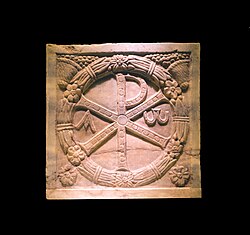
Monogramme of Christ (the Chi Rho) on a plaque of a marble sarcophagus, 4th century CE (Musei Vaticani, here in a temporary exhibition at the Colosseum in Rome, Italy)

Summary of Roman Religious Elements
Category Key Element Purpose/Meaning
Core Virtue Pietas Maintaining a correct relationship with gods and state.
State Divination Augury & Haruspicy Ascertaining divine will for public decisions.
Private Worship Lararium Household shrine for Penates and Genii.
Elite Priesthood Vestal Virgins Guarding the sacred fire of Rome.
Late Empire Christianity Shift from polytheism to monotheistic state religion.

Frequently Asked Questions

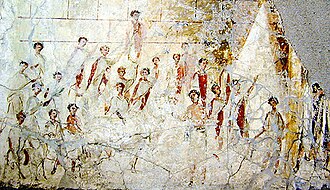
This fresco from outside Pompeii shows Roman men celebrating a religious festival, probably the Compitalia.
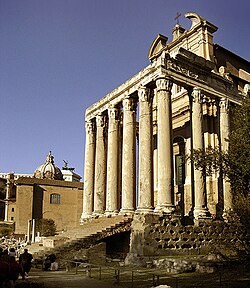
Portico of the Temple of Antoninus and Faustina, later incorporated into a church
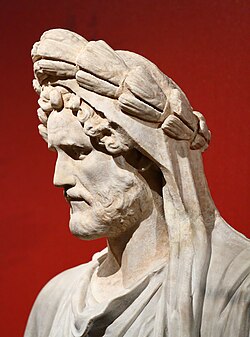
Portrait of the emperor Antoninus Pius (reigned 138–161 AD) in ritual attire as an Arval Brother
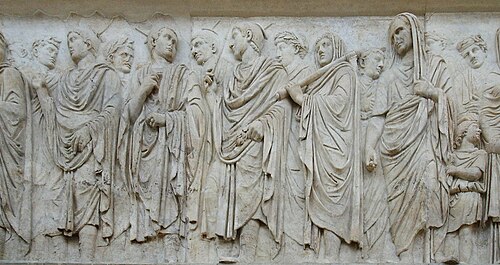
Three flamines in their distinctive pointed headgear, grouped to the centre of a panel from the Ara Pacis
Female figure, veiled and seemingly alarmed, from a wall-painting usually described as a narrative from Dionysiac/Bacchic mystery cult, which might also involve Ariadne and a marriage. There is "almost no agreement about how it works in detail". From Pompeii's "Villa of the Mysteries"[95]
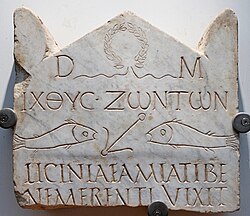
This funerary stele, one of the earliest Christian inscriptions (3rd century), combines the traditional abbreviation D. M., for Dis Manibus, "to the Manes," with the Christian motto Ikhthus zōntōn ("fish of the living") in Greek; the deceased's name is in Latin.
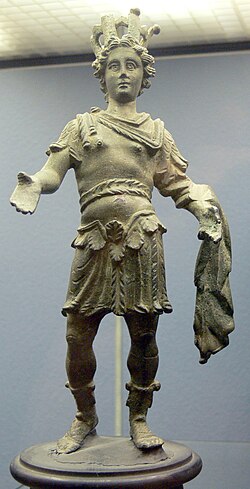
A genius of the legion (2nd–3rd century CE)
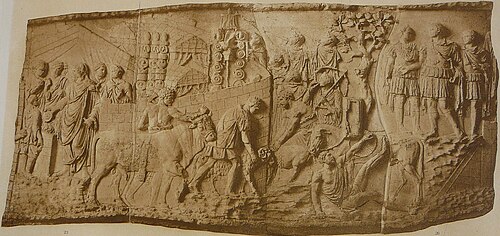
Panel from Trajan's Column depicting the lustral procession of the suovetaurilia victims under military standards
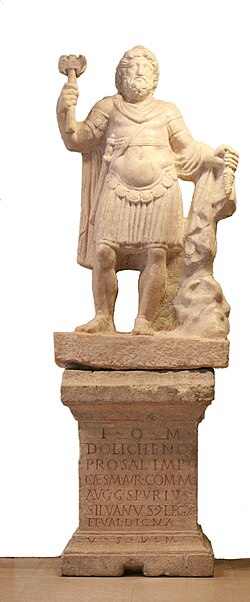
A votive statue of Jupiter Dolichenus dedicated by a centurion for the wellbeing of the emperor (Carnuntum, 3rd century)
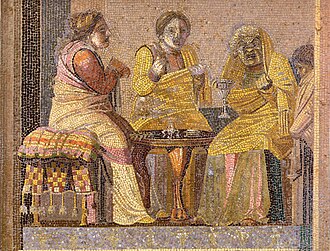
Mosaic from Pompeii depicting masked characters in a scene from a play: two women consult a witch
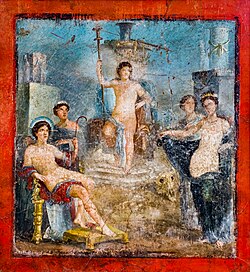
Dionysus (Bacchus) with long torch sitting on a throne, with Helios (Sol), Aphrodite (Venus) and other gods. Wall-painting from Pompeii, Italy
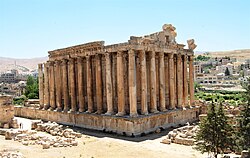
Temple of Bacchus ("Temple of the Sun"), c. 150 AD
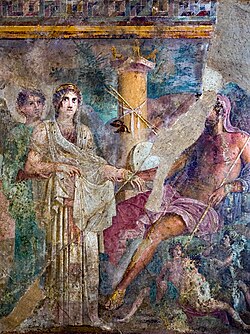
Wedding of Jupiter King of the Gods, and Juno, Queen of Heaven and goddess of marriage, and women. Fresco in Pompeii
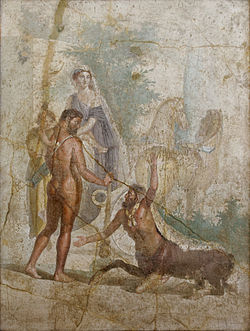
A fresco from Pompeii depicting Hercules, Hyllus, Deianira, and the centaur Nessus from Greco-Roman mythology, 30–45 AD
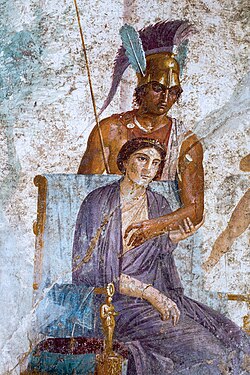
Mars caresses Venus enthroned. Wall-painting in Pompeii, c. 20 BC – 50s AD
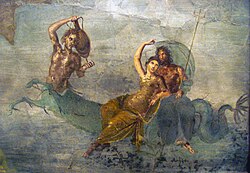
Fresco of Neptune and Salacia, Pompeii
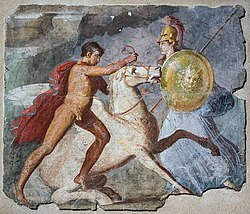
Bellerophon, Pegasus, and Athena (Minerva), fresco of the 3rd style from Pompeii, first half of the 1st century
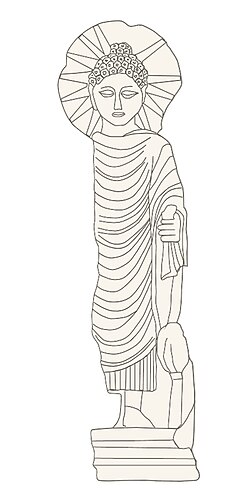
The Berenike Buddha, discovered in Berenice, Egypt, in 2022.
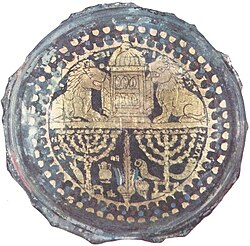
Jewish ritual objects in 2nd-century gold glass from Rome
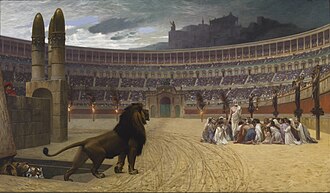
The Christian Martyrs' Last Prayer, by Jean-Léon Gérôme (1883)
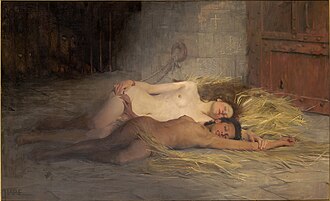
The Victory of Faith, by Saint George Hare, depicts two Christians in the eve of their damnatio ad bestias
The Aula Palatina of Trier, Germany (then part of the Roman province of Gallia Belgica), built during the reign of Constantine I (r. 306-337 AD)
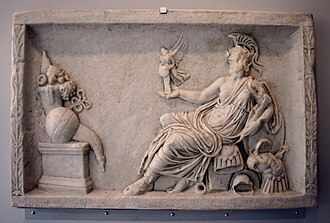
Defaced Dea Roma holding Victory and regarding an altar with a cornucopia and other offerings, copy of a relief panel from an altar or statue base
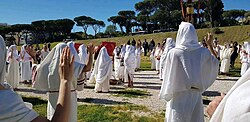
Rituals to the Tutelary Numen of Rome, for the 2777th Natale di Roma. Carried out by Pietas Comunità Gentile

What is the difference between religio and superstitio in Rome?

Religio referred to the traditional, state-sanctioned religious practices that maintained the peace between Rome and the gods. Superstitio described unauthorized, excessive, or "foreign" practices, such as illicit magic or astrology, which were often viewed as dangerous or subversive.

How did the Romans incorporate foreign gods?

Through a process called interpretatio graeca, Romans identified their own deities with those of other cultures (primarily the Greeks). They adapted the myths, names, and artistic representations of these foreign gods to fit into the Roman system.

What was the role of the Vestal Virgins?

The Vestals were priestesses of Vesta who maintained the sacred fire of Rome. Their purity and the continuity of the fire were considered vital to the survival and prosperity of the Roman state.

Why was the Imperial cult important?

The Imperial cult involved the worship of the emperor or his spirit. It served as a political tool to unify a vast, diverse empire by providing a common religious focal point of loyalty to the Roman state.

How did Constantine I change Roman religion?

Constantine I ended the persecution of Christians and provided the faith with legal status and imperial patronage, initiating the transition from a polytheistic society to one where Christianity became the dominant religious and political force.