Roman Provinces: The Administrative Evolution of an Empire
The Roman provinces (Latin: provincia, plural provinciae) served as the primary administrative regions of Ancient Rome located outside the Italian heartland. From the early days of the Republic to the twilight of the Empire, these territories were the engines of Roman wealth and power, each managed by a governor appointed by Rome to maintain order, collect taxes, and command military forces.
Over several centuries, the concept of a province evolved from a temporary military assignment into a sophisticated, multi-tiered bureaucratic system. This transition mirrored Rome's own growth from a regional city-state to a global superpower.
Key Facts
- Definition: Administrative units outside Roman Italy controlled by appointed governors.
- First Permanent Province: Sicily, established after the First Punic War.
- Peak Extent: The empire reached its greatest territorial size under Emperor Trajan in AD 117.
- Major Reform: Emperor Diocletian introduced the Tetrarchy, dividing the empire into smaller provinces and larger dioceses.
- Final Transition: The administrative system was eventually replaced by the military theme system in the 640s.
The Republican Period: From War Zones to Permanent States
The Emergence of the Provincia
Initially, a provincia was not a piece of land, but a task—specifically, a military command. Commanders were dispatched to wage war, but this did not always imply annexation. For instance, Macedonia was assigned as a province as early as 211 BC, yet it was not directly administered by Rome until 148 BC. Similarly, early assignments in Hispania (Spain) were ad hoc and driven by military necessity rather than systematic governance.
The Shift to Permanent Administration
The creation of Sicily as the first permanent province after the First Punic War marked a fundamental shift in Roman thinking. Administration moved from expansion to defense. Because these defensive roles offered less opportunity for military glory, they were typically assigned to praetors (high-ranking magistrates) rather than consuls.
By 123 BC, the lex Sempronia de provinciis consularibus required the senate to announce consular provinces before elections. This reduced the use of temporary military assignments and increased the number of permanent provinces, which rose from 22% of consular assignments (200–124 BC) to 60% (122–53 BC).
Political Instability and Command
As the Republic waned, the assignment of provinces became a tool for political ambition. Figures like Gaius Marius and Pompey the Great bypassed senate approval through popular legislation to secure massive commands. Pompey’s lex Gabinia of 67 BC, for example, granted him authority over all land within 50 miles of the Mediterranean.
The Early Imperial Period: The Augustan Settlement
Augustus transitioned Rome from a Republic to an Empire while maintaining a facade of traditional normality. In 27 BC, during his "first settlement," he ostensibly returned control of the provinces to the senate. However, he retained direct command over the most strategically vital regions—including Spain, Gaul, Syria, and Egypt.
This arrangement gave Augustus control over 22 of the 28 existing Roman legions (over 80%), ensuring his grip on the empire's military power while the senate managed the more peaceful interior provinces.
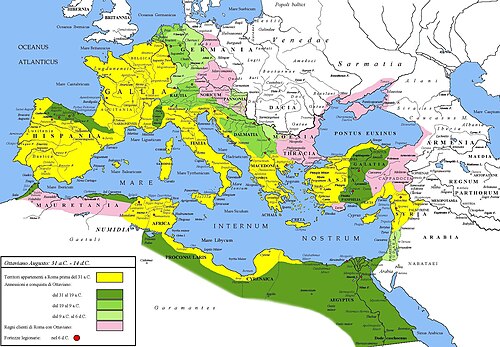
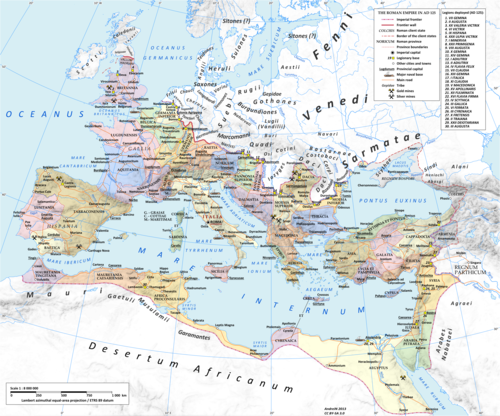
As the empire expanded under subsequent leaders, the provincial map grew. Under Hadrian, the provinces were organized into a stable network of administration.
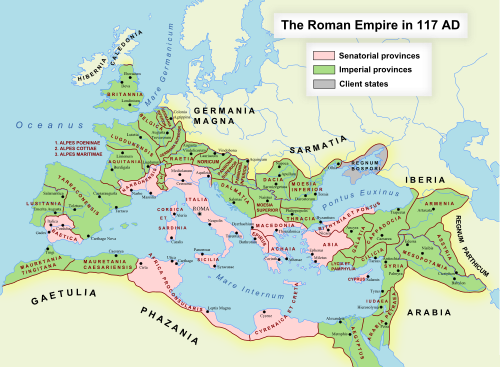
The empire reached its zenith under Trajan in AD 117, dividing territories into imperial provinces (controlled by the emperor), senatorial provinces (controlled by the senate), and client states.
The Late Imperial Period: Diocletian and the Tetrarchy
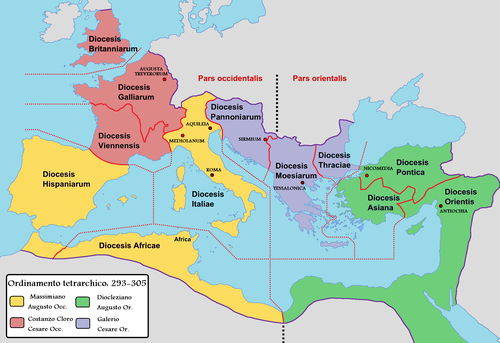
By the late 3rd century, the empire had become too vast for a single ruler. Emperor Diocletian introduced the Tetrarchy (AD 284–305), dividing the empire into four regions governed by two senior emperors (Augusti) and two junior emperors (Caesars).
Diocletian radically reorganized the territory into nearly a hundred smaller provinces, including Italy. These were grouped into dioceses (headed by a vicarius), which were further subdivided into praetorian prefectures under Constantine I. This created a rigid hierarchy of governors, ranging from proconsuls to praesides.
In the 6th century, Justinian I began merging civil and military authority, leading to the creation of Exarchates. This evolution culminated in the 640s with the theme system, a military-based administrative structure that marked the transition to the Byzantine period.
Summary of Provincial Evolution
| Period | Primary Unit | Governance Style | Key Characteristic |
|---|---|---|---|
| Early Republic | Temporary Provincia | Military Commanders | Task-based, focused on warfare |
| Mid-Late Republic | Permanent Province | Praetors/Consuls | Defensive and administrative |
| Principate (Augustus) | Imperial/Senatorial | Emperor/Senate | Strategic split of military power |
| Late Empire (Diocletian) | Province < Diocese < Prefecture | Tetrarchs/Vicarii | Highly bureaucratic and subdivided |
| Byzantine Transition | Themata (Themes) | Military Governors | Merged civil and military authority |
Frequently Asked Questions
What was the first permanent Roman province?
Sicily was the first permanent province, established following the First Punic War. Its creation shifted the Roman definition of a province from a temporary military assignment to a permanent administrative territory.
How did Augustus control the military while appearing to share power?
Augustus formally returned provincial control to the senate in 27 BC but retained personal command over the provinces that housed the vast majority of Rome's legions, such as Gaul and Syria, giving him effective control over the army.
What was the Tetrarchy?
The Tetrarchy was a system of government introduced by Diocletian that divided the empire into four administrative regions, each ruled by either a senior emperor (Augustus) or a junior emperor (Caesar).
What replaced the provincial system in the 7th century?
The older administrative arrangements were entirely replaced by the military theme system (themata) in the 640s, which combined civil and military authority under a single governor.
Who were the governors of the provinces?
Provinces were ruled by Roman-appointed governors. Depending on the era and the province's status, these could be praetors, proconsuls, or other officials like correctores and praesides during the late empire.