Roman Emperor: The Evolution of Imperial Power and Titles
The office of the Roman Emperor represents one of history's most enduring and complex political institutions. From its inception as a veiled military leadership to its final form as a divine-right monarchy in the East, the role evolved through centuries of political upheaval, cultural shifts, and territorial changes. Spanning from the rise of Augustus in 27 BC to the fall of Constantinople in 1453, the imperial office redefined the nature of sovereignty in the Western world.
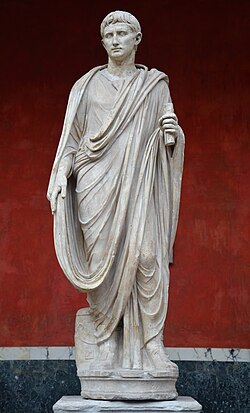
Initially, the transition from Republic to Empire was not an overnight change in title but a gradual shift in power. The first emperor, Augustus, maintained a facade of republicanism, positioning himself as the Princeps (First Citizen) rather than an absolute monarch. This period, known as the Principate, balanced the official authority of the Senate with the actual power held by the emperor and the military.
Key Facts
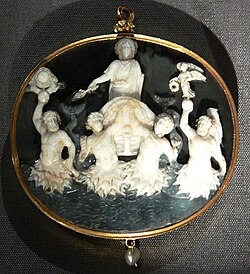
- First Emperor: Augustus, who established the empire on January 16, 27 BC.
- Last Emperors: Romulus Augustulus (Western Empire, 480 AD) and Constantine XI Palaiologos (Eastern Empire, 1453 AD).
- Primary Titles: Evolved from Imperator and Princeps to Basileus and Autokrator.
- Succession: Varied between hereditary claims, adoptive systems, and military acclamation.
- Legacy: The Ottoman sultans adopted the title "Caesar of the Romans" (kayser-i Rûm) after 1453.
Succession and Legitimacy
![Latin inscription dedicated to Septimius Severus and Caracalla in Ostia Antica, AD 196.[e]](/images/c4/7b/c47b90086885d7a52499c36925dbeaf8a612d3a7b55e4596ff27901f92d95109.jpg)
Legitimacy in the Roman Empire was often a volatile mix of bloodline, adoption, and military support. While the Senate officially appointed emperors, the Roman military frequently held the true deciding vote. Following the collapse of the Julio-Claudian dynasty, Vespasian became the first emperor to openly designate his sons, Titus and Domitian, as his sole heirs by granting them the title of caesar.
The Senate continued to exert influence, such as declaring Nero a "public enemy" and appointing Nerva in AD 96. This led to the Antonine dynasty, which utilized an adoptive system of succession until Marcus Aurelius. Marcus Aurelius introduced a new precedent by ruling jointly with others, first with Lucius Verus and later with his son Commodus, who was proclaimed co-augustus in 177.
![Denarius of Augustus (18 BC).[b]](/images/7e/9f/7e9f14158f9a434d86350c589c602bd6bfe08622791a91a9d2efeaf02dd8c91f.jpg)
The Transition to the Byzantine Period
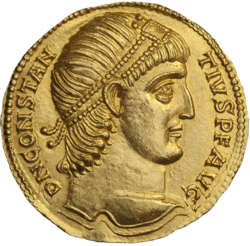
As the empire shifted its center of gravity eastward, the nature of the monarchy became more overt. In the Eastern Empire, the emperor was viewed as an open monarch. Starting with Heraclius in 629, emperors adopted the title basileus, a Greek term for monarch used since the era of Alexander the Great. While the term had been used informally since the 3rd century, it only became official in the 7th century.
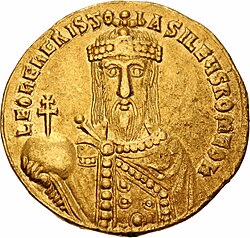
By the 9th century, the full title evolved into "basileus and autokrator of the Romans." The term autokrator (Autocrat) served to distinguish a senior emperor from a junior co-emperor. During the Palaiologos dynasty, the accession process became a two-stage rite: an initial acclamation as basileus, followed by a later coronation as autokrator, which included the tradition of being raised on a shield.
![Miniature depicting Manuel II Palaiologos and his family, 1404.[j]](/images/13/0a/130ac5b85eb3d6c94cb6498f6f3383f39ca2713439a07c9bf03cfea2976c51e4.jpg)
The Great Schism of Imperial Titles
The recognition of the Eastern emperors in the West ended with the accession of Empress Irene in 797. This prompted the papacy to create a rival lineage: the Holy Roman Emperors. Charlemagne was crowned Imperator Romanorum by Pope Leo III on Christmas AD 800. This created a medieval conflict of "two emperors," as the rulers in Constantinople never recognized the legitimacy of the Western claimants, often referring to the Eastern realm as the "Greek Empire."
Imperial Nomenclature and Titles
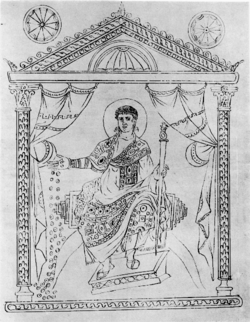
The titles held by the emperors reflected their source of power and the era's political ideology. The term Imperator originally denoted a victorious general, while Caesar began as a family name before becoming a title for heirs. Augustus became the primary title for the reigning emperor, symbolizing sacred authority.
In the later empire, portraits shifted away from realism. The Colossus of Constantine exemplifies this trend, where the emperor was depicted as a symbol of power rather than an individual person.
![The Colossus of Constantine. Portraits after the Tetrarchy stopped including realistic features, as the emperor began to be seen as a symbol rather than an individual.[58]](/images/72/ec/72ec506492663725a6bca1af1a22787dc25ead6b45b2f57fdc6b0bd7e30b1729.jpg)
| Title | Primary Meaning/Context | Period of Prominence |
|---|---|---|
| Princeps | "First Citizen"; emphasized republican facade | Early Empire (Principate) |
| Augustus | Sacred/Venerable; the primary regnal title | Throughout the Empire |
| Basileus | Greek for "King/Monarch" | Byzantine Period (7th C. onwards) |
| Autokrator | "Autocrat"; denoted senior imperial authority | Late Byzantine Period |
| Dominus Noster | "Our Lord"; emphasized absolute power | Late Empire (Dominate) |
Frequently Asked Questions
Who was the first and last Roman emperor?
Augustus is recognized as the first emperor, establishing the empire in 27 BC. The last emperor of the Western Empire was Romulus Augustulus (480 AD), while the last emperor of the Eastern (Byzantine) Empire was Constantine XI Palaiologos, who died in 1453.
What is the difference between a Basileus and an Autokrator?
While both are imperial titles, basileus was the general Greek term for a monarch. Autokrator was used to signify the senior emperor in a system of co-rule, distinguishing the primary ruler from a junior colleague.
How did the Holy Roman Empire relate to the Roman Empire?
The Holy Roman Empire was a rival lineage created by the papacy in 800 AD after the West stopped recognizing the Eastern emperors. These Western emperors were not recognized by the rulers in Constantinople, leading to a long-standing dispute over who was the true successor to Rome.
Did the Ottoman Empire claim the title of Roman Emperor?
Yes. After the conquest of Constantinople in 1453, the Ottoman sultans adopted the title kayser-i Rûm, which translates to "Caesar of the Romans."
How was the succession of emperors determined?
Succession was inconsistent. It ranged from hereditary succession (as seen with Vespasian) and the adoptive system (used by the Antonines) to military acclamation and official appointment by the Senate.